
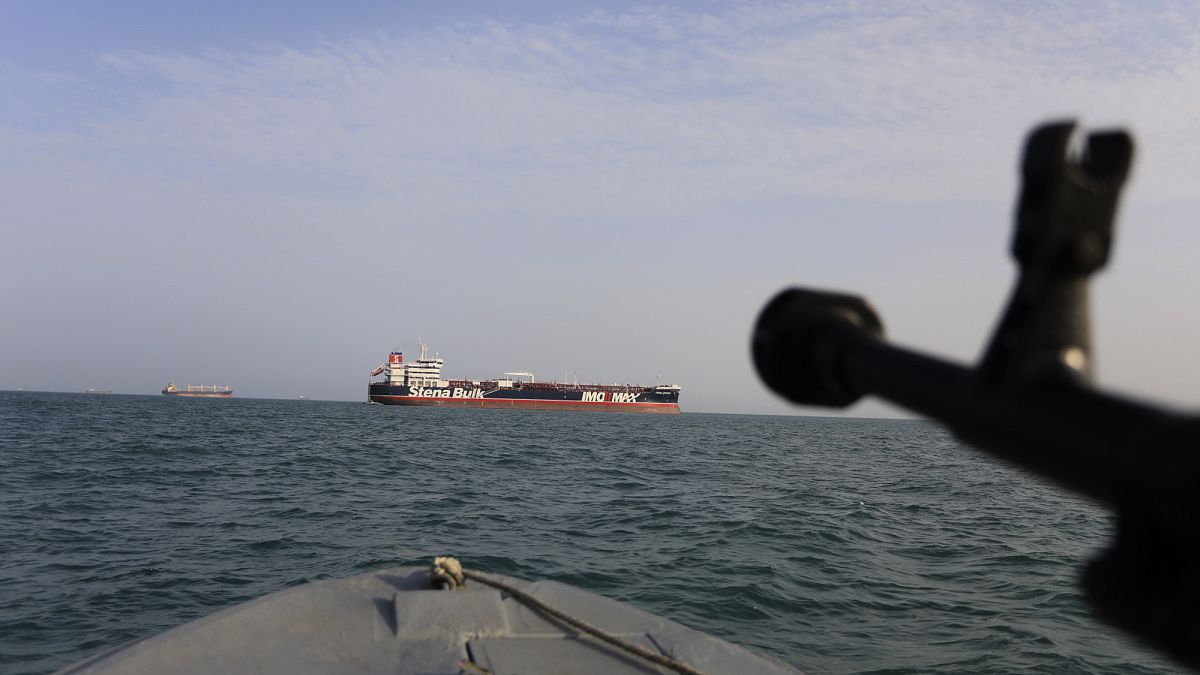
The narrow waterway that connects the Persian Gulf to the Gulf of Oman and the rest of the world has never been more scrutinised.
Normally, it would carry roughly 20% of the world’s oil trade and 30% of global fertiliser supply.
Instead, it has become a key battleground in the Iran War as it enters its third week, where oil and shipping have become the frontlines of economic warfare.
“What was once a disruption-sensitive environment has now shifted into a persistently hostile operating zone, where voyage viability, insurer acceptance, and real-time tactical conditions are major constraints,” Marco Fogione, the director of the UK-based Chartered Institute of Export and International Trade, told Euronews.
Despite the US promise to alleviate the bottleneck in the Strait of Hormuz, hundreds of vessels and tankers continue to stay idle on either side of the waterway.
Missile attacks, mine threats and naval deployments have drastically reduced shipping, driven insurance costs higher, and pushed energy markets into crisis mode.
Insurance premiums skyrocket
War risk insurance for ships passing through the Strait of Hormuz have surged dramatically since the start of the Iran War.
Forgione noted that while coverage was briefly withdrawn, premiums have risen by 200% to 300%, which is unsustainable to maintain long-term.
Before the crisis, war-risk insurance for a vessel passing through the Gulf would be at 0.02% to 0.05% of the vessel’s value.
Since the start of hostilities, premiums have reportedly jumped to 0.5% to 1% of the vessel’s value, or even more.
It means that for a tanker valued at $120mn a normal premium of approximately $40,000 would now cost between $600,000 and $1.2mn for a single trip.
The knock-on effects of the surge in prices mean that they will be felt by consumers at the pump or supermarket within weeks.
“These pressures have already pushed up tanker freight rates, and as those costs cascade through refinery inputs and logistics chains, they ultimately reach consumers through higher fuel prices,” Forgione noted.
How shipping companies are reacting
Some of the world’s major carriers, like Maersk, MSC, CMA CGM and Hapag-Lloyd, have suspended voyages through the Gulf, while others are diverting cargo away from the strait, which could lengthen transit times.
Many companies have had to incorporate geopolitical risk into their operational planning.
Christopher Long, director of intelligence and risk at Neptune P2P Group, noted that it includes closer monitoring of threat intelligence, reassessing transit timings and ensuring that vessels move through higher risk areas with appropriate situational awareness.
“Companies are also reviewing contingency planning, crew preparedness and communication protocols, so that vessels can respond more effectively should security conditions deteriorate further,” Long said.
From a trade perspective, Forgione noted that “for businesses, the message is clear: strengthening supply chain resilience is no longer optional but an urgent strategic priority”.
Rerouting or diverting has its limitations due to the geography of the Persian Gulf, leaving companies with very few alternatives.
Therefore, diversification of the supply chain, Forgione explained, will reduce reliance on any single partner and allows businesses to absorb shocks more effectively.
“When disruptions occur, firms with multiple sourcing options are better insulated, because they can adjust quickly and maintain continuity.
Long also highlighted that greater visibility and transparency across the supply chain would allow companies to identify weaknesses early and address them before they escalate.
Naval escorts: Can a multinational intervention help?
With at least 16 vessels being attacked or damaged since the conflict began, the US has pledged naval escorts for ships and tankers to pass through the Strait of Hormuz.
US President Donald Trump has also urged countries which are heavily reliant on products from the Gulf, like China, Japan, South Korea, France and the UK, to send warships to ensure a safe path for the marine vessels.
But is it worth braving the journey?
Long, who is also a former British naval officer, believes that naval escorts and patrols provide an important layer of reassurance, but companies will want to continue treating the waterway as a high-risk operating environment, even when security forces are present.
Iran has been doubling down on its threat to keep the Strait of Hormuz effectively closed, warning ships not to cross at the risk of being attacked.
A prolonged campaign of disruption could potentially destabilise the global economy, the effects of which could take years to reverse.
So, what would trigger a major multinational naval response?
A significant escalation involving direct attacks on commercial vessels or sustained disruption to maritime trade could prompt a stronger multinational response.
“Historically, threats to critical shipping corridors have triggered coordinated naval deployments aimed at restoring security and freedom of navigation,” Long continued.
Navigating uncertainty
Disruptions to maritime corridors are nothing new, but if the hostilities in the Strait of Hormuz do not abate — and with tariffs rising across the world — economists are warning of far-reaching ripple effects and prolonged uncertainty.
Trade experts like Forgione have been urging governments and businesses to renew efforts to bolster economic security, calling it a “strategic necessity, not a policy luxury”.
“One of the most effective ways to build this resilience is through deepening and widening trade agreements with a diverse range of countries and regions, helping nations stay competitive in an increasingly protectionist global environment,” he concluded.
Gaining access to new markets would significantly widen opportunities for businesses to diversify their supply chains, creating alternative supplier sources that could help them weather turbulent times.