
US President Donald Trump named Qatar, Saudi Arabia and the UAE as the “great leaders and allies” who convinced him to “hold off” on a renewed strike on Iran, propelling the three Gulf countries to the forefront of an expanded political architecture in addition to Pakistan’s mediation efforts in the search for a conclusion of the war in Iran.
Trump said that the Qatari, Emirati and Saudi leaders — whom he said he respects — asked him to postpone the renewed military action as “serious negotiation are now taking place”.
“In their opinion a deal will be made which will be very acceptable to the United States of America, as well as all countries in the Middle East and beyond,” the US president said in a post on his Truth Social platform on Monday night.
In further comments at the White House, Trump said that he had put off a “very major attack” on Iran after being “asked by Saudi Arabia, Qatar, UAE and some others if we could put it off for two or three days.”
“They think that they are getting very close to making a deal,” he said, adding, “if we can do that without bombing the hell out of them, I’d be very happy.”
However, Trump maintained the pressure on Tehran, saying that he told military leaders “to be prepared to go forward with a full, large-scale assault of Iran, on a moment’s notice, in the event that an acceptable deal is not reached.”
The comments offered a rare public glimpse into the role Gulf states are exercising behind the scenes to prevent further escalations of the war, including their concerted, growing influence over the White House.
Qatar reacted on Tuesday by saying that its position had been clearly communicated to Washington and other partners in recent days, that Gulf states are working to prevent a new escalation with Iran and that they continue to support Pakistan’s mediation efforts, avoiding a direct reply to Trump’s announcement late Monday.
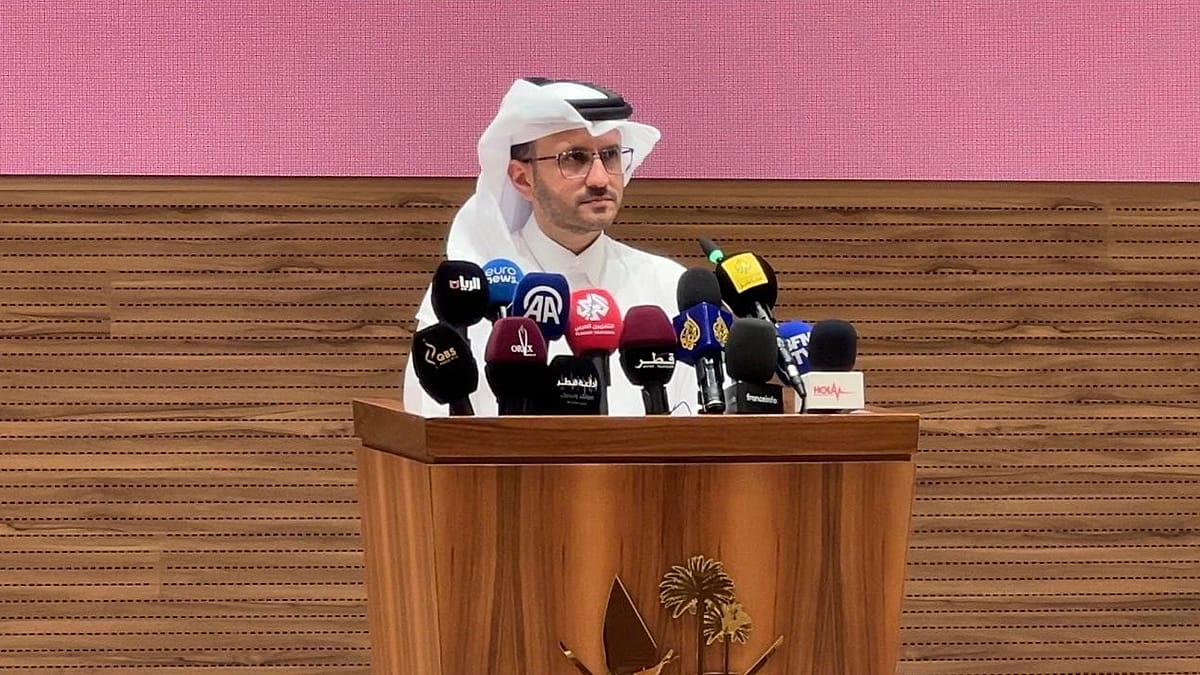
Qatar’s Foreign Ministry spokesperson Dr Majed Al-Ansari told a news briefing in Doha that he was not going to comment on Trump’s discussions with the Gulf leaders.
Instead he underlined that “Qatar’s position has been clearly stated to our partners in the United States: the region must not be engulfed again in war, and any escalation would have an immediate effect on its peoples.”
“Qatar supports the ceasefire in place and giving diplomatic channels a chance for further discussions that might lead to an agreement.”
He stressed that there was strong regional backing to keep the ceasefire alive and that negotiations “need more time,” adding that the effects of the war extend beyond the Gulf region.
“There is a clear solidarity in supporting the mediation led by Pakistan, but also supporting the ceasefire in place and giving the diplomatic channels a chance for further discussions that might lead to an agreement,” Al-Ansari said.
While Al-Ansari declined to discuss details of conversations between Qatar’s Emir Tamim bin Hamad Al Thani and Trump, he confirmed Doha had stressed the importance of de-escalation and reopening the Strait of Hormuz.
“The freedom of navigation of the Strait of Hormuz is legally our right,” he said. “We have always stressed the importance of opening the strait and not changing the status quo.”
While urging diplomacy, Qatar also delivered strong criticism of Iran over attacks targeting Qatari territory during the conflict.
“For the State of Qatar our position has always been clear,” Al-Ansari said. “There was an aggression against our country by Iran. It was against the sovereignty of Qatar, against the people of Qatar and against the wealth and prosperity of our people,” adding that “this is not something we take lightly.”
“The people of Iran deserve to live in peace and prosperity and not to be affected by war and conflict,” Al-Ansari added. “The government of Iran has chosen to target Qatar during this war and has put relations in a strain as a result.”
Qatar’s Foreign Ministry also announced that its Foreign Minister Mohammed Al Thani spoke on the phone with his Saudi counterpart Faisal bin Farhan about the necessity for all parties to respond to the ongoing mediation efforts “in a way that opens the door to addressing the roots of the crisis through peaceful means and dialogue, and prevents the renewal of escalation.”
A similar call took place between Qatar and the UAE on Tuesday, Al-Ansari said.
Meanwhile on Tuesday, as the UAE announced multiple attacks over the last 48 hours involving at least six drones, UAE presidential advisor Anwar Gargash appeared to distance the Emirates from other, more passive regional actors, stating that “the victim’s role has merged with that of the mediator, and vice versa, while the friend has turned into a mediator instead of being a steadfast ally and supporter.”
“The confusion of roles during this treacherous Iranian aggression is baffling, encompassing the Gulf Arab region’s surrounding states,” Gargash said in a post on X.
“In this most perilous phase in modern Gulf history, amid this perfidious aggression, the grey position remains more dangerous than outright inaction,” he added.
Tehran says it is ‘prepared to confront any military aggression’
As Trump announced the imminent resumption of US attacks on Iran, the Washington-based Institute for the Study of War think tank (ISW) said that Tehran continues to formalise and institutionalise its claimed control over transit through the Strait of Hormuz in contravention of the UN Charter on the Law of the Sea (UNCLOS).
IRGC-affiliated outlets continued to threaten commercial and digital activity linked to the Strait of Hormuz as part of broader regime efforts to institutionalise Iranian authority over the waterway, ISW added.
Responding to Trump’s threats, Iran’s Deputy Foreign Minister Kazem Gharibabadi wrote on X that “Iran, united and resolutely, is prepared to confront any military aggression”.
Referring to the US speaking of “readiness for a massive assault at any moment,” Gharibabadi asked if “this means calling ‘threat’ by the name of ‘opportunity for peace’.”
At the same time, an Iranian member of parliament warned on Tuesday that attacks on Iran’s oil infrastructure could trigger retaliation against oil wells and energy assets belonging to its adversaries, Euronews’ Persian service reports.
Ahmad Bakhshayesh Ardestani, a member of Iran’s parliamentary National Security and Foreign Policy Commission, told ILNA that he did not believe the US would launch a large-scale military attack on Iran, arguing that Washington would gain little from such a move.
However, he suggested that if military action were to occur, strategic sites such as Kharg Island and Isfahan could be potential targets, as Kharg Island remains critical to Tehran’s oil exports, while Isfahan has long been associated with Iran’s nuclear programme.
Ardestani claimed that attempts to target Isfahan could be linked to concerns over enriched uranium stockpiles.
“If Iran were attacked, it would retaliate by targeting enemy oil wells and energy infrastructure, arguing that such action would be more effective than striking pipelines and would significantly increase global fuel prices,” he said, outlining possible Iranian response.
Similar messages have emerged from other Iranian officials, according to Euronews’ Persian service.
Esmaeil Saghab-Esfahani, Vice President and Head of the Organisation for Energy Optimisation and Strategic Management, previously said Tehran had adopted a “tit-for-tat” strategy but warned that any further escalation could result in a more severe response.
He said that if Iranian oil facilities were targeted, Tehran could strike oil production facilities in countries from which attacks were launched.