
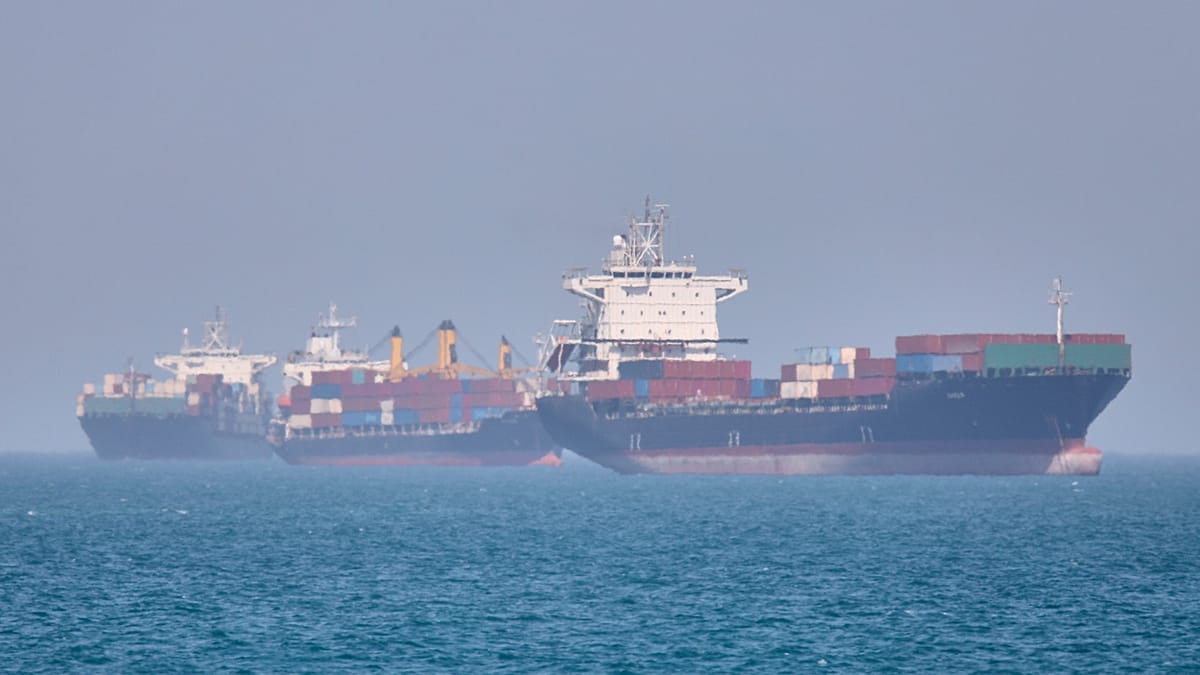
As tensions in the Strait of Hormuz escalate, global shipping companies are scrambling to keep trade moving by redrawing global trade maps through costly workarounds.
For many industries that have been built on predictability and freedom of navigation, the uncertainty hanging over supply chains has quickly become the world’s most disruptive maritime risk.
The current crisis presents less of a temporary shock and more of a unique structural problem for container shipping firms like Maersk, Mediterranean Shipping Company and Hapag-Lloyd.
The cost of rerouting cargo
Unlike disruptions caused by piracy in the Red Sea, where vessels could reroute via the Cape of Good Hope, Hormuz offers no viable maritime alternatives. Any cargo heading to Gulf economies must still pass through the narrow waterway. As a result, carriers are forced to adapt to a volatile situation by putting in place operational workarounds.
“This is a natural and expected development, and it has been happening since day one of the disruption,” said Maha Raad, shipping expert and partner at Strategy& Middle East, part of PricewaterhouseCoopers.
“But it is more than a simple rerouting. It reflects a deeper redesign of maritime networks around security, reliability, and effective corridor control.”
Firms are also increasingly becoming operationally flexible.
“Companies are now placing far greater emphasis on real-time intelligence, dynamic risk assessments and closer coordination with naval and regional maritime security frameworks,” said Christopher Long, head of intelligence and compliance at the Neptune P2P Group.
Last week, global shipping companies announced more contingency measures. Maersk said that while it continues to suspend most vessel crossings through Hormuz, it is rerouting key Middle East services around the Cape of Good Hope and relying on transhipment hubs like Salalah Port.
Meanwhile, Hapag-Lloyd introduced revised feed-based networks that bypass direct Arabian Gulf calls. MSC launched a new Europe-Red Sea-Middle East service, taking advantage of key ports like Aqaba, King Abdullah, and Jeddah ports.
From these key ports, smaller feeder vessels, which are known to be relatively more flexible in responding to changes, make the final leg of transport into other ports.
“The key question is not only which alternative port can receive the cargo, but which end-to-end corridor can operate at scale,” Raad explained.
“That means deploying the right vessel and feeder capacity, selecting routes that balance safety, cost, and transit time, ensuring port and yard capacity, and coordinating inland movement, customs, trucking, rail and storage.”
While these workarounds do ensure some continuity of trade, they are far from being a long-term strategy.
“Transit times increase, fuel costs rise, insurance premiums remain elevated, and pressure builds across ports and logistics infrastructure elsewhere in the supply chain,” said Long, who also believes that a key challenge is to maintain continuity of operations while also ensuring the safety of the vessels, crew and cargo.
Maintaining freedom of navigation
Attempts to stabilise the Strait of Hormuz militarily have also had a limited effect. The Trump administration’s “Project Freedom” initiative, which did see a few vessels safely escorted through the waterway, has been paused amid diplomatic efforts to reach a peace deal with Iran.
“Decisions cannot be based solely on formal declarations of war or peace,“ Long said.
“Even when de-escalation efforts are underway, shipping companies still have to account for the possibility of drone attacks, vessel interference, electronic disruption, sea mines or asymmetric incidents targeting commercial traffic.”
There is another puzzling question: if the strait is not governed by any particular country, why haven’t there been more efforts by multilateral organisations?
According to Long, freedom of navigation becomes significantly more complicated during periods of active geopolitical confrontation.
“Multilateral organisations such as the UN generally operate through consensus-building and diplomatic mechanisms rather than direct operational enforcement,” the former British naval officer said.
“In situations where major powers hold differing positions on escalation, intervention or military presence, achieving coordinated international action can become extremely difficult.”
Rethinking competition and resilience
Beyond operational costs and challenges, the financial burden is mounting. Insurance premiums covering war risks for ships transiting through Hormuz have surged, making passage increasingly unfeasible from both a financial and human cost perspective.
Yet industry experts say the disruption may ultimately fast-track a long-awaited transformation in global supply chains.
Raad’s take: “The silver lining is that this disruption is accelerating a necessary shift from lean, linear supply chains to more flexible and networked ones.”
For Gulf states, the crisis is also reshaping competition and forcing policymakers to rethink resilience strategies. Rather than competing through standalone ports, countries are increasingly being forced to position themselves as integrated logistics corridors connected by ports, rail, road and industrial zones.
“Global trade can no longer rely on a single ‘optimal’ route,” Raad stated. “Critical corridors have become strategic assets.”
“The industry is learning that resilience must now be built into the architecture of global trade itself, as geopolitical volatility continues to shape the maritime environment for years to come,” Long said.
For now, global trade continues to be weighed down by tit-for-tat threats, which have proven to be as disruptive as complete paralysis.
Even if a peace deal restores safe passage through Hormuz, the disruption will linger. Weeks of suspended trips, diverted cargo, and stressed feeder networks have created backlogs that could take months to clear.
For global shipping, reopening the Strait is merely the first step towards restoring the rhythm of trade it once sustained.