



Published on
As heatwaves across Europe make life more uncomfortable, here are some of the technologies that can make the scorching heat a little more bearable.
Fans — at home and on the go
For those who do not have air conditioning, fans can be a lifesaver.
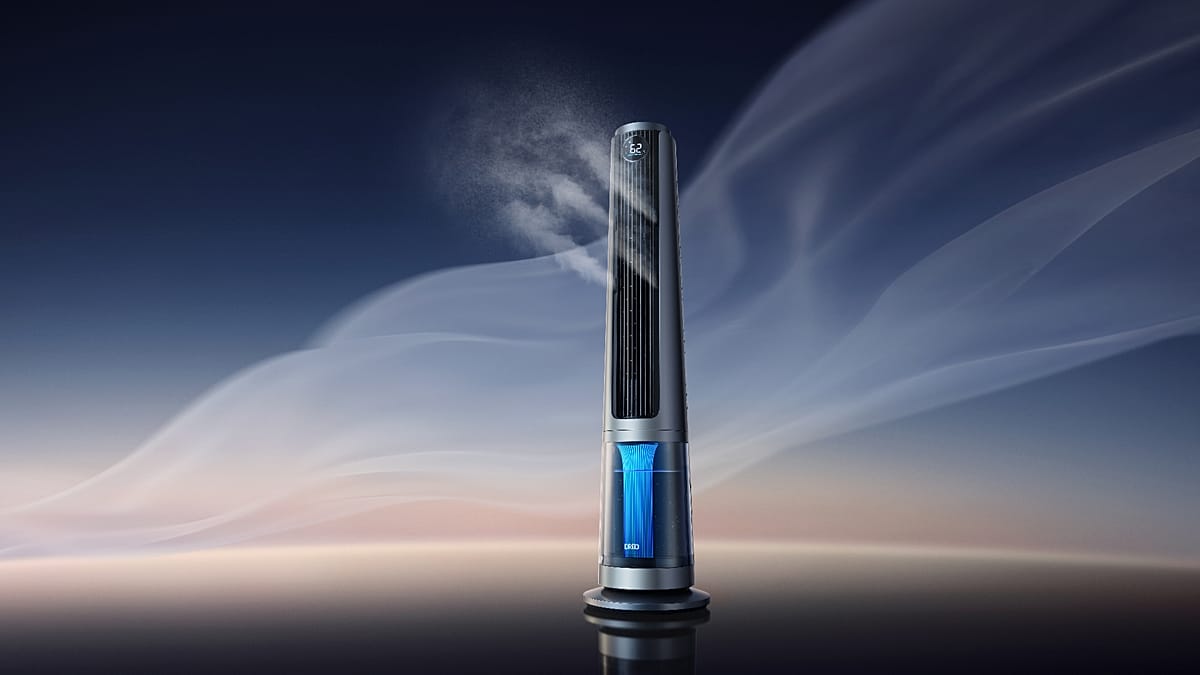
Some of the most interesting include Chinese company Dreo’s misting fans. Euronews Next spotted them at CES in January and saw the TurboCool range, which does not just blast you with cool air but also fires a fine mist at you.
The particles or ‘ultrasonic mist’ disappear quickly, so there is no concern of dampness on your sofas. The ultrafine mist can evaporate as soon as it leaves the fan.
There are several versions of the fan, including one that can sit on desks and a tower version for larger surfaces, which can cool a room by up to ~15.5C and costs £199.99. The mini version can drop temperatures by up to ~2.5C (£99.99).
Misting fans are having their moment as they can lower the temperature in a room unlike regular fans.
As for handheld fans, which are useful when out and about, one of the most talked about is from Dyson.
Their Husjet Mini Cool handheld fan claims it can deliver airflow speeds of up to 25m/s, and last for six hours on a single charge.
Rather than spinning blades, it has a precision nozzle and a honeycomb mesh liner that can be rotated 360 degrees so you can point it in any direction.
It can also be placed on desks or around your neck with a lanyard. Though small, it is mighty in power, but comes with a powerful price tag of €99.
And if you would rather have a fan just for your neck, there is a market for that.
The neck is where major blood vessels are close to the skin, so a fan in place here can cool you down immensely. Plus it’s great for cyclists in the heat.
The JisuLife Neck Fan Life3 FA14 is one that has strong airflow and has five speed settings. The battery can also last up to 16 hours on a single charge.
The personal cooler
In May, Sony released what is widely seen as a wearable air conditioner.
The Reon Pocket Pro sits at the base of your neck and fits under your top to cool your body down, rather than blowing air like a fan.
It uses multiple sensors and uses an algorithm to estimate the user’s behaviour, temperature, humidity, and the surrounding environment’s temperature and humidity, the company says.
It runs for 15 hours on a single charge, the company says. But it comes with a hefty price tag of $259.99. But as it can also be used in winter for heat, the multi-year use may justify the price.