



April 2026 marked the completion of Artemis II, the second mission in NASA’s programme to return humans to the Moon.
The endeavour was complex: it required a successful lift-off with the Space Launch System (SLS), one of the most powerful rockets ever built, and it took four astronauts farther away from Earth than any humans had ever been before.
But NASA’s next step in its Moon programme, Artemis III, is no less critical. According to Jeremy Parsons, the Artemis programme manager, it can easily be considered “one of the most complex and ambitious missions NASA has ever undertaken”.
But what makes Artemis III so challenging, and how are its astronauts preparing for it?
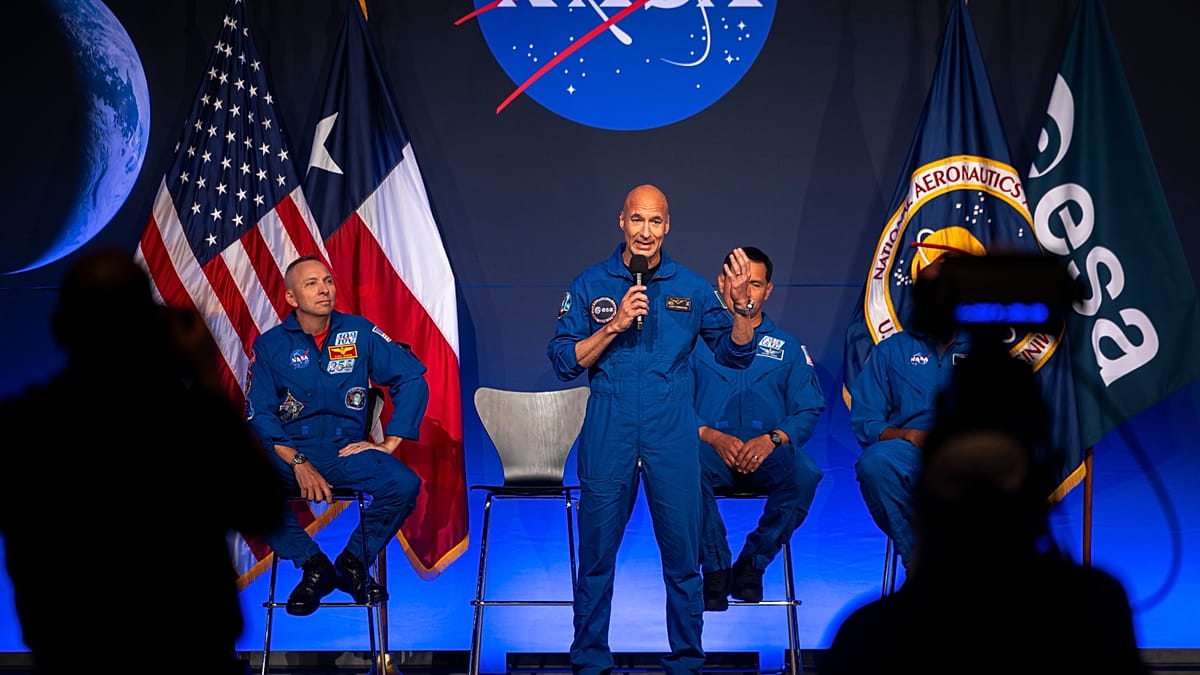
Euronews asked Luca Parmitano, ESA astronaut selected as the pilot of this mission and the only European to be part of the crew.
Artemis III, a technological and human leap
Set to launch in the second half of 2027, Artemis III will send a crew of four astronauts into low-Earth orbit aboard the Orion spacecraft, which will be launched via the SLS. The crew will then perform rendezvous and docking manoeuvres with two lunar landers.
Rendezvous consists of bringing two spacecraft together, whereas docking is the physical joining of these two vehicles.
According to Parmitano, Artemis III is demanding on both a technological and human level.
“We have three launches that have to happen in close proximity and from very different spacecraft,” he told 12 Minutes With.
For the synergy among these three spacecraft, Parsons described the mission as being akin to a ‘highly choreographed dance,’ with launches performed by three of the world’s most powerful rockets.
Jeff Bezos’ Blue Origin lunar lander will be the first one to launch, followed by NASA’s Orion spacecraft and Elon Musk’s SpaceX lunar lander.
This chronology is both technical and strategic. Blue Origin, Parmitano explained, is the only spacecraft that can loiter for about 30 days, while the Orion spacecraft has a limit of 21 days of resources.
Both commercial companies will fly test versions of their landers, and for Blue Origin two crew members from Orion will open the hatch and enter the lander. “Those are technological aspects that are really complex,” Parmitano told 12 Minutes With.
Rendezvous and docking manoeuvres will be both manual and automatic, requiring immense focus and training from the crew. “We will always shadow the automatic approach because it’s something that hasn’t been tested yet,” Parmitano explained.
On top of the technical challenges, astronauts will also have to adapt to complicated human conditions.
The Orion livable space is only about 8 cubic metres, and the environment is designed for deep space conditions instead of low-Earth orbit. “There’s a lot going on, a lot of training and a lot of thoughts going into what the mission is going to look like,” Parmitano stressed.
How are astronauts getting ready for Artemis III?
Three NASA astronauts will join Luca Parmitano on Artemis III: Randy Bresnik, Frank Rubio and Andre Douglas.
The crew has approximately a year and a half to prepare for the mission, a limited time compared with the training schedule of the Artemis II team, which lasted about three years.
That is why Parmitano’s schedule is already extremely busy. Two weeks ago, the crew was at Pax River, the United States Naval Test Pilot School in Maryland, to train some pilot and engineering skills. “We flew there with two aircraft just to get refreshed on some of the techniques,” Parmitano told 12 Minutes With.
Last week, the astronauts also started training with simulations. “The first one in the mockup was full-suited, and getting familiar with our spacesuits,” Parmitano explained. “And then Andrea and I were in a six-hour simulation dealing with several different malfunctions,” he added.
These simulations will continue for the rest of the summer, while during the fall, the crew will start exercising with the landing systems, Parmitano explained.
The schedule might, however, undergo some modifications as experts claim NASA’s timeline is ambitious.
In May, Blue Origin’s New Glenn rocket, designed to bring into orbit the company’s lunar lander, exploded during a test, damaging the launchpad. This was seen by many as a huge setback for Artemis III, but NASA administrator Jared Isaacman said multiple times since then that the mission is on track.
Despite the challenges, Parmitano is excited to go into orbit again and told 12 Minutes With that he will not miss anything. “When you go on such a mission, when you have that privilege, you leave everything on the ground, knowing that you will be there, and you go up thinking of everything that you can get from living in orbit,” he said.