
It’s been four years since Russia launched its full-scale and illegal war of aggression on Ukraine, triggering the largest conflict on European soil since World War Two.
Upper-end estimates suggest the number of soldiers killed, wounded or missing on both sides has now reached 1.8 million, according to the Centre for Strategic and International Studies, while the civilian death toll in Ukraine alone nears 15,000.
Almost six million Ukrainians have fled their country, while around 3.7 million have been forced out of their homes and moved elsewhere in the country.
Beyond the immense scars of grief and terror, Ukraine’s natural landscape has also been devastated. Despite covering less than six per cent of the continent’s land mass, Ukraine is home to a third of European biodiversity. But war has increased pressure on over a thousand of its threatened animal, plant and fungi species.
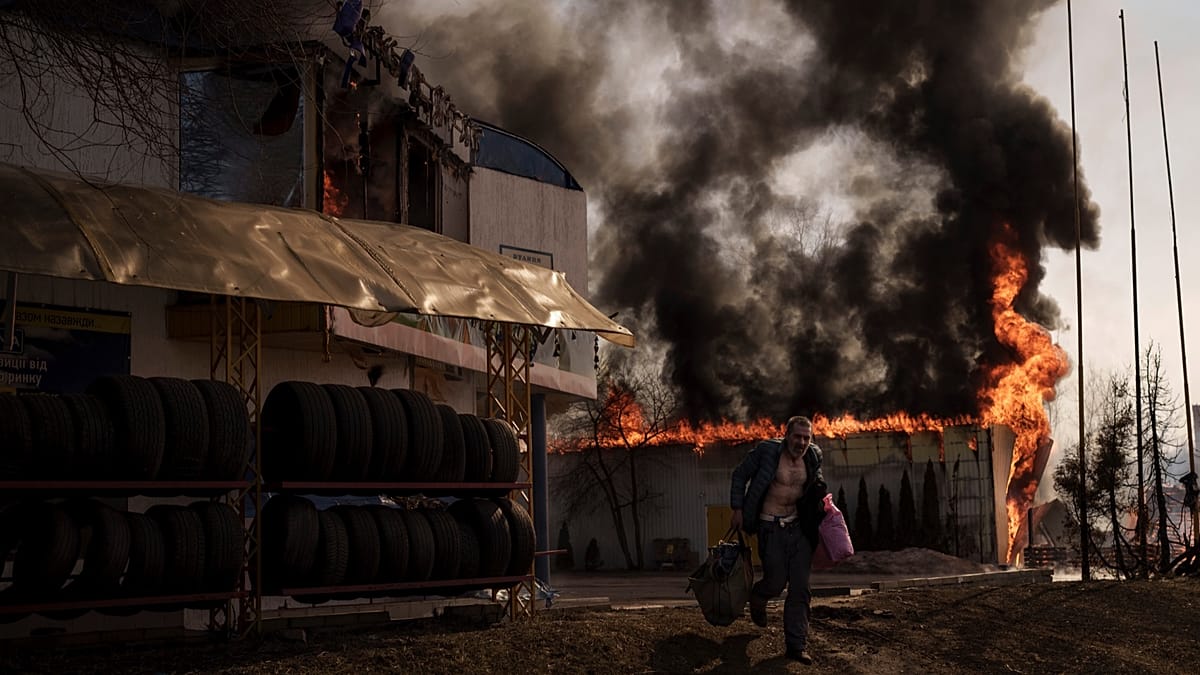
Harrowing footage of gas-guzzling tanks, destroyed infrastructure and uncontrollable blazes has also shed light on how war and military action have become one of the world’s top polluters, despite the lack of attention it receives.
The carbon cost of Russia’s war on Ukraine
The Initiative on GHG Accounting of War has been calculating the carbon emissions created since Russia’s war on Ukraine first started.
Its latest report says the conflict’s fourth year has driven greenhouse gas emissions up by 75 million tonnes of CO2 equivalent (tCO2e), bringing the total since 24 February 2022 to a staggering 311 million tCO2e.
This is almost the equivalent of France’s annual emissions, or the annual global emissions from energy used for pumping water.
These emissions stem from warfare (fossil fuelled tanks and machinery), landscape fires, energy infrastructure, migration, civil aviation and damage reconstruction.
How climate change ‘exacerbates’ the impacts of war
While emissions rose across all of these categories during the fourth year of invasion, landscape fires surged for the second consecutive year – accounting for 23 per cent of overall emissions.
In 2025, Ukraine experienced 1.39 million hectares of natural landscape fires, far exceeding pre-war levels.
It comes as Ukrainian charities are desperately trying to rewild the country to protect wildlife and even help soldiers heal their psychological wounds.
“Unusually hot and dry conditions – likely intensified by global warming – turned even minor sparks from combat into uncontrollable blazes, as firefighting remained impossible,” the report states.
Experts say this “vicious cycle” underscores how armed conflict and climate change “exacerbate one another”.
Emissions from reconstruction efforts also spiked, particularly in the energy sector. It follows Russia’s escalated attacks on Ukraine’s heating and electricity infrastructure during the harsh winter of 2025-2026.
A fossil fuelled war
Fossil fuel consumption, for example from tanks and fighter jets, accounts for the majority of warfare emissions globally. In the fourth year of the war on Ukraine, it made up over a third (37 per cent) of the conflict’s emissions.
The rest derives mainly from ammunition production and the replacement of destroyed military hardware.
“Despite relatively stable frontlines, the war’s persistent combat – marked by relentless attacks and localised intense battles – has sustained high fuel demand and ammunition consumption,” the report adds.
“Although battlefield tactics and equipment use have evolved, armed forces still rely heavily on fossil fuels to power tanks, armoured vehicles, and the expanding logistical network supporting military operations.”
Military emissions are responsible for around 5.5 per cent of global emissions, but the extent of their pollution often goes unreported – even in the EU. It’s why a growing number of organisations are calling for greater transparency.
“Europe can’t claim climate leadership while its military emissions remain opaque,” says Dr Soroush Abolfathi, an associate professor at Warwick University and part of The War on Climate.
“Armed forces worldwide are thought to generate around 5.5 per cent of global emissions – yet the EU leaves about 82 per cent of its own military emissions off the books.”
The world’s first climate reparations
At the UN COP30 summit in Belém last November, Ukraine announced plans to hold Russia accountable for these war-related emissions.
The Ukrainian government will file a claim under the Environmental Damage category of the Register for Ukraine this year, urging Russia to pay more than €37 billion in what would be the world’s first case of climate reparations from war.
This sum has been calculated using a “social cost of carbon” of $185 (around €156.90) per tCO2e.