
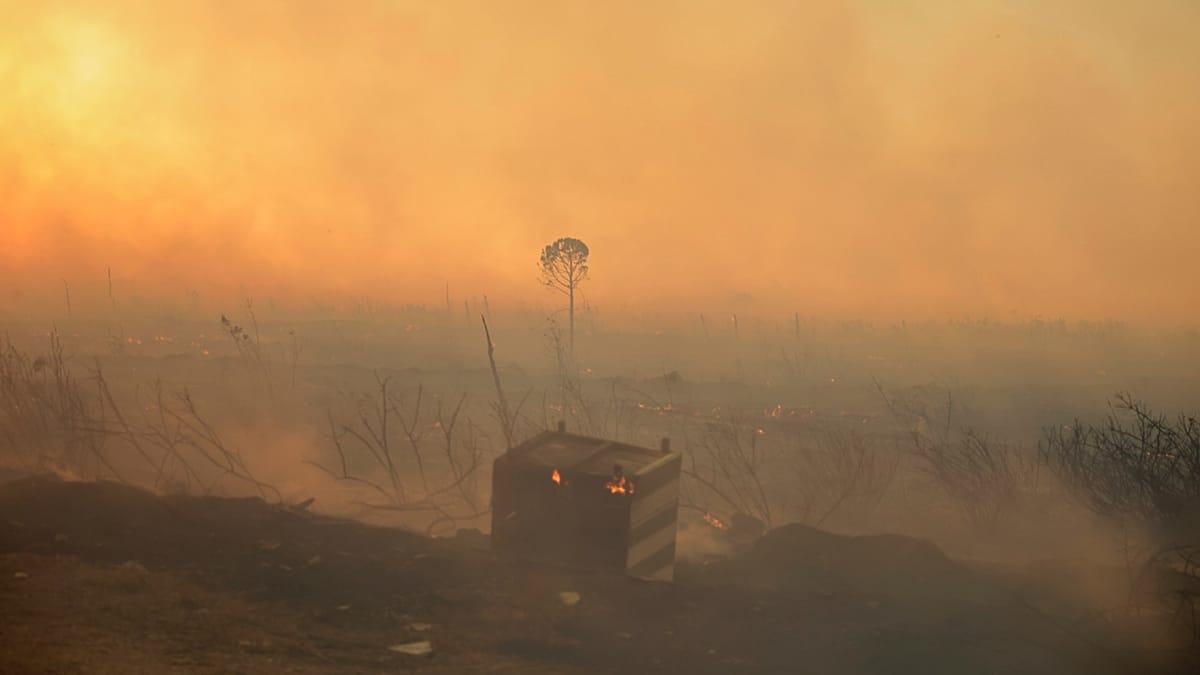
People clinging to tree tops to stay alive, thousands of homes crumbling, and roads rapidly transforming into rivers of mud.
These haunting images are not a dystopian prediction of what is to come: they are the reality of extreme weather that has gripped the world in a deadly chokehold.
In Europe, flash floods, deadly heatwaves, droughts and record-breaking wildfires became the defining feature of 2025 – a legacy it is still scrambling to recover from.
But experts warn these events will likely become the “new normal” unless drastic action is taken to reduce heat-trapping emissions being released into the atmosphere.
Is climate change to blame for extreme weather?
While scientists refrain from pinpointing blame for specific extreme weather events, it’s widely agreed that climate change is fuelling their frequency and severity.
For every 1℃ rise in air temperature, the atmosphere can hold around seven per cent more moisture, which can lead to more intense and heavy rainfall.
“Human-induced climate change means that summer weather is occurring on top of a warmer background climate,” explains the National Centre for Atmospheric Science.
“With every degree of warming to the Earth’s climate, the frequency and intensity of heatwaves are projected to get worse.”
Europe’s extreme weather in 2025
2025 kicked off with a stormy start, as violent winds swept across parts of France. Regions in the north, such as Charleville-Mézières, Châlons-en-Champagne, and Bar-le-Duc, were hit the hardest – experiencing frequent gusts that climbed up to 110 km/h.
By spring, extreme weather had hit several other European countries. Dozens were evacuated in central and northern Spain due to Storm Martinho, while the worst flooding in three decades crippled Romania’s historic Praid salt mine. Hundreds of people were displaced, their homes damaged by days of torrential rain and strong winds.
But it was during the summer months when things really ramped up. Extreme heat broke temperature records across the continent, even far north in the usually cold Arctic Circle, where “truly unprecedented” heat soared above 30℃ on 13 days in July.
Finland endured three straight weeks of 30℃ temperatures, and struggled to cope with the blistering conditions.
An ice rink in the north of the country opened up to those seeking refuge from the heat, while local hospitals were inundated. The heatwave also sparked concerns over the welfare of reindeer, who risked overheating.
Further south, Europeans sweltered under temperatures exceeding 40℃ – pushing dozens of nations into drought. The intense heat soon turned into a continent-wide emergency, with several countries issuing health and wildfire warnings.
Madrid’s health ministry told people to keep out of the sun if possible, and pay close attention to the elderly and pregnant, while French authorities ordered public swimming pools to be free to help residents cool down.
In Italy, bans on outdoor work during the hottest hours of the day came into force. And in Greece, major tourist attractions were temporarily closed.
But deaths from extreme heat still occurred, and eventually started to make the headlines. Montse Aguilar, a 51-year-old street cleaner in Barcelona collapsed on the streets after enduring a grueling 35℃ while the city was placed under high alert.
Aguilar’s death sparked local protests, with hundreds of fellow street cleaners and concerned citizens marching through downtown Barcelona armed with banners reading: “Extreme heat is also workplace violence”.
How many people died due to extreme heat?
Researchers at Imperial College London and the London School of Hygiene & Tropical Medicine looked at 854 European cities and found that climate change was responsible for 68 per cent of the 24,400 estimated heat deaths this summer, having raised temperatures by up to 3.6°C.
The countries hardest hit by a single heatwave were Romania, Bulgaria, Greece and Cyprus, where from 21 to 27 July an estimated 950 heat deaths occurred in temperatures up to 6°C above average. That is around 11 daily deaths per million people.
The European capital cities that saw the most deaths per capita were Rome, Athens and Bucharest. The study’s authors say it reflects their exposure to some of the most extreme heat in Europe, but they point out that other factors also play a role, including preparedness, population demographics and air pollution.
Across all 854 cities, climate change was behind 4,597 estimated heat deaths in Italy – the highest overall total. It also caused 2,841 deaths in Spain, 1,477 in Germany, 1,444 in France, 1,147 in the UK, 1,064 in Romania, 808 in Greece, 552 in Bulgaria and 268 in Croatia.
Analysis by World Weather Attribution (WWA) also found that climate change made weather that fuelled wildfiresacross Portugal and Spain around 40 times more likely.
More than 380,000 hectares of land have burned in Spain since the start of 2025 – almost five times the yearly average. In Portugal, more than 260,000 hectares have been lost. That is close to three per cent of the country’s land mass and is three times the average area burned by wildfires in a year.
At least eight people died in the blazes, while tens of thousands were forced to evacuate.
How extreme weather impacts Europe’s economy
Experts warn this summer’s extreme weather sparked short-term economic losses of at least €43 billion, with total costs slated to hit a staggering €126 billion by 2029.
A study published back in September, led by Dr Sehrish Usman at the University of Mannheim in collaboration with European Central Bank (ECB) economists, found that heatwaves, droughts and floods affected a quarter of all EU regions during the 2025 summer.
The immediate losses amount to 0.26 per cent of the EU’s economic output in 2024, but the study’s authors stress that these estimates are likely conservative as they don’t include compound impacts when extreme events occur simultaneously, such as heatwaves and droughts.
They also don’t include the cost of hazards like wildfires, which broke records across Europe this year, or hail and wind damage from storms.
Which countries took the biggest economic hit?
Italy suffered one of the worst economic downfalls with projected losses of €11.9 billion in 2025, rising to €34.2 billion by 2029. France followed behind with more than €10 billion in immediate damages and €33.9 billion before the end of the decade.
Spain was among the most affected countries where researchers identified all three types of extreme weather events. Its total estimated losses were €12.2 billion in 2025 and €34.8 billion by 2029.
Will extreme weather be worse in 2026?
While Europe grapples to recover from these extreme weather events, scientists predict 2026 will be one of the hottest years since 1850.
The UK’s Met Office has released its latest outlook for the global average temperature, warning that 2026 is likely to become the fourth year where global average temperatures climb 1.4°C over the preindustrial average.
“The last three years are all likely to have exceeded 1.4°C and we expect 2026 will be the fourth year in succession to do this,” says Professor Adam Scaife, who led the team behind the global forecast.
“Prior to this surge, the previous global temperature had not exceeded 1.3°C.”