
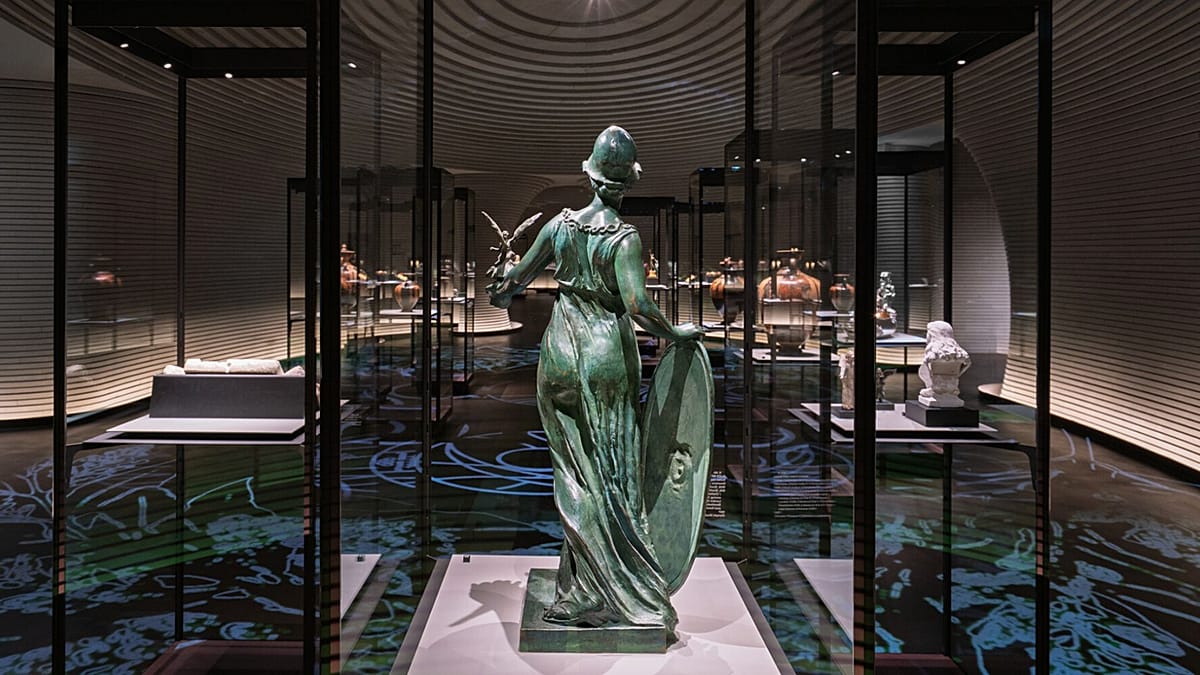
Three thousand years of history and Olympic values, all under one roof.
The exhibition “The Olympic Games. A 3000-Year History” has been open at the Fondazione Luigi Rovati in the historic heart of Milan since November last year.
Now, as the Milano-Cortina 2026 Winter Olympic Games have officially kicked off, its themes feel more timely than ever.
“The exhibition here shows that all these three big civilisations (Greek, Etruscan and Roman), all brought something and they have something to bring to us, and that the modern time Olympics, they also have heritage, they also bought novelty,” says Lionel Pernet, Director of the Musée cantonal d’archéologie et d’histoire (MCAH) of Lausanne and one of the curators of the exhibition.
Ancient and modern are woven together throughout the galleries. Vases decorated with sporting scenes sit alongside contemporary athletic equipment. At first glance, the pairings might seem unexpected. But the intention is clear: to show how sport – and the values attached to it – travels across centuries.
“We can understand that the history of art and the history of civilization, the history of our world, is something that goes back in the past, and it is continuing in the present,” says Giovanna Forlanelli, President of Fondazione Luigi Rovati.
“We are looking to the people that run, that make sports in the same way in which the Greek looked at these athletes,” she says.
For this reason, the golden running shoe designed for Michael Johnson and used during the 1996 Atlanta Games fits perfectly alongside a terracotta foot from the Hellenistic age. A vase depicting running athletes is placed next to the baton signed by the Italian relay team that won the 4×100 meters at the Tokyo 2020 Olympics.
Anne-Cécile Jaccard, curator at the Olympic Museum of Lausanne and curator of the exhibition in Milan, says: “The value is to show to the visitors that, in antiquity, there were international competitions on a Greek level, international competitions that gathered different type of people in an area. And it’s the same thing today, we gather nations in order to have sports competition, but also in order to build a dialogue.”
Yet the Olympic story has also evolved and the modern Games in 1900 marked a turning point. “One thing that appeared are women, because they were not allowed to compete during the Olympic Games, because they had the Heraean Games, so this is the novelty, I would say, at the second edition of the Games in Paris, 1900, women were allowed to compete,” says Jaccard.
From that moment on, the narrative expanded – and so did the meaning carried by the objects now on display in Milan, many of them on loan from the Olympic Museum in Lausanne.
A pair of running shoes becomes history when worn in competition – even more so when they belonged to Moroccan hurdler Nawal El Moutawakel, the first Arab, African and Muslim Olympic champion in the 400-metre hurdles.
The same goes for the singlet worn by Usain Bolt, or Michael Jordan’s shoes.
“The equipments (objects) that we are looking for must tell a story, because we are a museum of society, and we tell the story of humankind,” explains Jaccard.
“So the athlete has to be the bearer of a special story, of his own family story, for example, his community or her community, the story of a sports and the story of the world, because when you have the Games, sociopolitical events happened and you can link them to the Olympics.”
Medals, statues, posters, torches, coins, frescoes and painted scenes complete the journey – each one preserving a moment of competition, encounter and shared spectacle.