
While the human and territorial costs remain at the forefront of the global consciousness, the underlying economic metrics of Russia’s full-scale invasion of Ukraine lay bare the immense strain on the nation and its international partners.
Ukraine faces an unprecedented dual challenge: bankrolling the relentless, daily defence against Russian forces while simultaneously preparing for the most expensive national reconstruction effort in modern European history.
Fending off the Russian military machine has required a colossal and continuous injection of capital over the past four years.
According to recent figures confirmed by Andriy Hnatov, head of the general staff of the Armed Forces of Ukraine, a single day of full-scale war costed the country on average a staggering $172mn (€145.7 million) in 2025.
Back in 2024, the average daily cost of fighting the war was around $140mn (€118.5mn) which represents an increase of almost 23%.
The current operational burn rate of the Ukranian army suggests that around $5bn (€4.2bn) are needed every month to sustain the soldiers, procure ammunition and deploy innovative combat technologies, among other necessities.
To maintain this level of resistance, Ukraine is allocating over 30% of its GDP directly to the military budget. By comparison, most peacetime European nations have historically struggled to meet the baseline NATO target of 2%.
Such extreme expenditure places the Ukrainian economy under immense pressure, effectively operating on a total wartime footing.
Lieutenant General Hnatov has starkly warned that the country cannot withstand this financial burden alone, emphasising that continued Western financial aid is the only support preventing economic collapse.
With domestic reserves stretched to their absolute limits, the financial exhaustion of the involved parties is rapidly becoming a decisive factor on the battlefield.
The reconstruction cost
Even as Kyiv scrambles to fund its immediate survival, the long-term economic horizon is coming into sharper focus.
On the eve of the four-year anniversary of the war, the Government of Ukraine, the World Bank, the European Commission and the United Nations released their updated joint Rapid Damage and Needs Assessment (RDNA5).
The findings present a sobering picture of the devastation.
As of December 2025, the total cost of reconstruction and recovery in Ukraine is estimated at almost $588bn (€500bn) for the next decade.
To contextualise the magnitude of this figure, it is nearly three times the country’s projected nominal GDP for last year.
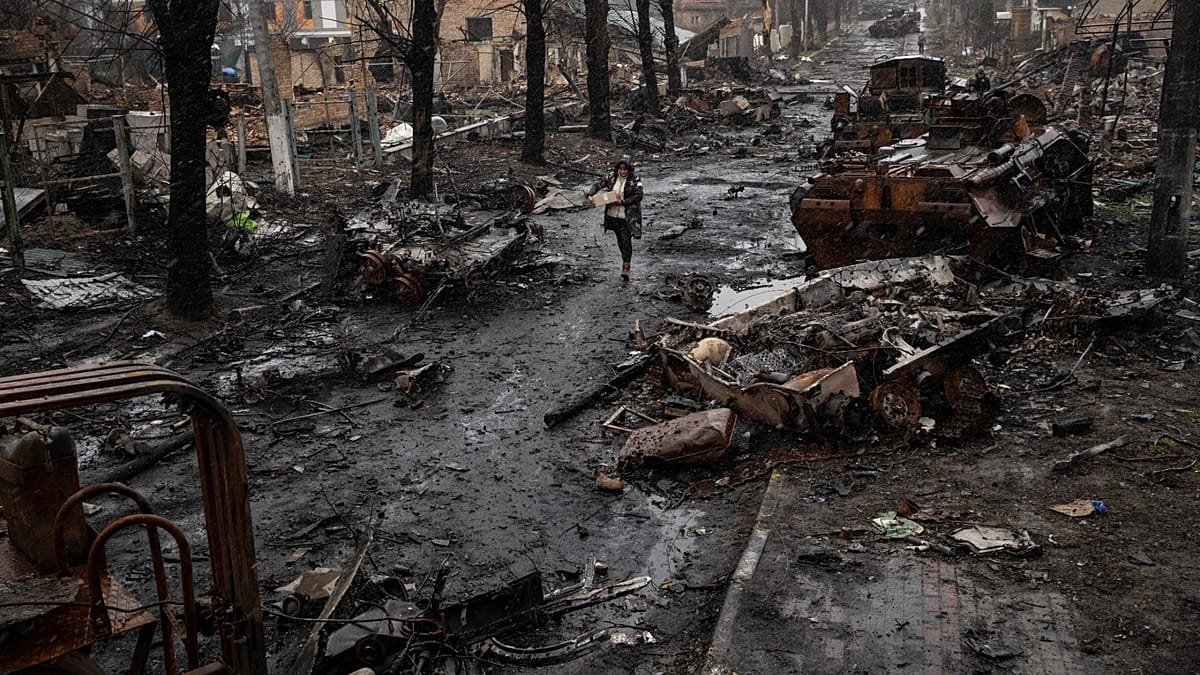
Direct physical damage alone has now surged past $195bn (€165bn). The destruction is heavily concentrated in frontline regions and key metropolitan areas, with housing, transport and energy infrastructure bearing the brunt of the onslaught.
The World Bank report highlights a 21% increase in damaged or destroyed energy assets over the past year, directly linked to intensified Russian strikes during a bitterly cold winter.
Furthermore, 14% of all housing in the country has been damaged or destroyed, displacing and impacting over three million households.
Despite the expanding footprint of destruction, Ukrainian officials remain steadfast.
Upon the report’s release, Prime Minister of Ukraine Yulia Svyrydenko proclaimed that “amid unprecedented Russian attacks on energy infrastructure and homes across Ukraine this winter, our people show resilience, our entrepreneurs keep working. We still manage to recover fast and develop further”.
The path to a modern European state
International institutions are already laying the groundwork to ensure the reconstruction does not merely replace what was lost, but also modernises the nation.
The private sector is expected to play a crucial role in unlocking the necessary domestic and international capital.
The EU Commissioner for Enlargement, Marta Kos, reaffirmed Brussels’ commitment to the recovery effort following the publication of the updated RDNA5.
“Russia’s war of aggression has brought destruction unseen in generations,” Kos noted while adding that the EU’s response is clear: “we will rebuild Ukraine as a strong, modern EU country. Through bold reforms and the Ukraine Investment Framework as our tools to mobilise investments at scale, we will transform devastation into prosperity”.
As the war enters its fifth year, the battle lines are drawn not only in the muddy trenches of the east but on international balance sheets.
For Ukraine, victory will require both enduring the crippling daily costs of defence and securing the monumental half-trillion-dollar investment needed to effectively rise from the ashes.