
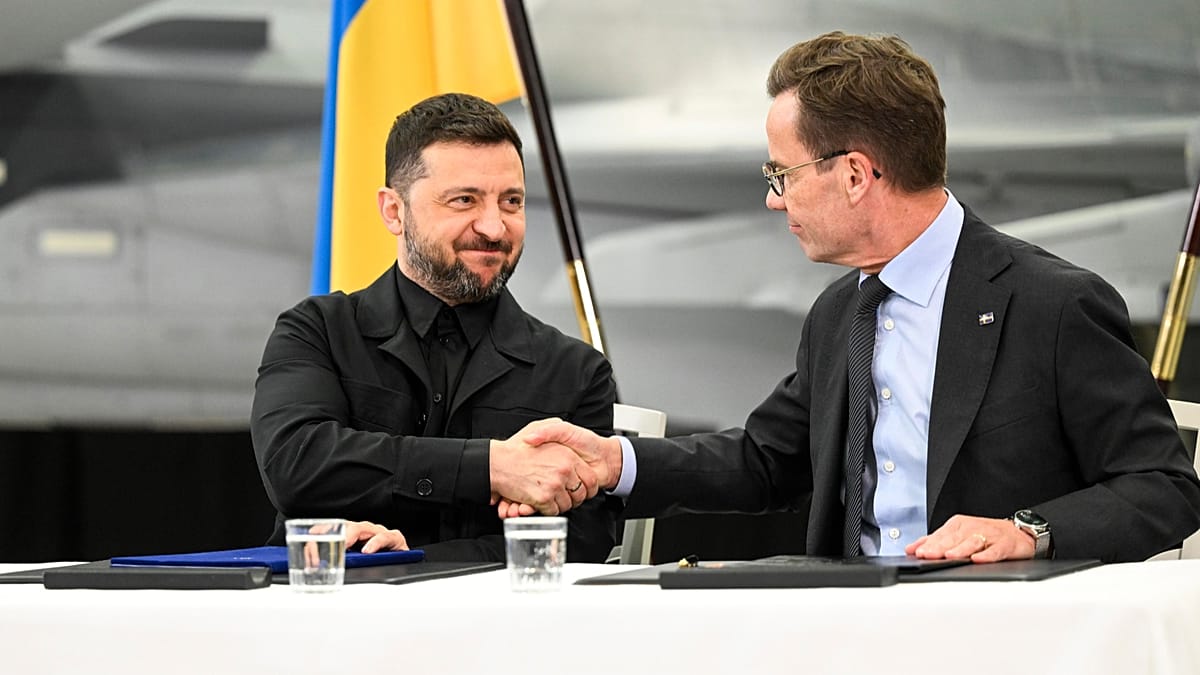
A group of four countries have relaunched the push to unlock immobilised Russian assets to fund Ukraine’s budgetary and military needs before European Union member states become distracted by their own domestic elections.
The EU holds €210 billion of these assets, most of it in Belgium.
“Ukraine needs more financial support in both the short and long term. The EU, in dialogue with its partners, should continue to provide comprehensive, predictable and structured financial support to Ukraine in line with its need,” the letter reads.
The letter was led by Sweden and co-signed by the Netherlands, Spain and Poland, a selection meant to represent Northern, Western, Southern and Eastern Europe.
It is addressed to High Representative Kaja Kallas and Irish Foreign Minister Helen McEntee, as Ireland currently chairs the Council’s rotating presidency.
Earlier this year, the bloc gave the final green light to a €90 billion support loan for Ukraine. But Kyiv is still strapped for cash, and EU capitals want a solution that does not further strain national budgets.
There is also urgency to lock in funding before next year’s election season, when key member states, including France, Poland, Italy and Spain, head to the polls.
“We believe now is the time to revert to the issue of how we can make further use of Russia’s immobilised assets for the benefit of Ukraine,” reads the letter, drafted on the initiative of the Swedish government.
“While we should be proud of our achievements, we cannot afford to rest on our laurels.”
At a press conference on Thursday, a European Commission spokesperson said it was “ready to provide any assistance that might be needed in this context” and would study the letter “carefully”
Old struggle, new push
Using Russia’s immobilised assets was intensively debated last year as the EU grappled with the withdrawal of US assistance for Ukraine.
Under an inventive proposal, the Commission planned to convert the €210 billion into a zero-interest loan to cover Kyiv’s budgetary and military needs. Brussels insisted the scheme would stop short of confiscation, which is illegal under international law, since Russia could recoup the money if it paid war reparations.
Belgium opposed the plan from the outset. As the host of Euroclear, the assets’ main custodian, it feared being left exposed to Russian litigation.
Belgian Prime Minister Bart De Wever demanded “full mutualisation” of the risks to shield his country from Moscow’s retaliation and damage claims. Euroclear called the proposal fragile and overtly experimental, warning it risked an investor exodus.
“There is no free money in the world. It just does not exist,” De Wever said then.
Despite a strong push from a group of proponents led by Germany, the plan eventually fell apart at a make-or-break summit in December. Now, supporters believe the timing is right to bring it up again.
Budgetary hole
As a fallback, the 27 leaders agreed to issue an extraordinary €90 billion loan for Ukraine, backed by common borrowing and repayable only once reparations are paid. Hungary, Slovakia and Czechia negotiated a full opt-out.
The loan was meant to cover Kyiv’s needs for both 2026 and 2027, split evenly at €45 billion a year. The first payment went out in June.
But Russia’s relentless bombardment has upended Kyiv’s calculations. Ukrainian President Volodymyr Zelenskyy has urged allies to plug a €23 billion deficit in the Ministry of Defence budget, telling them he needs “more money, much more” to stay “competitive” in deep strikes. He also raised the matter of the assets.
Zelenskyy’s request caught Brussels off guard, raising fresh concern over how long the bloc’s €90 billion credit line will last.
Brussels has so far disbursed €3.2 billion in budgetary aid and €8.35 billion in military aid. In total, €22 billion has been allocated for weapons purchases this year.
As Moscow escalates its campaign of ballistic missile strikes, prompting a scramble for air defence systems for Kyiv, capitals are realising the €90 billion loan may not stretch to cover 2026 and 2027 in full, as originally planned.
The new EU budget, with a dedicated Ukraine envelope, will not kick in until 2028.
Looking for ‘new options’
Earlier this month, Ukraine’s Foreign Minister Andrii Sybiha raised the question of reallocating Russia’s assets during a visit to Kyiv by his Belgian counterpart, Maxime Prévot.
Prévot said the risks Belgium had previously flagged had not gone away, but signalled an openness to considering new proposals, noting no objection in principle to using the money to support Ukraine.
In other words, Belgium’s position has not shifted: if the debate reopens, it will again demand uncapped guarantees, Belgian officials say.
Euroclear, which also remains opposed, is meanwhile fighting a legal challenge from the Russian Central Bank.
As allies gathered in Kyiv for its 35th Independence Day, Swedish Foreign Minister Maria Malmer Stenergard raised the issue again, signalling her intention to put it on the table at the next informal meeting of foreign ministers, set for Ireland on 1-2 September.
“We therefore propose that the Commission’s technical experts are invited to explore, in close consultation with member states, new options on how to use the immobilised assets for the benefit of Ukraine, which ensure that the risk rests with all EU member states and where no member state holds a disproportionate burden,” the letter says.
“Managing financial and economic risks, as well as compliance with international law, will constitute important components of this technical analysis and discussion,” it adds, acknowledging “the question is complex”.