
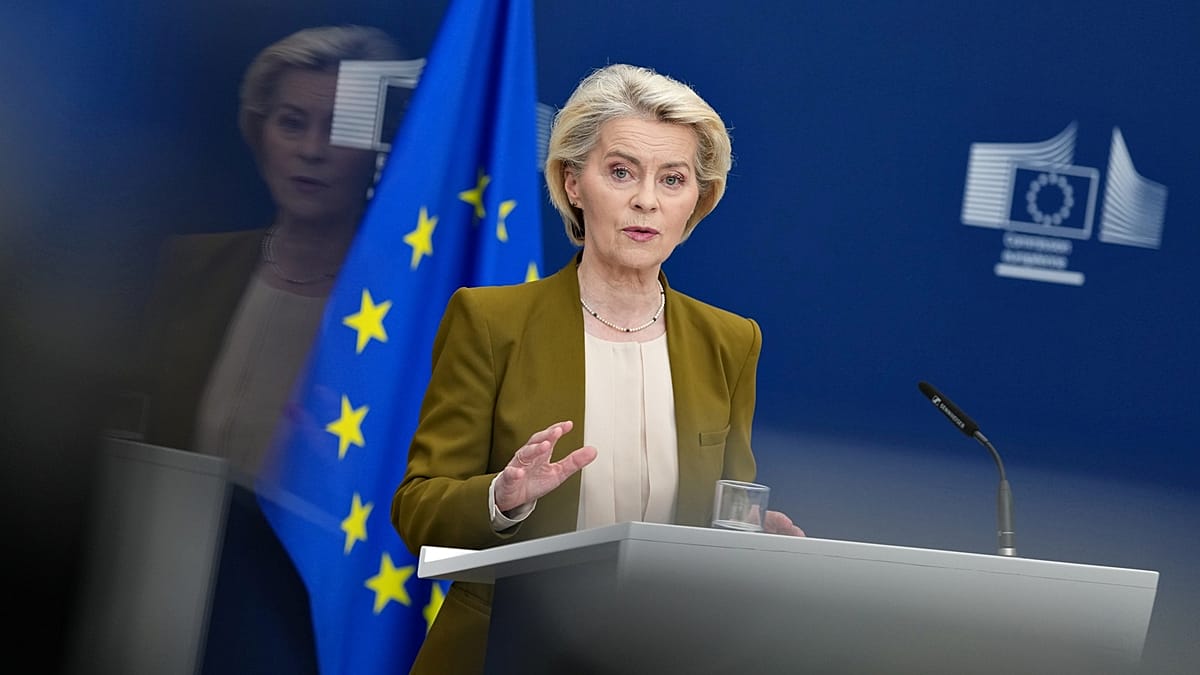
The European Commission has proposed a fresh round of sanctions against Russia, targeting oil sales, the “shadow fleet”, banks, cryptocurrency firms, metals, fish products and soldiers who have taken part in the full-scale invasion of Ukraine.
The proposal, unveiled on Tuesday by Commission President Ursula von der Leyen, comes as Kyiv’s allies consider new ways to revive the stalled peace process and force the Kremlin to accept a ceasefire as a precondition for negotiations.
“Russia has clearly failed to subjugate Ukraine. The price Russia pays is heavier by the day, and it is paid primarily by the people of Russia,” von der Leyen said.
“So the objective of our package couldn’t be clearer: we want to maintain the full intensity of our sanctions.”
The main element concerns the price cap on Russian oil that the EU, in conjunction with the G7 and Australia, has implemented since December 2022. Last year, the mechanism was made dynamic, with the cap set at 15% below the average price.
However, the disruption triggered by the blockade in the Strait of Hormuz has pushed the price of Russia’s Urals oil to $87 per barrel, compared to $58 per barrel in February.
This means that if the EU goes ahead with the planned review on 15 July, the cap will be adjusted upwards, and, as a result, grant Moscow the temporary relief it wants.
The Commission proposes to delay the revision until January 2027 and keep the price cap as it is now: $44.10 per barrel.
The adjustment mechanism “was not made for market shocks like the one caused by the closure of the Strait of Hormuz,” von der Leyen said.
The pause until January, she added, “will give oil markets time to stabilise, while preserving pressure on Russia’s revenues”.
Earlier this year, von der Leyen put forward a plan for a full ban on all maritime services, such as banking, insurance, shipping and flagging. The ban, advocated by the Nordics and the Baltics, lost momentum after the conflict in the Middle East.
Greece and Malta, two coastal member states that service Russian tankers, voiced opposition and made it clear they would not move ahead without the G7 on board. Other G7 allies showed little enthusiasm, and the plan soon fell into limbo.
By shifting the focus to the cap, the Commission effectively admits the ban will not happen any time soon. A summit of G7 leaders is scheduled to take place next week in France, where Von der Leyen is expected to discuss sanctions.
Additionally, the Commission proposes to blacklist 30 vessels from the “shadow fleet” that Moscow uses to bypass the cap. The oil tankers are in an alarmingly decrepit condition and are considered both a security and environmental risk to Europe.
More than 600 of these vessels have been denied access to EU ports and services.
On top of that, other ships and infrastructure, such as ports and refineries, that assist the activities of the “shadow fleet” will also be blacklisted, von der Leyen said.
The draft package targets 31 Russian banks as well as 20 cryptocurrency firms, platforms and oil traders outside accused of helping Moscow evade restrictions.
It also envisages banning exports of various metals, alloys and components used in the defence sector, as well as, for the first time, imports of certain fish products from Russia.
European exports of alumina appear to be excluded from the package, despite an ongoing controversy surrounding a plant in western Ireland accused of indirectly enabling Russia’s weapons production.
A notable element in the proposal is a prohibition on denying entry into the Schengen area to Russian soldiers who have served in the war of aggression, an initiative that Estonia put forward earlier this year and has since gained support from other countries.
“Europe stays off limits for anyone who has participated in the invasion of Ukraine, as simple as that,” von der Leyen said.
Approval of the sanctions requires unanimity by the 27 member states. If endorsed, it will represent the 21st package of restrictions since February 2022.
Officials and diplomats in Brussels are hopeful the green light will be found before 15 July to avoid the automatic review of the price cap.
Von der Leyen’s announcement arrives as Russia ramps up large-scale, deadly airstrikes against Ukrainian cities, prompting outrage among Europeans. Recent signs of strain in the Russian economy have further reinforced the push for restrictions.
“Our sanctions keep biting hard and cutting deep,” von der Leyen said. “They are weakening the economic foundations of Russia’s war effort.”
Ukrainian President Volodymyr Zelenskyy has pitched a face-to-face meeting with Russian President Vladimir Putin to end the war. The negotiations, Zelenskyy said, should be based on the current line of contact and conditional on a ceasefire.
On Sunday, the leaders of France, Germany and the United Kingdom backed Zelenskyy’s idea “with active US and European participation”.