
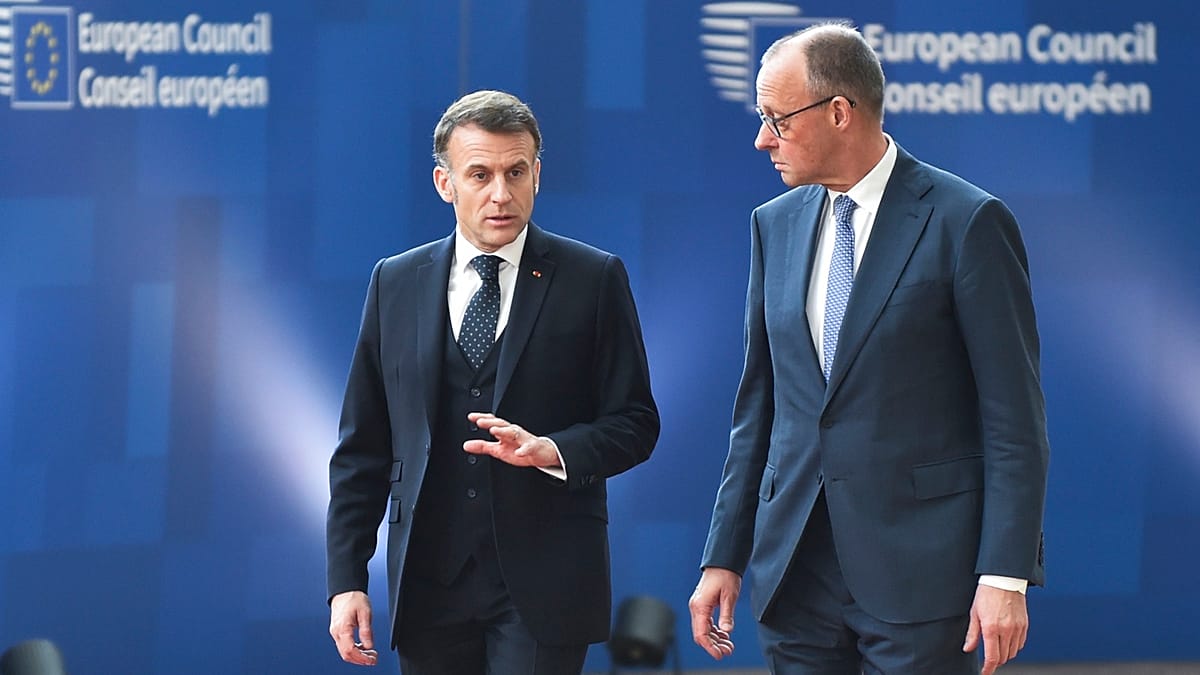
The 27 leaders of the European Union are gathering in Brussels for a two-day summit focused on Russia’s invasion of Ukraine, the shockwaves from the Chinese economy and the bloc’s next long-term budget. The situation in the Middle East, competitiveness, drug trafficking and migration will also be on the agenda.
Thursday’s summit comes on the heels of a closely watched G7 meeting in Évian, France, that managed to convince US President Donald Trump to sign a joint statement pledging to increase military support for Kyiv and sanctions on Russia.
For Europeans, securing Trump’s endorsement is a major diplomatic win to paper over the multiple fractures in the transatlantic alliance.
The White House’s unilateral decision to grant three consecutive waivers for Russian oil has been an intense source of friction. But in Évian, Trump said the reopening of the Strait of Hormuz following the framework deal between the US and Iran would “soon” allow his administration to reinstate the restrictions.
The EU is preparing a new package of sanctions to capitalise on the growing strain in Moscow’s resource-intensive war machine.
“It is the moment to continue putting pressure on Russia, and that’s what we’re working towards,” a spokesperson for the European Commission said.
Fresh from the G7, Ukrainian President Volodymyr Zelenskyy is set to join the 27 leaders on Thursday for the first segment of the summit, which will address ways to revive peace negotiations and bring Russian President Vladimir Putin seriously to the table.
António Costa, the president of the European Council, has made “brief contacts” with Russia at a “diplomatic level to open communication channels, but nothing was discussed on substance”, an EU official confirmed ahead of the summit.
Member states remain sharply divided on the idea of direct talks.
Zelenskyy is also expected to raise the issue of EU accession after his country and Moldova, informally coupled, opened the first cluster of negotiations on Monday. While in Évian, Zelenskyy doubled down on his request for fast-tracked membership.
“Russia will find a way to block Ukraine’s way to the EU. They don’t want to see us successful,” he said. “That’s why we need a fast track.”
However, the prospect of an accelerated process has gone down badly with EU leaders, who insist on preserving the integrity and credibility of the complex methodology. Diplomats are concerned that public opinion is not yet sold on enlargement, and much more work is needed to secure voters’ buy-in for such a consequential decision.
“There’s only one track, and that’s the track of merit, and we know what merit is,” a senior diplomat said. “If you become an EU member, you sit around the table and decide upon 30% of the national legislation. So I want only countries around that table that have the same rule-of-law values as others to decide on legislation that touches people.”
German Chancellor Friedrich Merz plans to make the case for an alternative (and untested) scenario: “associate membership”, which would include, among other things, observer status to EU meetings and mutual assistance in case of armed attack.
Merz’s pitch, though, has received mixed reviews from Kyiv and other capitals, and is unlikely to make a splash on Thursday.
From China to the budget
Following the discussion with Zelenskyy, EU leaders will have their hands full for dinner with a hotly anticipated debate on China.
Brussels has concluded that EU-China trade is unsustainable, and something must change in the relationship to avoid an all-out confrontation. Last year was the first on record that the 27 member states, without exception, posted a trade deficit with Beijing. Fears of de-industrialisation have gone from abstract to tangible.
“We’re not naive anymore. China’s five-year plan is an attack on our market,” a second senior diplomat said. “The cost of action will be less than the cost of inaction. That’s something that’s not disputed now and that you wouldn’t have heard a few years ago.”
Though the grim diagnosis is widely shared, the prescribed medicine is still under careful consideration. Some member states, like France, Poland, Belgium, the Netherlands, Sweden, Denmark and Lithuania, favour a more assertive stance to correct the profound imbalances in trade relations and crack down on Beijing’s subsidies.
But others, like Germany, Spain and Greece, are hesitant to come out guns blazing against China, fearing devastating retaliation and loss of business opportunities.
The divisions are set to play out during dinner on Thursday, which has been designed as an open exchange to allow leaders to speak their minds.
Paying close attention will be Ursula von der Leyen, the president of the European Commission, who has long warned about a “new China shock”.
Von der Leyen and her team want to use the political feedback to guide their course of action, which might include new trade instruments to take faster action. The Commission has struggled to get the necessary support for triggering the Anti-Coercion Instrument against China, despite rampant accusations of blackmail and weaponization.
“We want dialogue, but dialogue has to deliver. We like competition, but competition has to be fair. And we want access to the Chinese market that shows reciprocity,” von der Leyen said earlier this month. “It’s a whole concept that we’re working on.”
On Friday, leaders will turn to another contentious topic: the next seven-year EU budget, which the Commission has pencilled at a record-breaking €2 trillion.
Cyprus, the country holding the EU Council presidency, has proposed a “moderate” 2% cut, worth €32.8 billion, to the original draft. For the countries keen on preserving agriculture and cohesion funds, that is more than enough. But for the “frugals”, now self-rebranded as “modernisers”, a 2% reduction is nowhere near satisfactory.
The debate on Friday is expected to see leaders double down on their red lines, demands and conditions, all of which remain deeply entrenched.
It remains to be seen whether the 27 will manage to seal the final deal in December to avoid the budget talks dragging into 2027, when elections in France, Spain, Italy and Poland risk throwing a spanner in the works.
The two-day summit in Brussels will bring together four new leaders: Péter Magyar (Hungary), Andris Kulbergs (Latvia), Rumen Radev (Bulgaria) and the return of Janez Janša (Slovenia).