
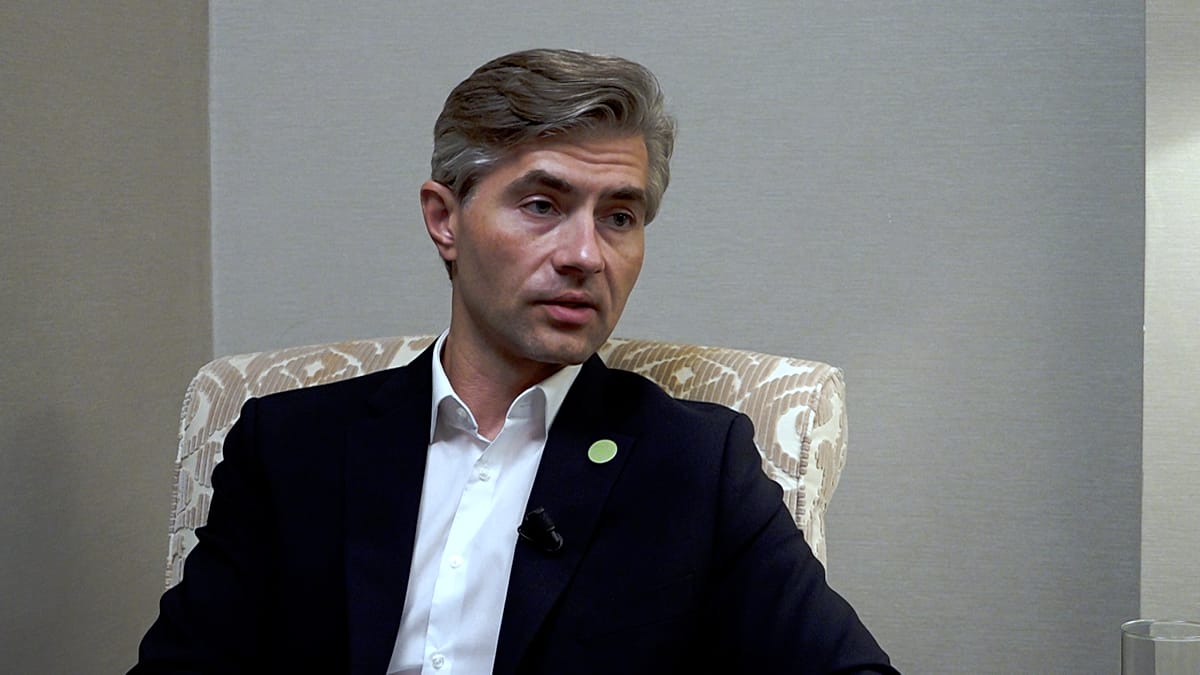
Previous deterrence measures implemented by Brussels against Russia have so far failed to prevent it from carrying out attacks against European countries, intensifying the threat the country poses to the bloc, Lithuanian Foreign Affairs Minister Kęstutis Budrys told Euronews.
His comments come days after Germany attributed the presence of a drone rigged with explosives near a Ukrainian Antonov cargo aircraft at Leipzig/Halle Airport, which plays a key role in the transport of military goods, to Russia. The Kremlin has rejected these accusations.
While Budrys applauded Berlin’s response to the incident, which involved handing Germany’s intelligence services greater powers to counter attacks, he argued the overall response from the European Union has fallen short.
“The German services, security intelligence services, they acted really quickly, they prevented this plot, this state terrorism act, and they attributed it to the country and the services responsible for it, so it is a good sign that we have [these] capabilities,” the Lithuanian minister said on Euronews’ interview programme 12 Minutes with.
However, he argued that the Leipzig operation — the latest in a string of attempted attacks and suspected acts of sabotage by Russia against EU countries in recent months — showed that the measures taken so far to combat threats posed by the Kremlin were insufficient.
“For Russia, our previous responses were not enough to recalculate the whole situation, meaning they are not deterred,” Budrys said.
“Russia still sees this as a sort of cheap way to increase the tension in our society, to raise questions of whether we should continue our support for Ukraine. And it means that Russia, highly likely, will escalate [its attacks] in the future.”
This was echoed by European Commission President Ursula von der Leyen on Wednesday. She warned that such incidents had become the “new normal,” and that the EU has to “step up and that means being ready to respond to Russia’s recklessness faster and better.”
Visa limits and increased sanctions
Budrys referred to the recent attacks as kinetic (involving traditional weaponry) rather than hybrid, which he said refers more to disinformation campaigns and cyberattacks.
“How we are stopping it on the field is through our counterintelligence capabilities, our security and intelligence services, which must be strengthened,” he said, adding that pressure must also be increased on the political and economic fronts.
After blaming Russia for the drone sabotage at the German airport last month, Berlin took steps on this front, ordering the closure of the Russian consulate in Bonn, terminating the contract for the Russian House in Berlin, and announcing tougher entry controls for Russian nationals.
Restricting the movement of Russians was also discussed at a meeting of EU foreign ministers in Wicklow, Ireland. Russian nationals lost access to multiple-entry Schengen visas in November 2025.
“It cannot be that such a huge number of Russian tourists are still travelling right now in the European Union,” Budrys said. More than 477,000 tourist visas were granted to Russian nationals last year.
“How is it that citizens of a country that wages these activities can still travel here? So we have to restrict those,” he added.
Following Wednesday’s meeting, EU foreign policy chief Kaja Kallas said EU member states agreed to press ahead with tougher visa restrictions for Russian tourists and a visa ban for former and current members of the Russian army across the bloc.
Germany’s Foreign Minister, Johann Wadephul, also vowed to increase pressure on Moscow’s shadow fleet, a group of ageing tankers used by the Kremlin to evade Western sanctions on its oil industry.
Von der Leyen confirmed this week that the EU was preparing additional sanctions against Russia. These are expected to be prepared by foreign ministers at their next meeting.
“We have to increase our sanctions on Russia to show that we are not intimidated and that we won’t stop our support for Ukraine,” Budrys said.