
Close Menu
Daily Guardian EuropeDaily Guardian Europe
  • Home
  • Europe
  • World
  • Politics
  • Business
  • Lifestyle
  • Sports
  • Travel
  • Environment
  • Culture
  • Press Release
  • Trending
What's On

‘Never too late’: Science-led policy can reverse ocean damage, says Abu Dhabi environment chief

February 13, 2026

Europe’s open-border dreams meet German politics – POLITICO

February 13, 2026

Watch the video: Love is all around us — but babies are not?

February 13, 2026

US orders its largest aircraft carrier to Middle East in show of force to Tehran

February 13, 2026

International astronauts launch to ISS after NASA’s first medical evacuation

February 13, 2026
Facebook X (Twitter) Instagram
Web Stories
Facebook X (Twitter) Instagram
Daily Guardian Europe
Newsletter
  • Home
  • Europe
  • World
  • Politics
  • Business
  • Lifestyle
  • Sports
  • Travel
  • Environment
  • Culture
  • Press Release
  • Trending
Daily Guardian EuropeDaily Guardian Europe
Home»Lifestyle
Lifestyle

ESA satellite finds ‘inside-out’ planetary system that challenges formation theories

By staffFebruary 13, 20263 Mins Read
ESA satellite finds ‘inside-out’ planetary system that challenges formation theories
Share
Facebook Twitter LinkedIn Pinterest Email
By&nbspRoselyne Min&nbspwith&nbspAFP

Published on
13/02/2026 – 12:57 GMT+1

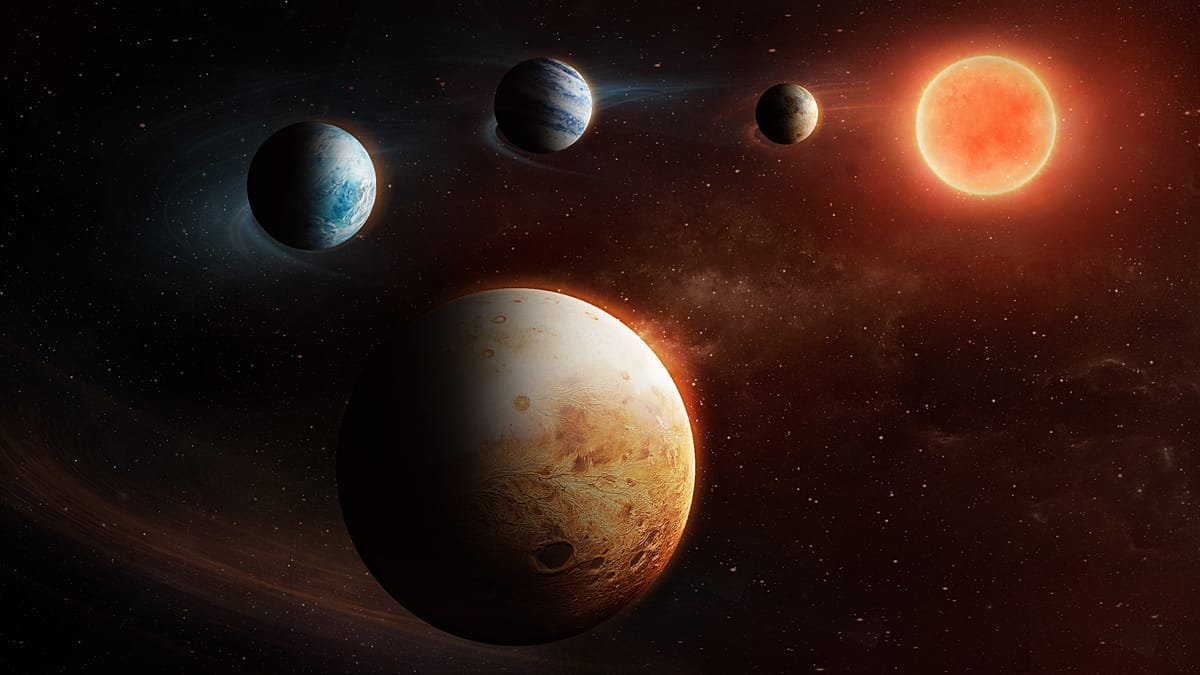
Astronomers say they have discovered a distant planetary system with planets arranged in a surprising order, challenging long-standing ideas about how planets form.

In our Solar System, the four planets closest to the Sun are small and rocky, while the four farther away are large gas giants. Scientists have long believed this pattern — rocky planets near the star and gaseous planets farther out — was common across the universe.

However, a star called LHS 1903 discovered in the Milky Way’s thick disc suggests otherwise.

In a collaborative effort involving researchers across Europe, astronomers analysing data from several telescopes had already identified three planets orbiting the red dwarf star, which is cooler and dimmer than our Sun.

The closest planet to the star was rocky, followed by two gas giants. That is the order scientists expect.

But digging into observations made by the European Space Agency (ESA)’s exoplanet-probing Cheops space telescope revealed a fourth planet farther from the star. Surprisingly, this outermost planet also appears to be rocky.

“That makes this an inside-out system, with a planet order of rocky-gaseous-gaseous-and then rocky again,” Thomas Wilson, the lead author of the study and a planetary astrophysicist from the University of Warwick in the United Kingdom, said in a statement with ESA.

“Rocky planets don’t usually form so far away from their home star,” Wilson added.

One planet after another

Inner planets are expected to be small and rocky because intense radiation from the nearby star blasts most of the gas away from their rocky core.

But farther out in the cold reaches of the system, a thick atmosphere can form around cores, creating gas giants.

Trying to explain the unusual LHS 1903 system, researchers tested several possibilities before proposing a new idea: the planets may have formed one after another rather than all at once.

According to the currently most widely accepted theory, planets form simultaneously in a massive ring of gas and dust called a protoplanetary disc.

This involves tiny dust grains clumping together, then snowballing into cores that eventually evolve into mighty planets.

But in this system, scientists believe LHS 1903 may have formed after most of the gas had already disappeared.

“Yet here is a small, rocky world, defying expectations,” Wilson said.

“It seems that we have found the first evidence for a planet which formed in what we call a gas-depleted environment,” he added.

Since the 1990s, astronomers have discovered more than 6,000 planets outside our Solar System, called exoplanets, mostly by spotting slight changes in brightness as they cross in front of their star.

“Historically, our planet formation theories are based on what we see and know about our Solar System,” said Isabel Rebollido, a planetary disc researcher at ESA.

“As we are seeing more and more different exoplanet systems, we are starting to revisit these theories.”

Share. Facebook Twitter Pinterest LinkedIn Tumblr Email

Keep Reading

International astronauts launch to ISS after NASA’s first medical evacuation

From Baikonur to Beijing: How Kazakhstan is carving out new space horizons

Can Europe’s infrastructure handle the AI boom?

European Commission, Interpol and 100 others call to outlaw AI nudification tools

Women in tech at Web Summit: Next decade’s mission is closing the gap

Cisco president warns AI agents need ‘background checks’ like human employees

Cyprus connects to Greek supercomputer as it enters AI race

Meta faces trial over child sexual exploitation claims as wave of lawsuits targets Big Tech

From AI chatbots to shopping and streaming: Which mobile apps are the most downloaded in Europe?

Editors Picks

Europe’s open-border dreams meet German politics – POLITICO

February 13, 2026

Watch the video: Love is all around us — but babies are not?

February 13, 2026

US orders its largest aircraft carrier to Middle East in show of force to Tehran

February 13, 2026

International astronauts launch to ISS after NASA’s first medical evacuation

February 13, 2026

Subscribe to News

Get the latest Europe and world news and updates directly to your inbox.

Latest News

UK ban on Palestine Action as terror group unlawful, High Court rules – POLITICO

February 13, 2026

Ukraine’s call to join EU in 2027 forces major re-think of enlargement rules

February 13, 2026

Brussels government reaches coalition agreement after 600-day deadlock

February 13, 2026
Facebook X (Twitter) Pinterest TikTok Instagram
© 2026 Daily Guardian Europe. All Rights Reserved.
  • Privacy Policy
  • Terms
  • Advertise
  • Contact

Type above and press Enter to search. Press Esc to cancel.