
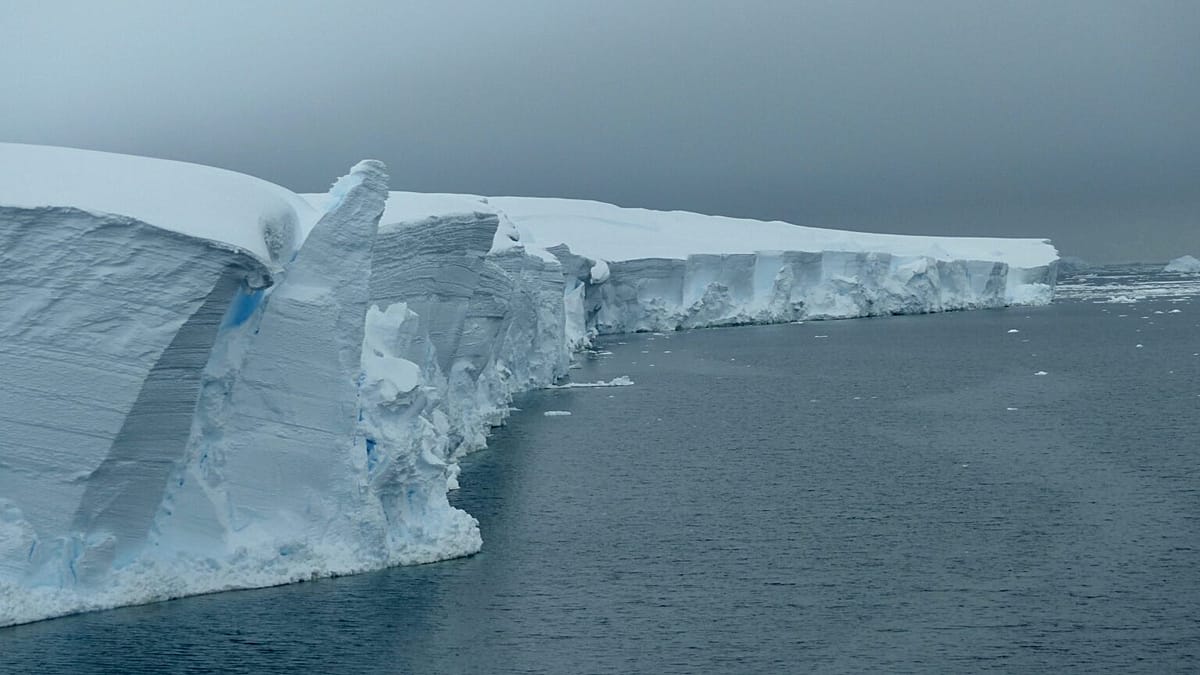
A global group of scientists, engineers and policy experts has unveiled an ambitious plan to build a wall along the ‘Doomsday Glacier’ as flooding fears continue to grow.
Located on the West Antarctic Ice Sheet, Thwaites Glacier earned its apocalyptical name due to its potential impact on sea levels. Covering a vast 192,000 km², making it comparable in size to Great Britain, the glacier is melting at an unprecedented rate due to human-fuelled climate change.
Already, four per cent of the world’s annual sea level rise is due to Thwaites’ current ice loss, as heat-trapping gases continue to bake the planet. If it were to collapse completely, sea levels could increase by a staggering 65cm. For every centimetre of sea level rise, around six million people on the planet are exposed to coastal flooding.
But can the consequences of climate change really just be barricaded off?
Building a wall along the Doomsday Glacier: Is it possible?
The Seabed Anchored Curtain Project aims to limit sea level rise by creating physical barriers that would protect ice sheets from warm ocean waters that flow beneath the fringing ice shelves. It argues that a reduction in greenhouse gases alone will not be enough to stabilise the ice sheet.
Researchers and engineers from Cambridge University, the University of Chicago, Alfred Wegener Institute, New York University, Dartmouth College, NIVA, Aker Solutions, and the University of Lapland’s Arctic Centre are teaming up to design a curtain around 152 metres tall and 80km long.
It’s a bold plan, one that will take years to achieve if it ever comes to fruition.
The team has established a roadmap that includes a three-year research program to design curtains and moorings, decide on which materials could be used, and to construct and test the technology to make sure it can restrict warm currents.
Already, mooring data is being retrieved from the Thwaites Glacier, while a fundraising campaign aims to raise $10 million (around €8.4m).
“Over the current three-year program, we will target the technology development, engineering, and the scientific testing of prototypes deployed at a fjord site in Norway,” the Seabed Curtain Project says. “In parallel, we will continue to develop our relations with Indigenous peoples of the Arctic and representatives of the most affected countries in the global south.”
Drilling into the Doomsday Glacier
Researchers from the UK and Korea recently reached the most inaccessible and least-understood part of Thwaites Glacier, where they will drill one metre deep into the ice to directly observe how warm ocean water is melting it from below.
Over the next two weeks, the team will use a hot water drill to bore through the ice and deploy instruments that will send back the first real-time data from the location. It marks the first time that hot water drilling has taken place on the main trunk of the Thwaites ice shelf – an area notorious for its crevasses and quick movements.
“This is one of the most important and unstable glaciers on the planet, and we are finally able to see what is happening where it matters most,” says Dr Peter Davis, a physical oceanographer at the British Antarctic Survey.
“We’ll be watching, in near real time, what warm ocean water is doing to the ice 1,000 metres below the surface. This has only recently become possible – and it’s critical for understanding how fast sea levels could rise.”
The team has two weeks to complete drilling. Once the instruments are in place, they will send data each day for at least one year via Iridium satellites, providing scientists with a “never-seen-before look” into the processes driving change at one of Earth’s most important glaciers.