
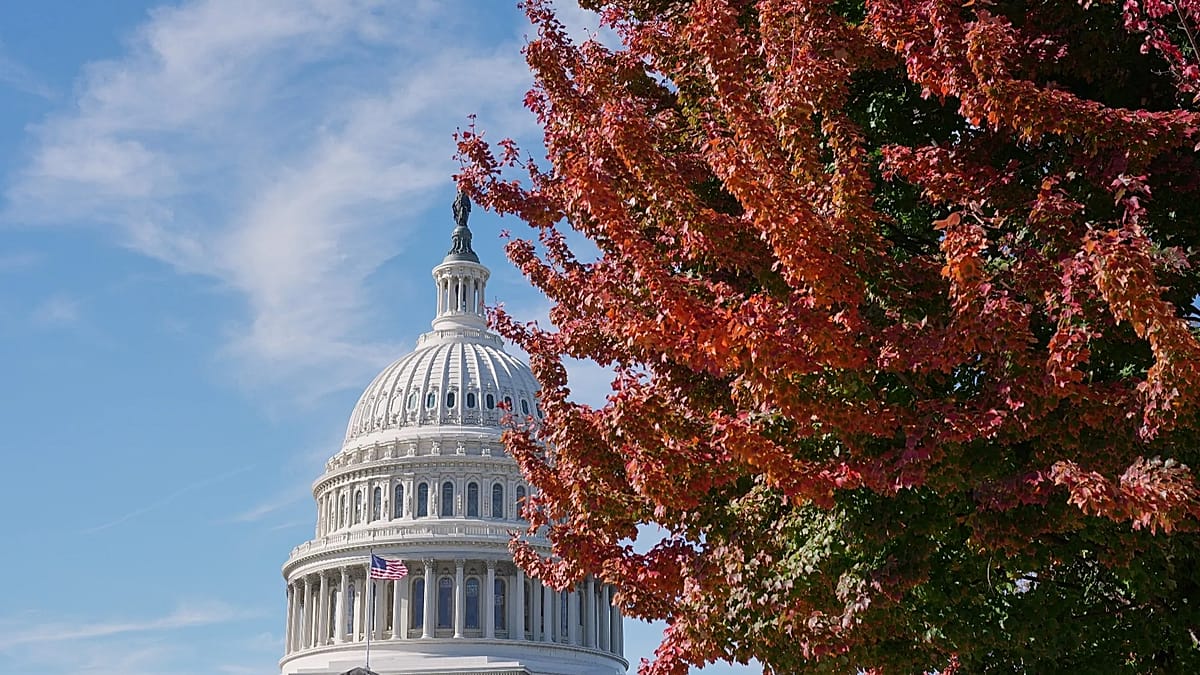
Two years ago, Hakeem Jeffries was a minority leader watching Republicans run the table in Washington. He is now the presumptive Speaker of the House, the most powerful member of Congress, and is expected to take the gavel in January.
By Tuesday, projections showed Democrats winning 254 seats to the Republicans’ 165, with 16 races still to be called. NBC News projects they will finish with 259, which would be the party’s biggest majority in more than three decades.
A narrow one would have handed a dozen or so left-wing members a veto over his speakership and his agenda, and several incoming Democrats are still withholding their support. He can now afford at least three dozen defections.
The same arithmetic works on legislation: he can lose his party’s fringe on a bill and still pass it. Jeffries is set to become the first Black speaker in American history, and he inherits the two things this White House fears most from a Democratic House: control of spending and the power to subpoena.
Loser: Donald Trump
For two months, Donald Trump told voters to “pretend I’m on the ballot.” He took that message to Texas, Iowa and Kansas, states where his party should never have needed the help. Voters did as they were asked. Trump won Texas by 13.6 points in 2024. Democrat James Talarico won it by 12 last week. Kansas swung 21 points towards the Democrats, and South Carolina swung 22.
Mississippi, a state Trump won by 23 points, is still too close to call. About 24 hours after his last plea, the president posted that he “wasn’t on the ballot, and if I was, we would have won IN A LANDSLIDE!”
The exit polls disagree. His approval among midterm voters stood at 37%. Many of his voters also appear to have stayed home: Trump voters made up 44% of last week’s electorate, well short of the 49.8% of the vote he won in 2024. Trump has blamed weak candidates.
The trouble is most of them were his. He endorsed Ken Paxton over a sitting senator, handpicked Darline Graham and backed Michael Whatley. “It wasn’t me” is a hard sell when your name is on every endorsement.
Winner: Moderate Democrats
If Democrats had a strategy, it was to be boring in all the right places. In Kansas, they ran Adam Hamilton, a first-time candidate who leads the largest United Methodist church in the US. In South Carolina, a paediatrician.
In North Carolina, a former two-term governor. In Iowa, a state lawmaker and four-time Paralympian who promised to work with Trump on border security. Independents were ready to punish Trump, and boring gave them a safe place to land.
Kamala Harris won independents by just three points in 2024. Last week, Democrats won them 58% to 38%, a 20-point margin. Roughly two-thirds of moderates backed Democrats for the House, up from about six in 10 for Harris.
Even Talarico, more liberal than most of the other seat-flippers, won Texas with a friendly, centrist pitch, taking about two-thirds of moderates, most independents and roughly one in 10 Republicans.
In Mississippi, District Attorney Scott Colom leads Senator Cindy Hyde-Smith by about 2,500 votes, and that race is likely headed for a legal fight.
Losers: Ken Paxton and the MAGA picks
Trump’s own advisers warned him that Ken Paxton carried too much baggage. He endorsed him anyway, calling the scandal-plagued attorney general “a true MAGA Warrior” and helping him push Senator John Cornyn out in the May runoff.
In October, Trump said he had no regrets because “Cornyn would have lost.” We will never know. We do know Paxton lost by 12 points in once-red Texas.
The pattern repeated across the map. Majorities of voters in Iowa and Ohio said their Republican candidates were “too supportive” of Trump, and most North Carolina voters said the same of Whatley, the former Republican National Committee chairman. Nationally, 6% of Republicans voted for Democrats.
That sounds small until you get to Texas, where about one in 10 crossed over. When your own voters walk across the aisle at that rate, the problem is not the ground game. It is the candidate and the message.
Winner: Progressive Democrats
The moderates won the map, but the progressive left won the primaries and a fair number of general elections too. Abdul El-Sayed, a Bernie Sanders ally, beat Mike Rogers in Michigan to become the first Muslim elected to the Senate.
Peggy Flanagan held Minnesota and Troy Jackson unseated Susan Collins in Maine, both from the party’s progressive wing. In 2010, a Tea Party wave swept into Washington, and its heirs went on to form the Freedom Caucus and make life miserable for Republican speakers.
The new progressive class could build the same kind of bloc and do the same to Jeffries. Majorities are easier to win than to manage.
Loser: The Graham name in South Carolina
For 23 years, Graham meant South Carolina’s Senate seat. After Lindsey Graham unexpectedly died in July, his sister Darline took over as interim senator and became Trump’s handpicked candidate to keep the seat in the family.
It did not go to plan. She flubbed a foreign policy question on the debate stage, and about two-thirds of voters said she lacked the right experience.
Even some Republicans hesitated. Others split their tickets, backing Republican Alan Wilson for governor but not Graham. Annie Andrews, a paediatrician, became the first Democrat elected to the Senate from South Carolina since Fritz Hollings in 1998.
The family name carried a seat for two decades. It could not carry this campaign.
Winners: Kyiv and Brussels
The Kyiv Independent’s headline said it plainly: “Democrats seize control of Congress in blow to Trump, potential boost for Ukraine.” A Democratic Congress holds the purse strings, and a Democratic Senate will be in no mood to wave through a deal that leaves Ukraine short.
German Foreign Minister Johann Wadephul said he was optimistic both parties would now engage more with each other to boost backing for Ukraine.
Brussels will also note that tariffs proved a liability at the ballot box, with 66% of voters saying they hurt the US economy. Ukraine is one of the few places Trump could throw Democrats a bone, claim a bipartisan win and look like a dealmaker in the process. Whether he prioritises it over Israel and Iran is another matter.
Loser: JD Vance
JD Vance went into election day as a Republican front-runner for 2028. He comes out of it as vice president during a historic defeat. The morning after, he offered his own verdict: “The reason we lost is the war.”
It is a rare thing for a vice president to say about his own president’s war in Iran, and Republican primary voters will read it either as courage or as a man reaching for the exit.
Some on the right have already chosen the second reading. A Washington Examiner op-ed called him “fundamentally unfit to lead the Republican Party”.
It did not help that, asked a week before the election by a young Republican how her generation could afford to start a family, Vance opened with a joke about Jon Husted’s backside. Husted lost Ohio. The seat he was defending was Vance’s old one.
Winners: James Talarico and Jon Ossoff
Every wave produces its stars, and this one produced two. James Talarico, a 37-year-old state lawmaker, ended a Democratic drought of more than 30 years in Texas statewide races and summed it up in five words: “We just took back Texas.”
Jon Ossoff, 39, did the harder thing in a wave year and made Georgia look easy. He beat Mike Collins by 18 points in a state Trump won two years ago, after raising $126 million more than his opponent.
Ossoff insists he has “zero interest in running for president.”
Washington has heard that before. Both men will spend the next two years fielding questions about 2028, and both will enjoy it more than they let on.
Loser: Trump’s inner circle
Robert Garcia, who will chair the House Oversight Committee, summed up his plans in two words on election night: “Lawyer up.” His first target, he says, is “the Trump Crime Family.”
World Liberty Financial, the Trump family’s crypto company, tops that list, along with the Emirati royal nicknamed the “Spy Sheikh”, who bought a $500 million stake in it.
Donald Trump Jr.’s venture firm, 1789 Capital, is next in the queue. Jamie Raskin, set to chair the Judiciary Committee, says Don Jr. “seems to have a clairvoyant sensibility of exactly who is going to get government contracts.”
Jared Kushner, Raskin says, “is a corporate executive that we absolutely will need to talk to.” Aides are on the list too.
Garcia says Attorney General Todd Blanche could face a subpoena on “day one” and has promised quick action on alleged pay-to-play involving Kristi Noem and Corey Lewandowski. The White House can lean on executive privilege. The family businesses and their backers cannot.
Winners: Ad-makers, TV stations and, finally, viewers
OpenSecrets projects this will be the most expensive midterm in American history, at $11.9 billion, about a third more than in 2022. Ohio’s Senate race topped $500 million on its own, more than $100 for every vote cast.
For the ad-makers, consultants and local TV stations of Ohio, Texas and Georgia, Christmas came in October.
The real winners, though, are viewers, who can now watch the evening news or a football game without being told someone’s opponent wants to destroy America. Enjoy the quiet. The 2028 primaries start sooner than anyone would like.
Loser: Americans who want Washington to get something done
Voters sent Washington a to-do list last week. Washington is about to lose it. About eight in 10 registered voters told an AP-NORC poll last month that lowering the cost of living should be one of Congress’ highest priorities, and roughly seven in 10 said the same of ending the war with Iran.
About half said the same about finding common ground between the parties. What they will get is a stand-off.
Trump has already told Fox News what happens next: “They’ll send over things that are insane, and I’ll veto them.” Democrats are well short of the two-thirds needed to override him, and Senate Republicans still have the numbers to filibuster.
That leaves the executive order, even though 71% of voters told exit pollsters they want Congress to provide more checks and balances on the president. Add the investigations, and expect a lot of hearings and very few laws.
Three-quarters of voters already disapprove of Congress, according to the NBC News Exit Poll, and two years of gridlock will not change that. Prices, the war, the deficit and immigration will mostly be kicked down the road to 2028, by which point everyone will be campaigning again.