
Starting with culture to stabilise the Middle East. It is a political proposal put to the European Union by several Syrian intellectuals, mainly those now living in Europe, such as the Syrian linguist and musicologist Nabil Al Lao, former director of the Damascus Conservatory, later founder and superintendent of the opera house in the Syrian capital between 2003 and 2010.
“The EU countries, especially France, Germany, Italy and Spain, have the tools to launch a cultural policy in the Levant with an initial, visible impact that could evolve into a concrete, broader political process,” Professor Al Lao tells Euronews.
This would be a strategy that goes beyond traditional cultural policies. Its aim is to turn the theatre of war into an archaeological landscape, combining the recovery of cultural heritage with civil infrastructure projects to involve populations exhausted by years of war and heal mutual mistrust.
It is not simple cultural diplomacy but a realistic strategy designed to create new civil and political balances in a country struggling to emerge from a bloody inter‑communal war that began in 2011 and officially ended in late 2025 with the fall of the Assad dynasty regime, whose deep‑rooted causes, however, remain unresolved.
From Assad’s interpreter to refugee: the story of a return?
Nabil Al Lao is not only a musicologist but also a renowned Arabist and a specialist in French studies. In addition to Italy, he has lived in France, in Paris and Lyon. He also served as the official French-language interpreter for Rais Hafez al-Assad and later for his son Bashar. Al Lao took part in past bilateral meetings with French presidents Nicolas Sarkozy and Jacques Chirac. The Syrian professor remembers Jacques Chirac as “a man of great culture and profound political refinement”.
It was Nabil Al Lao who translated from French into Arabic the live conversation in which Chirac urged Bashar al-Assad not to kill former Lebanese Sunni prime minister Rafiq Hariri, detested by Hezbollah.
Despite the message from the Élysée, Hariri was killed in 2004 in an attack in Beirut, apparently inspired by the intelligence services in Damascus.
“The deadly attack on Hariri was the regime’s point of no return, definitively wiping out any hope of rebuilding a stable relationship with Europe based on some form of internal democratisation.”
It was in those years, as superintendent of the Damascus Opera, that Al Lao became convinced of the importance of giving a cultural foundation to a broader peace process in the Middle East.
In 2004 he managed, almost clandestinely, to send a group of young Syrian musicians to Ramallah to perform together with Israeli and Palestinian musicians of their own age. The occasion was a concert organised by the great conductor Daniel Barenboim, of Argentine origin but an Israeli, Spanish and Palestinian citizen, together with Edward Saïd, the famous Palestinian-American intellectual, who died just a few months after the major musical event in Ramallah.
“You are welcome here, Professor Saïd”
The orchestra was called the East-West Diwan, after the title of Johann Wolfgang von Goethe’s collection of poems.
Nabil Al Lao still remembers Edward Saïd’s phone call suggesting he send young Syrians to play with Israelis and Palestinians: “He introduced himself, saying he was at the Syrian-Lebanese border. He wanted to meet me in Damascus and simply needed an invitation.” So, with great simplicity, Nabil Al Lao replied: “You are welcome, Professor Saïd”.
The young Syrian virtuosos played in Ramallah with their Palestinian and Israeli counterparts. The escapade cost Nabil Al Lao a reprimand from a senior official in Bashar al-Assad’s intelligence services.
“They could not do anything to me, because the idea for the orchestra came from the then King of Spain, Juan Carlos, who at the time maintained cordial relations with President Bashar al-Assad.”
Years later Al Lao had to leave Syria, gripped by civil war, after falling out of favour with Bashar al-Assad and his entourage of security men, perpetually “at war with each other” and among the many sponsors of some ISIS factions, the professor reveals. “I discovered this when they captured me in 2013: they were regime security men disguised as Islamic State militiamen.” They too took part, directly and indirectly, in the devastation.
From Syria to Lebanon
The reconstruction of the ancient, millennia-old Mesopotamian and Levantine culture, which also underpins European civilisation, could become a unifying force for a country made up of multiple ethnicities and religions that have suffered for decades from deep identity crises, putting at risk the territorial integrity of states in the region.
“Such a strategy could even bring Syria and Lebanon into a shared project for the first time in more than half a century,” says Professor Al Lao, referring to the recent damage inflicted on the Greco-Roman archaeological heritage of Baalbek, ancient Heliopolis in the Beqaa Valley in Lebanese territory.
Beyond the hundreds of deaths, thousands of displaced people and damage to civil infrastructure, the war between the Israeli Defence Forces and Hezbollah militias has also struck the ancient stone remains.
At least since the second half of the last century, Lebanon has been a theatre of conflict, violent incursions and rivalry between the Syrian regime of the Assad family, Israel, Iran and other players, from the Cold War through to the latest rounds of fighting.
For Nabil Al Lao, whose father is Syrian and mother Lebanese (both Sunni Muslims), a European project extending from Syria to Lebanon would heal old wounds between the two countries:
“The EU could, for example, start by bringing back into operation the old Damascus–Baalbek railway line, built in the days of the Ottoman Empire and abandoned for more than fifty years.” According to Al Lao, it would mean restoring value to a historic heritage (the epic story of the great Levant railways) while providing an essential public transport service for people living in those areas.
It is an 80-kilometre stretch of the railway that linked Damascus’s Hejaz Station to Beirut, put into service by the Ottoman authorities in 1895.
For its time it was a feat of railway engineering that crossed two peaks in the Anti-Lebanon mountain range, climbing to an altitude of 1,400 metres.
It was built with French capital and engineering, Swiss locomotives and the active involvement of the emerging productive forces of Damascus and Beirut.
Mesopotamian devastation
The damage to Syria’s cultural heritage has been among the most severe, and often irreparable, in the Middle East.
Aleppo, Palmyra, Damascus and the outlying regions of what was once the Assad dynasty’s country conceal treasures that have suffered destruction and looting at the hands of the iconoclastic fervour of ISIS jihadists and traffickers of artworks acting for third parties.
Today, Nabil Al Lao lives in Arona, on the Italian shore of Lake Maggiore, where he is preparing an important trip to Damascus, his home city. He hopes to meet senior officials from the culture and national education sectors of the current transitional government, led by President Ahmad al-Sharaa, to put forward a number of proposals for Syria’s reconstruction.
Al Lao says that the restoration of a unitary Syrian state could begin precisely with the ancient city of Palmyra: “Rebuilding Palmyra is possible within the framework of a European or international project. However, it is better that it be European, because almost all the technical surveys and classifications of Palmyra are in the hands of the French, Italians and Germans.”
The EU has for some years been providing financial support for UNESCO projects aimed at preserving Syria’s cultural heritage, both through common policies of the 27 and separately through bilateral initiatives by individual member states.
In 2025 the European Commission also allocated two and a half billion euros to support the country’s transition.
Dramatic times and the ironic encores of history’s theatre
Palmyra, also known in Syria as Tadmor, is one of the world’s main UNESCO sites, the ancient capital of Queen Zenobia’s caravan and trading kingdom. She broke away from the Roman Empire in 260 AD, proclaiming herself Augusta (a title reserved for Roman emperors) and heir to Cleopatra.
Tadmor lay halfway between the Roman Levant provinces and the Parthian Empire (the Persians), Rome’s rival power. To consolidate her newly won independence, Zenobia pursued a policy of rapprochement with the Parthians.
Rome saw this as an affront. After a siege, rebellious Palmyra was reconquered by Emperor Aurelian’s legions in 272 AD.
According to most historians, Zenobia was paraded in Rome as a prisoner in golden chains studded with precious stones and lived until her death in a villa in Tivoli as a Roman patrician. Other sources, however, claim she did not survive the humiliation of defeat and committed suicide, just like her political model Cleopatra, almost two centuries earlier.
Even 2,000 years ago, similar strategic games were being played in those regions to the ones we see today.
The Zenobia myth: gender history and social realism in today’s post-war Syria
Zeinab, the original name of Zenobia, stands as a symbolic figure of a woman ruling a prosperous and proud Mesopotamian kingdom in the 3rd century AD, wedged between two hegemonic powers.
Her figure, and the restoration of the ancient splendour of what was once Tadmor, would not only be a cold, albeit important, archaeological mission. It could play a highly symbolic role thanks to the charismatic figure of the Zenobia myth, at the head of a composite entity anchored in the history of Syria’s diverse cultural and ethnic components in the name of independence and unity.
Moreover, for Professor Al Lao, the memory of Zenobia and her kingdom “could also serve as an example for the female component of Syria”.
**“**There are now many more women than men in the country, because the hundreds of thousands killed in the civil war were overwhelmingly men. Women’s role therefore becomes essential in rebuilding Syria.”
According to official Syrian government figures, in 2023 women made up 60% of the population. Many men have been killed in fighting or have fled abroad.
Recent military conflicts and the monuments destroyed in Palmyra
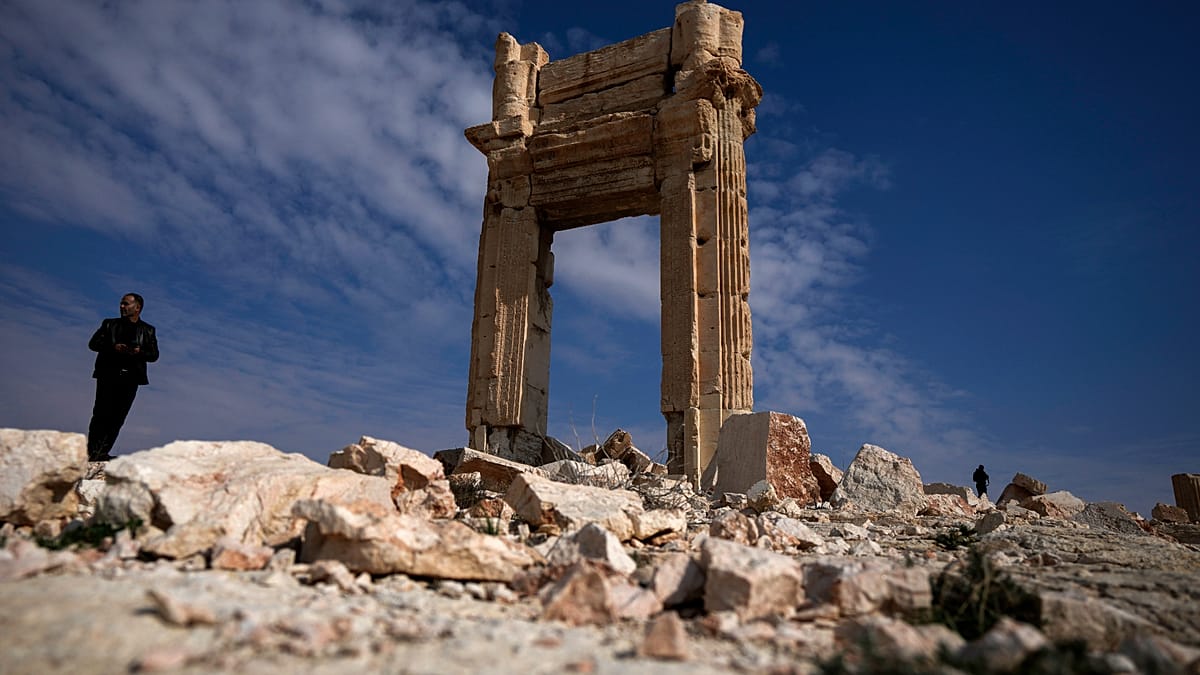
The Palmyra area was occupied by ISIS twice between 2015 and 2017. Because of deliberate destruction by jihadists, neglect during wartime and the fighting itself, the archaeological heritage has suffered damage that is sometimes irreparable. Here are some of them:
- The temples of Baal and Baalshamin (ancient pre-Christian and pre-Islamic Canaanite deities) were almost completely razed to the ground by the jihadists’ anti-idolatry zeal. The former was one of the main architectural vestiges among ancient places of worship in the Mesopotamian area, while the temple of Baalshamin dated back to the 17th century BC.
- Of the Triumphal Arch built by the Roman Emperor Septimius Severus, only the two side columns remain. The arch itself has been reduced to a heap of rubble now being pieced together by archaeologists. Although work is progressing slowly, UNESCO believes the stone blocks can be salvaged and reassembled.
- Funerary towers and monuments have also been almost permanently destroyed.
- The Palmyra archaeological museum suffered extremely serious damage and looting during the fighting between jihadists and the Russian expeditionary corps that retook Palmyra alongside Assad’s troops.
EU and Syria: cultural diplomacy as a substantial political factor
There are numerous groups of young archaeologists working in Syria: they are mainly Italians, French and Germans.
Fifty Italian universities are engaged in a determined effort to rebuild and to open up new archaeological sites.
“Syrian intellectuals and students in exile in Europe and Italy have made these initiatives possible thanks to their desire to return to their country of origin and save it through culture,” says Francesca Maria Corrao, Full Professor of Arabic language and culture at LUISS University in Rome.
Meanwhile, at Rome’s La Sapienza University, Professor Davide Nadali heads an archaeological project which he co-directs with his Syrian colleague Mohammed el Khalid**.**
They resumed excavations in 2022 after a twelve-year breakand have discovered new, important archaeological sites**,** especially in north-west Syria, in the area of Ebla (today Tell Mardikh), an ancient Mesopotamian city of the Eblaites, a pre-Assyrian civilisation. The first excavations date back to 1964 and were carried out by teams led by Italian archaeologist Paolo Matthiae.
For Professor Corrao there is currently no risk that former ISIS members, now within the security forces of the current transitional government in Damascus, might threaten the recovery of the assets destroyed by the groups they once belonged to.
“If the transitional government has announced urbi et orbi its decision to pursue a policy that takes account of the country’s different religious and cultural expressions, it will not set about destroying them, especially while an archaeological excavation is being funded,” Corrao says.