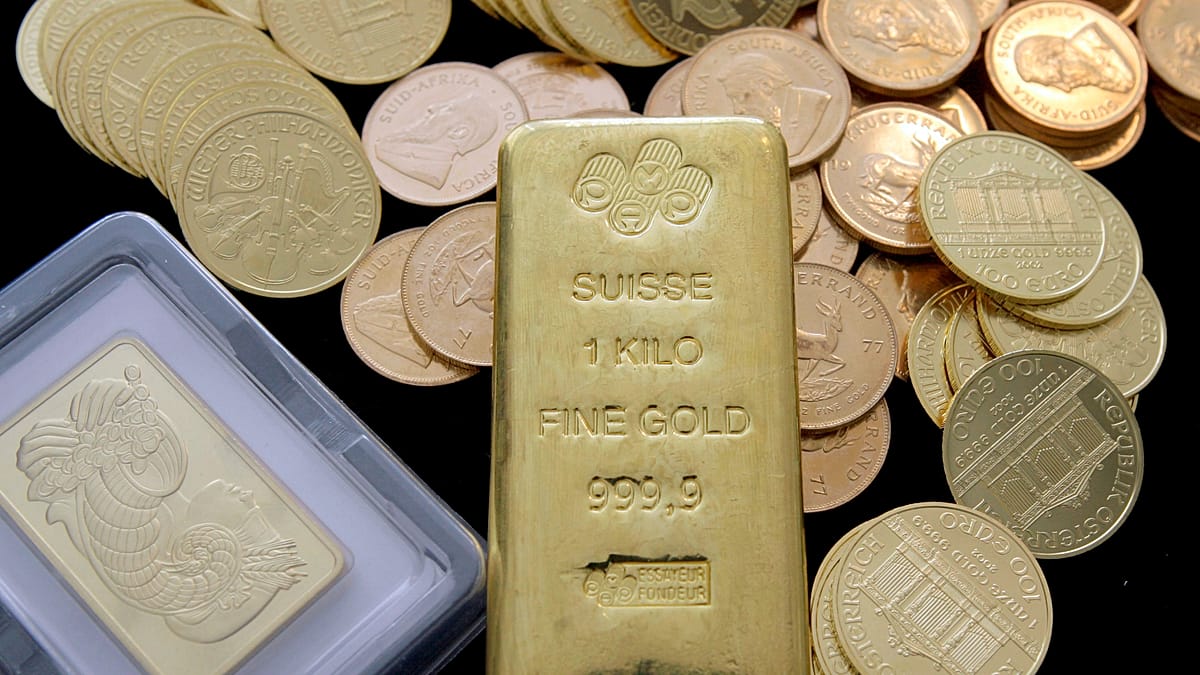



Marathon Fusion, a small fusion energy company in San Francisco, announced on Wednesday that it had transmuted, or converted, mercury into stable gold last month, beating a record set by CERN tenfold. The Geneva-based organisation runs the world’s largest particle physics laboratory.
The claim, which has not been independently verified, revives an alchemist’s dream and a market fear that lab-made gold could do to bullion what lab-grown precious stones did to diamonds.
Founded in 2023 by Kyle Schiller and Adam Rutkowski, a former SpaceX engineer, Marathon develops fuel systems for future fusion power plants, which aim to generate electricity by fusing atoms together, as the sun does.
It lists the US Department of Energy as a partner on its website and won a 2023 award from ARPA-E, the department’s agency for high-risk energy research.
Its backers include Breakthrough Energy, the climate technology network founded by Bill Gates, and Anglo American, the mining group that owns De Beers, the world’s leading natural diamond company behind the “A diamond is forever” slogan.
In its announcement, the company said it had turned “mercury into real, stable gold, beating CERN’s record by a factor of 10”.
In 2025, CERN said its Large Hadron Collider (LHC), the world’s most powerful particle accelerator, had created about 29 picograms, or 29 trillionths of a gram, of gold during its 2015–2018 run. That amounted to around 86 billion gold nuclei, or atomic cores, which existed for only a tiny fraction of a second before being destroyed in collisions with accelerator equipment.
Marathon’s method fires neutrons from fusion reactions at mercury, turning it into an unstable isotope, or form of the metal, that decays into gold.
It also claims to have broken a 40-year-old Soviet record with its plasma centrifuge, a machine that spins electrically charged gas at high speed to separate isotopes used in fusion fuel.
It says it is now building a reactor in San Francisco to achieve record power density, meaning the most power produced for its size.
The gold claim has not been independently verified, and the material available does not establish how much gold was produced or at what cost.
What happened to diamonds?
Lab-grown diamonds are chemically identical to mined stones.
Although specialists can tell them apart, factories churned them out and sold them for a fraction of the price.
Wholesale prices for lab-grown stones fell 90% to 95% from their 2015 levels, diamond industry analyst Paul Zimnisky said last year, while competition from lab-grown stones also weighed on mined diamond prices.
De Beers launched its own lab-grown brand, Lightbox, in 2018 at $800 (€712) a carat. However, it shut it down in 2025 to focus on natural diamonds.
De Beers made an underlying loss of $511 million (€455mn) in 2025, and Anglo American is in talks to sell its 85% stake for about $1 billion (€890mn) to a group led by former De Beers boss Gareth Penny, according to Bloomberg, citing people familiar with the matter.
Swiss luxury group Richemont, which owns Cartier, and US jeweller Signet, which owns Kay and Zales, are reportedly also in talks to join the group.
Why gold is different
Gold is a far bigger market.
Mines produced 3,672 tonnes in 2025, and about 222,600 tonnes have been mined throughout history, according to the World Gold Council.
Central banks also hold it in their reserves as a safe store of value, and many have been buying heavily in recent years, including those of China and Poland.
Gold traded at $4,062 (€3,617) an ounce on Thursday, more than 27% below its record high of $5,598 (€4,985) in January.
Marathon’s own 2025 study estimated that a fusion plant could make about 5 tonnes of gold a year per gigawatt of electricity, roughly the output of a large nuclear reactor.
On that basis, 100 such plants would add an estimated 500 tonnes a year, roughly 14% of last year’s mine output.
However, no fusion plant yet sells electricity, and the first commercial ones are still years away. The gold could also contain radioactive isotopes and might need to be stored for up to 18 years before it could be sold, the company has said.
There are currently no public plans to attempt to produce and commercialise the product, but unlike lab-grown diamonds, transmuted gold, once its radioactivity fades, would be impossible to tell apart from the mined kind.