



A trip to Mars could take months. So what happens if an astronaut develops a serious eye problem halfway there?
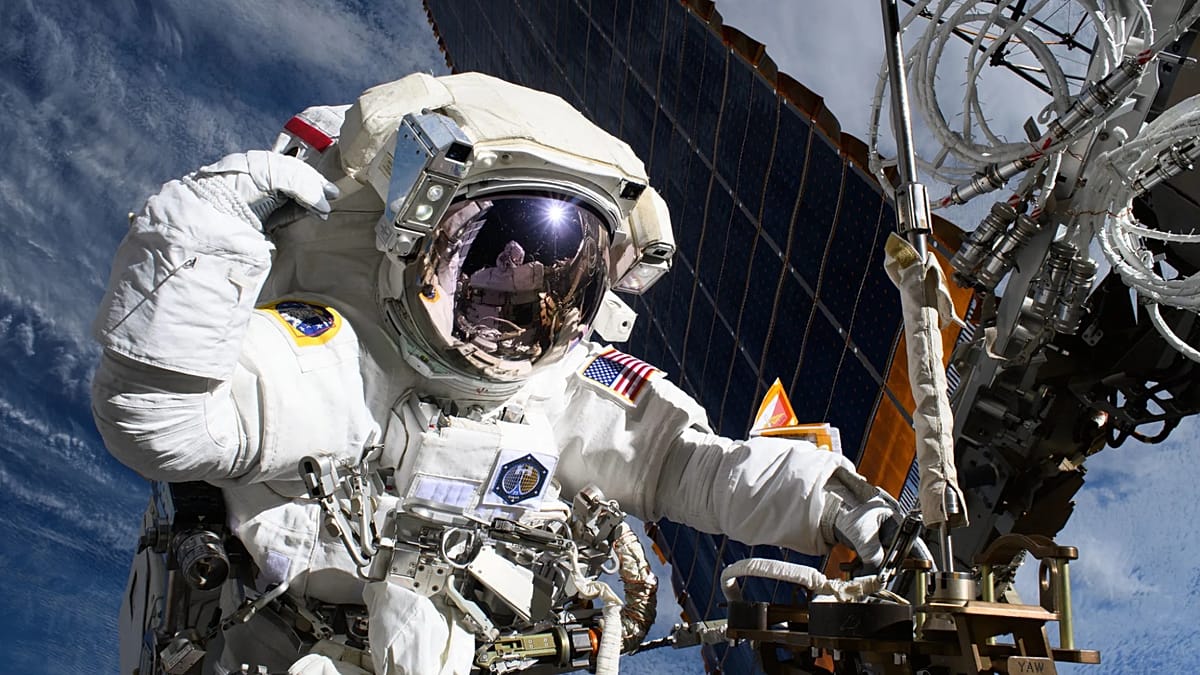
A team of researchers in the United States sent artificial lenses used in cataract surgery outside the International Space Station to find out whether the implants needed for future operations could survive the journey to places such as Mars.
Researchers behind the study believe someone will need cataract surgery on Mars in his lifetime.
“A Mars transit can require almost a year, and returning to Earth for a vision-limiting cataract, injury, or other surgical eye problem may not be realistic,” said Morgan Micheletti, an ophthalmic surgeon and director of research at Berkeley Eye Center in the US.
“Eventually, treatment will need to happen where the patient is.”
A cataract develops when the eye’s natural lens becomes cloudy. During surgery, doctors remove that lens and replace it with a clear artificial one called an intraocular lens.
Doing the same thing millions of kilometres from Earth would require someone capable of carrying out the operation, as well as equipment, sterile supplies and implants that survive the journey.
The idea also grew out of a fascination Micheletti has had since childhood.
“I have been fascinated by space for as long as I can remember,” he said.
“Once I became an eye surgeon, that fascination evolved into a more practical question. Could I perform surgery in space?”
What happened to the lenses in space?
For the project named JAMES, the team sent 135 unpackaged artificial lenses to the International Space Station.
They spent around six months outside the station in three positions, exposing them to different conditions — One faced highly reactive atomic oxygen, another received substantial ultraviolet radiation from the Sun and a third was partly shielded from both.
Another 45 unpackaged lenses remained on Earth for comparison.
After the space lenses returned, a team at the Intermountain Ocular Research Center at the University of Utah examined 61 of them alongside 20 of the lenses kept on Earth.
Most of the space-exposed lenses, 42 out of 61, showed no notable changes.
Of the other 19, eight acrylic lenses developed cracks and surface roughness consistent with erosion from atomic oxygen, while five developed yellow discolouration and let less light through at some wavelengths.
All six light-adjustable lenses, which can be fine-tuned with ultraviolet light after implantation, developed an unusual cobblestone or “bubble-wrap” appearance. Researchers do not yet know why.
That does not mean cataract implants would necessarily be damaged on a journey to Mars, researchers caution.
The lenses were deliberately unpackaged and exposed directly to the harsh environment outside the station to identify how they might fail. In reality, they would travel protected inside a spacecraft.
The next step is to work out how much packaging and shielding they need without adding unnecessary weight and volume.
How realistic is cataract surgery in space?
Cataract surgery beyond Earth remains a distant prospect.
The experiment tested how the artificial lenses withstand space conditions, not whether surgery itself could safely be performed there. Researchers also do not yet know whether the changes found in some lenses would affect vision or make them unusable.
Micheletti next wants to test the machine used in cataract surgery during short periods of microgravity on parabolic flights.
It uses ultrasound and fluid to break up and remove the eye’s cloudy natural lens.
If that works, he hopes to move towards longer microgravity tests and eventually a surgical experiment in orbit.
“The progression has to be deliberate. First the materials, then the equipment, then the procedure and, ultimately, the surgery,” he said.
“My long-term hope is to help make the first eye surgery beyond Earth possible.”
Findings from the experiment were presented at the European Society of Cataract and Refractive Surgeons congress in London on Sunday.
Researchers believe it is the first controlled experiment to expose multiple types of modern artificial eye lenses directly to the environment outside the International Space Station and return them to Earth for laboratory analysis.