
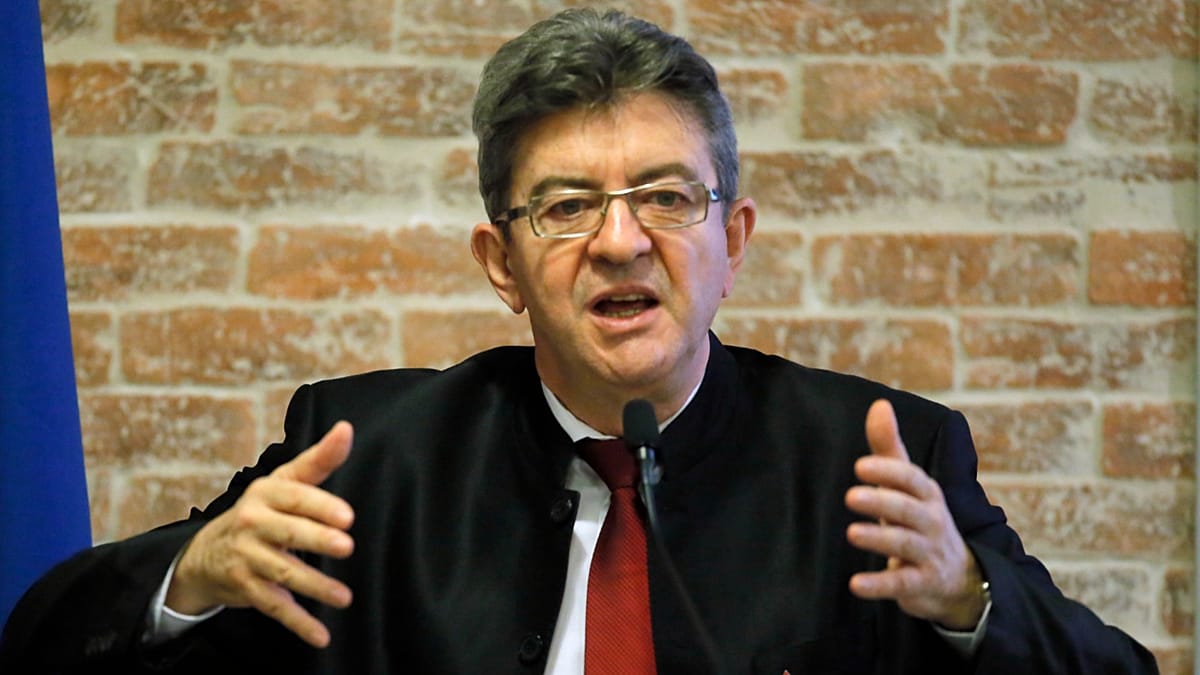
French far-left leader Jean-Luc Mélenchon has proposed to cancel a large chunk of France’s public debt, namely the 18 percent that is currently held by the country’s central bank. The rationale is to unlock money for public spending, but is this is even feasible?
Mélenchon, currently a candidate for the presidential elections in April 2027, and seen as a front-runner, first floated the idea during the COVID 19 pandemic and revived the controversial call this month while on the campaign trail.
“All we have to do is take the 18% held by the Bank of France and chuck it in the fire,” he said during a campaign speech, referring to roughly €600 billion.
His pitch has gained significant support from high-profile and left-leaning investment banker Matthieu Pigasse. In fact, Pigasse shared a stage with Mélenchon at a recent political rally of his party — France Unbowed (LFI).
“Public debt can be cancelled, as Jean-Luc said, without any economic or financial impact,” Pigasse said at the LFI rally last weekend to a large applause.
A well-known figure in France and within global financial circles, Pigasse advised the Greek government during its financial crisis, and recently helped Venezuela restructure its debt.
Yet, Mélenchon’s debt cancellation proposal triggered sharp rebukes from his political opponents and beyond.
Former EU Internal Market Commissioner Thierry Breton attacked it in an op-ed published Tuesday in the French financial newspaper Les Echos, noting such move would be legally impossible as the Bank of France is part of the Eurosystem governed by the European Central Bank and cannot independently cancel or erase bons.
France’s Economy Minister Roland Lescure said that Mélenchon was “talking absolute nonsense” and that his proposal would lead to another “financial crisis.”
“Cancelling the debt amounts to saying we won’t repay the people we owe money to […] behind the debt, there are savers, life insurance policies, and banks. If you say, ‘we’re cancelling it,’ you destroy trust,” Lescure told the French broadcaster BFM.
He too said such move would be illegal and a “gigantic middle finger” to the Eurozone as, by treaty, national central banks are prohibited from financing their own national governments.
Former International Monetary Fund Chief Economist Olivier Blanchard, who held the office during the Greek debt crisis in 2015, called the debate around the proposal “idiotic,” arguing that the effects of the debt cancellation would be negligible.
He shared on X that if the French Central Bank cancelled the government bonds it owns, the net effect would be zero. The state would save money on interest payments, but it would lose that exact same amount because the central bank would no longer send those profits back to the government.
Pigasse strongly criticised Blanchard’s remarks, accusing the former IMF top official of having mishandled the Greek crisis, which, he argued, resulted in spending cuts rather than earlier debt restructuring.
French economy set to dominate the electoral debate
The state of the French economy is set to dominate debates leading up the 2027 presidential election. With public debt now exceeding 116% of GDP, France’s next leader will inherit almost no fiscal breathing room.
This massive debt burden severely restricts public spending, forcing candidates to clash over how—or if—the state can afford investments needed in strategic sectors like artificial intelligence and defence.
The vote will take place against a deeply fractured political backdrop. A hung National Assembly with no stable majority leaves the government structurally paralyzed, turning the passage of routine legislation into constant political battles.
ECB President Christine Lagarde ruled out a presidential bid during a July interview with Euronews, though she indicated she may step down to provide economic guidance to the candidates.
On Thursday, the presidential race will kick off in earnest with a premier economic debate hosted by the powerful business lobby Medef and attended by seven French presidential hopefuls.
The lineup includes Mélenchon and National Rally’s Marine Le Pen, and his proposal is expected to be at the center of discussions. Ahead of the debate, Le Pen’s right-hand man Jordan Bardella called Mélenchon’s economic plan “nonsense.”
The National Rally has also faced longstanding criticism over the credibility of its economic programme. The party once openly advocated for France to leave the EU, but has since abandoned its so-called “Frexit” policy, following a shift similar to that in Italy.
For investors, a second-round presidential contest between Le Pen and Mélenchon would be seen as a high-risk scenario. Neither has a track record of managing a large national budget or of pursuing conventional economic policies.
Yet Le Pen’s focus on pouvoir d’achat — or the diminishing purchasing power of the working class — has strongly resonated with French voters.