
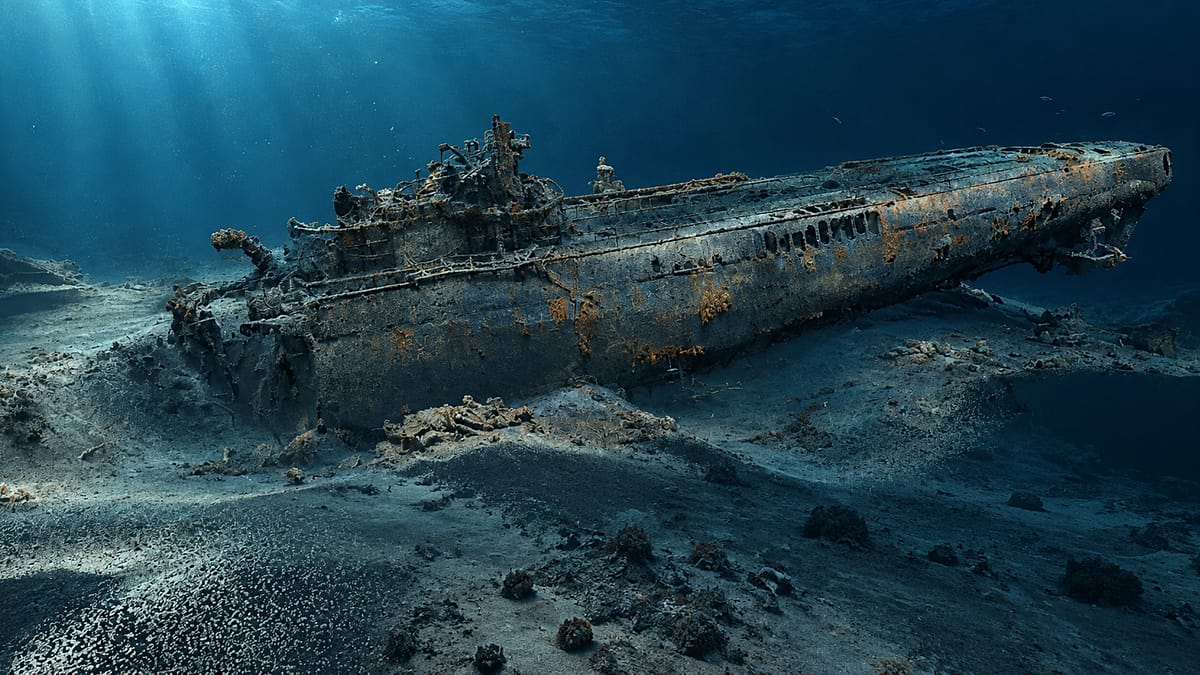
Around 150 metres below the water’s surface, west of the Norwegian island of Fedje, a fragment of German wartime history lies on the seabed. A submarine called U-864 has been resting there for more than eight decades, broken into two parts, surrounded by sediment and a cargo that still poses an environmental problem today.
U-864 is an exceptional case: according to historical records, large quantities of mercury were probably on board, with a Japanese order mentioning 1,867 containers.
If the entire shipment had been loaded, that would correspond to between about 65 and 67 tonnes. However, the exact loading documents have not survived, so the actual quantity cannot be definitively established. The only certainty is that mercury is still stored in the wreck.
A final voyage with a deadly end
By February 1945, the war was in its final phase. Even so, U-864 was still on a special mission. The German submarine was supposed to travel via Norway to Japan. On board, in addition to military and technical equipment, were specialists and material intended for Japan’s armaments industry. But the voyage ended off Fedje.
The British submarine HMS Venturer had decrypted German radio transmissions and tracked down U-864. On 9 February 1945, Venturer fired a torpedo. It hit the German submarine and destroyed it. U-864 sank to a depth of around 150 metres. All 73 people on board were killed. The attack is considered the only known case in which one submerged submarine sank another.
After that, the wreck was forgotten for decades.
It was not found until 2003
Only decades later did U-864 return to the spotlight: clues about the special cargo ultimately led to investigations off the Norwegian coast.
In 2003, the wreck was located by the Norwegian naval vessel KNM Tyr. It became clear that the submarine had not remained intact on the seabed. The two parts of the wreck lie separated from each other at a depth of about 150 metres.
The problem with the cargo is that mercury does not simply disappear. Mercury can remain in the environment for a very long time because, unlike many organic pollutants, it is not broken down biologically.
How long mercury persists in the environment depends on its chemical form and the prevailing environmental conditions. In contaminated sediments, it can remain for decades, in some cases even for centuries. The US environmental agency EPA points out that mercury can be released from soils for potentially hundreds of years.
Particularly problematic is the fact that micro-organisms can convert mercury into methylmercury. This especially toxic form accumulates in the food chain, especially in fish.
New images from the depths
New images released by the Norwegian Coastal Administration Kystverket (source in German) show what the wreck looks like today.
In May 2025, Kystverket had the wreck examined using remotely operated underwater vehicles. Among other equipment, WROVs (remotely operated underwater vehicles connected to a ship by cable), 4K cameras, photogrammetry and acoustic measurement techniques were deployed. The recordings were also used to create a three-dimensional model of the wreck and the surrounding seabed.
The submarine lies far below the surface of the water, partly embedded in sediment on the sea floor.
Dangerous cargo
Many of the presumed 1,867 containers are likely to have been damaged when the submarine sank.
A recovery operation could remove some of the mercury from the wreck, but the work itself could also stir up contaminated sediments and release pollutants.
This is exactly what the Norwegian authorities experienced during investigations and salvage work in 2026, when 22 containers were recovered from the wreck. Initial examinations showed that around 80% of the containers were damaged and leaking. Around half a tonne of mercury was brought ashore. At the same time, according to the Norwegian Coastal Administration, mercury was also released into the water from the working area.
Recover it or seal it for good?
Norway is therefore facing a dilemma. Should it try to retrieve the dangerous cargo from an 81-year-old wartime wreck lying at a depth of 150 metres? Or should the wreck and the contaminated seabed be permanently covered?
This question has been fiercely debated for years. In 2026, after its experience with the operations, Kystverket again recommended covering the wreck. In the authority’s assessment, a large-scale recovery could ultimately release more pollutants than it would remove.
Covering the wreck would not be a simple, final solution either: the cover would have to be monitored over the long term.
The people of Fedje live with the knowledge that just a few kilometres off their coast lies a German submarine whose cargo still raises questions. And while decades later, technology can now look deep inside the wreck, the crucial question remains unresolved: what should be done with it?
The Norwegian authorities have, incidentally, been analysing fish and shellfish from the region for years. So far, there appears to be no reason for undue concern: the tests have so far shown stable or low mercury levels.