
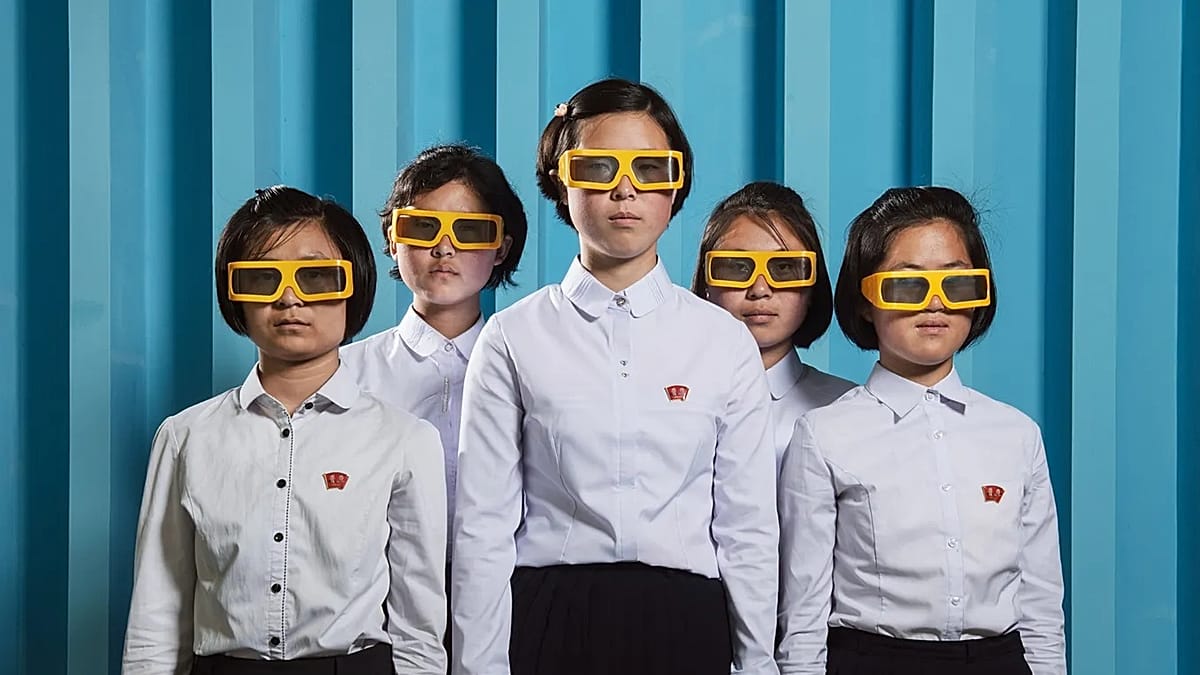
In a photograph, five schoolchildren stand before a blue wall. Their starched white shirts throw them into sharp relief. From behind the tinted lenses of their bright yellow sunglasses, they look directly at the viewer. Just as the viewer looks at them.
When French photographer Stephan Gladieu’s request to travel to North Korea was approved, he knew he wanted to focus on capturing the country’s people. “I made it clear from the beginning that I will not do architecture photography or photograph empty places—that had no interest for me,” Gladieu tells Euronews Culture.
“I wanted to give a representation of North Korean people, knowing that the North Koreans were totally invisible, because the regime over there does not talk about them much. And also because in Europe, the United States, and Asia, nobody really cares about the North Koreans.”
There are more than 26 million people in North Korea, according to the World Health Organization. The community is largely severed from the rest of the world, with a regression of people’s access to information over the last decade, as a 2025 report by the United Nations Human Rights Office shows.
Over the course of five trips to the country between 2017 and 2020, Gladieu pieced together a series of portraits titled ‘North Korea’, which offers a glimpse of a community conspicuously absent from global media coverage.
In ‘North Korea’, Gladieu’s portraits bring viewers closer to the people in the photographs. “It’s like a mirror,” he says. “I’m just there to pass and to put people that will look at the pictures in front of them…and I guess you learn as much about yourself as [about] the one in front of you—the same way you meet in real life.”
Gladieu’s early work in documentary photography took him around the world, from Romania after the fall of Nicolae Ceaușescu to Namibia, where the current generation of Ovaherero people contends with memories of the Ovaherero-Nama genocide at the hands of German colonial troops. In Namibia, he developed the style of “iconic portraits,” as he calls them, that he eventually used in ‘North Korea’.
To shoot these portraits, Gladieu brings staples of studio photography, such as lights, out into the street. “It was very interesting as a street photographer to take techniques from the studio to the street,” he says.
Gladieu was drawn, in particular, by the image of the religious icon— “not for the religious part of it, but more because of the iconographic style,” he says. The pared-down visuals are easy to understand, Gladieu explains, and have historically been used to pass on messages. This function of the icon guides his portraiture.
“For me, it was interesting to play with this [iconographic] code to try to build a humanist message,” he explains. “So, I had this first reflection about [using] three colours, the same frame, and bringing the flash [into] the streets with the same type of light for each photograph.”
The portraits in ‘North Korea ’ have a luminous glow and striking symmetry, echoing pictures in fashion magazines. But the subjects, pictured in front of grocery store aisles and in doctors’ offices, are rooted in reality. Gladieu uses this juxtaposition to create surreal vignettes of everyday life, walking the line between the realistic and the iconographic.
With each portrait, he chose to position the camera at a standard distance from the subject and light them in the same way. “I wanted to choose places that were not far away from where I met people— so everything you see is real,” he says. “If there was a place I really liked, I would wait there [to photograph people].”
Compared to documentary photography, iconic portraiture allowed Gladieu to “reuse and play with a code” that was more familiar to the context and required that he mostly stay in one place, he explains — initially making his guides more comfortable with his approach. “This probably succeeded in creating, amidst all the control, a bubble of freedom where I could do things that are my choice,” he says.
Through his five trips, each lasting about fifteen days and during which he was nearly always accompanied, Gladieu tried to understand the country and its community. He initially had “long discussions” to find out where he could go and what everyday reality looks like.
Gladieu’s position as an outsider made it difficult to find common ground with his guides and the people he was photographing, in part because of different histories and socio-cultural contexts. “When you don’t have any common reference [and] you see the same thing, you don’t analyse it or perceive it in the same way,” he says. “Even if we were next to each other, sometimes we don’t feel it in the same way.”
This led, at times, to different aesthetics and ideas of what the subjects of photography can be, according to Gladieu. “The relationship they have with perfection is very strong and you can feel it everywhere. You don’t photograph things if they are not completely finished,” Gladieu says. He recalls having differing views from his guides on capturing construction workers in front of buildings undergoing renovations, for example. “It’s not the fact that it could be a political problem, just the fact that it’s not complete and that it needs to be complete.”
This understanding of symmetry, at times, serendipitously complemented Gladieu’s style of proportioned iconic portraiture. In one instance, Gladieu had a chance to visit a shooting range and initially wanted to photograph two men inside— which he was told he could not do, as the men were in the military. While they refused his initial idea, they instead suggested that he photograph two hostesses at the range.
“When [the hostesses] came, they were dressed in brown, with a gun and everything.” Seeing them reminded Gladieu of a target he saw at the range, mounted on a brown, wood-textured wall. “I was like, ‘it’s obvious that I need to go to the target’,” he says.
Their suggestion led to a striking picture that the photographer did not expect to take. In the photograph, the women stand facing away from each other, with the target placed in between them, and the colours of their clothes match those of the background — creating a composition with a clear visual harmony. “It’s a picture that, for me, was incredible,” Gladieu says.
“They never saw exactly what I was doing, and I never really understood what they saw in my pictures, and why, with time, they accepted me to come back and continue to work,” Gladieu says. “I just knew that it was a sign that they recognise themselves in a way, even if it was sometimes complicated.”
Gladieu was chaperoned by guides who spoke English. While the language barrier posed less of a challenge to the photographer, he struggled with not knowing where he was going and his movements being closely controlled. “You don’t go anywhere in North Korea— you are driven somewhere, but you don’t go [on your own],” he says. “So, it’s very complicated in a psychological way.”
The series features a mix of individual and group portraits. “What was very difficult as well is when I had to take pictures of people alone, because [they] are almost never photographed alone,” Gladieu says. But even when photographed in groups, the pictures capture the presence of each unique person in them— even if just in how they organise themselves for the photograph.
“I try not to ask [them] anything, and I take more time than I need to prepare my scenes or pretend to have to adjust my light,” he says, reflecting on the process of shooting the photographs. “I do it because it gives them some time to just be completely in their shoes and in their pose.”
“I had the chance to meet them in real life,” Gladieu says. “The people who are going to look at the collection, maybe they will have the chance to meet them in pictures.”
‘North Korea ’ was initially published as a book in 2020 under the same title.
North Korea by Stéphan Gladieu is on at Lyon’s Musée de Confluences from 12 June 2026 to 02 January 2028.