
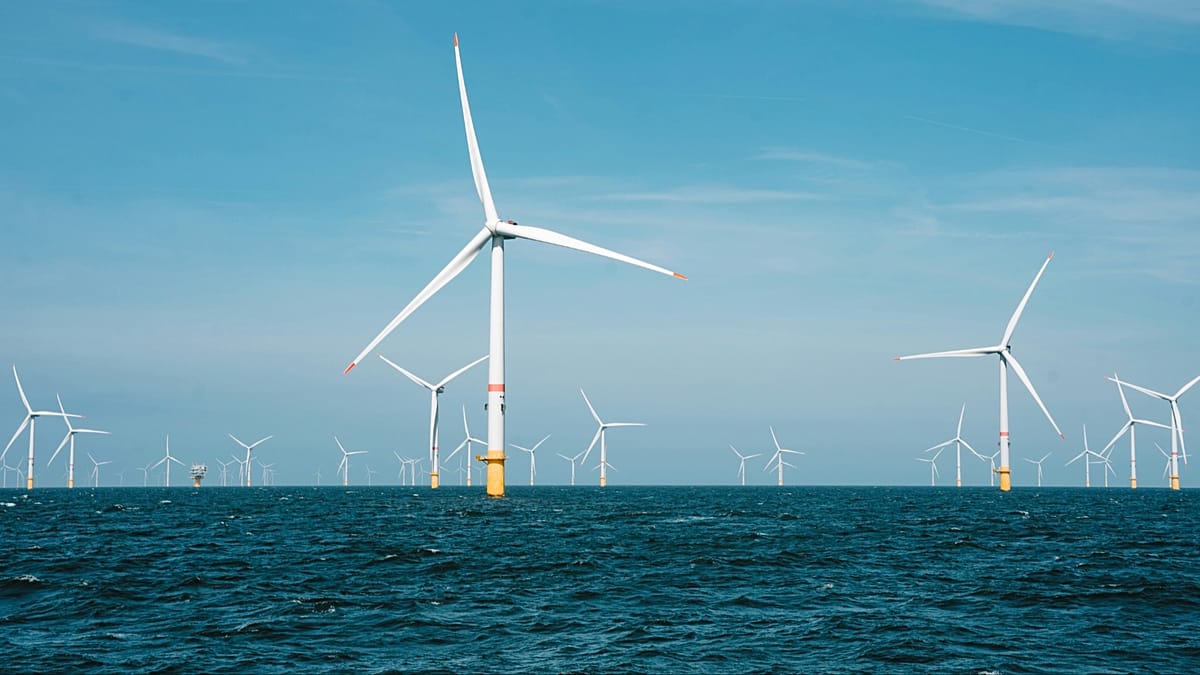
Ambitious plans to transform the North Sea into the world’s “largest green energy reservoir” have sparked concern among security experts.
Last month, almost a dozen European countries joined forces to get off the “fossil fuel rollercoaster”, committing to deliver 100GW of joint offshore wind projects across shared waters by 2050. This would generate enough electricity to power more than 140 million homes.
Belgium, Denmark, France, Germany, Iceland, Ireland, Luxembourg, the Netherlands, Norway and the UK signed the Hamburg Declaration on 26 January, pledging €9.5 billion in the hopes of mobilising €1 trillion of capital in Europe, creating 90,000 jobs and reducing power production costs by 30 per cent in the next 15 years.
Three years ago, North Sea nations pledged to build 300GW of offshore wind in the North Sea by 2050 in response to Putin’s illegal invasion of Ukraine and “weaponisation” of Europe’s energy supplies.
A third of that is now slated to come from joint clean-energy projects. These will include new offshore wind ‘hybrid assets’ – wind farms at sea that are directly connected to more than one country through multi-purpose interconnectors (MPIs).
However, as energy infrastructure transitions away from fossil fuel plants to more remote areas, experts worry it could become a critical target for hostile states.
In 2023, a joint investigation by public broadcasters in Denmark, Norway, Sweden and Finland found Russia had a programme to sabotage wind farms and communication cables in the North Sea.
It found Russia has a fleet of vessels that are disguised as fishing trawlers and research boats that are carrying out underwater surveillance and mapping key sites for possible sabotage.
Why offshore wind farms are ‘attractive for sabotage’
James Bore, a chartered security professional, tells Euronews Green that at a high level, any form of offshore energy production with multiple connections “introduces new dependencies”.
“Realistically, it’s deciding where the risk sits rather than a blunt increase in vulnerability,” he adds.
“Any large-scale energy production infrastructure is going to open up new attack vectors, but this is a shift from a model where fuel supply chains and geopolitics are key to one where physical infrastructure, data, and control systems are more important.”
The security expert warns that physical disruption of the infrastructure, such as attacks on generation facilities, offshore substations and undersea cables, is one of the key risks for this kind of development.
“They’re difficult to monitor continuously, and so are attractive for sabotage by highly capable, motivated hostile actors,” Bore says.
“However, damaging them is not trivial, and is a very overt action, while repairs and recovery are tried and tested. Any damage is typically localised, and a well-designed system will have sufficient redundancy to limit impacts of any single incident.”
As green energy developments become increasingly digitised, there is also a cyber-physical risk.
“Compromise here is more plausible than dramatic physical attacks, but the realistic outcomes are disruption or degradation rather than catastrophic failure,” argues Bore.
“These risks are well understood from other critical sectors and are manageable if addressed at the design stage rather than retrofitted.”
Is Europe’s underwater surveillance strong enough?
European defence-tech company EUROATLAS, which is developing autonomous underwater vehicles designed to secure and maintain critical subsea infrastructure, argues that North Sea nations are building a continent-scale underwater power system without investing in a “corresponding underwater security architecture”.
“Persistent autonomous underwater surveillance is becoming as essential to energy security as radar is to airspace,” says Verineia Codrean of EUROATLAS.
While underwater surveillance is becoming more important, Bore argues that it is only one part of a much broader approach to resilience.
“Redundancy, rapid repair capability, segmented grids, and international coordination tend to do far more for energy security than any single technology,” he adds.
‘Energy security is national security’
The UK’s Department for Energy Security and Net Zero (DESNZ) says the UK and EU allies have “doubled down” on clean power to help protect their people and strengthen national security.
“Energy security is national security, “ a DESNZ spokesperson tells Euronews Green.
“This historic agreement will see us work with European allies to unlock the world’s largest clean energy reservoir. The clean energy security pact includes dedicated measures to strengthen resilience against threats and protect offshore energy assets.”
Jane Cooper of RenewableUK, which represents almost 500 companies in the renewable energy industry, adds: “We are strengthening our security collaboration to ensure the North Sea’s critical energy infrastructure is protected from harm, so that we can continue to generate the huge quantities of clean power needed by the UK and our neighbours reliably at all times.”
How will The Hamburg Declaration step up security?
The Hamburg Declaration acknowledges increasing geopolitical tensions, stating that the protection and resilience of maritime energy infrastructure “demands close coordination and a common strategic approach to counter a variety of threats such as physical sabotage, cyber attacks, or other hybrid attacks”.
This will be done by “enhanced coordination” of all military, civil and private security services, enhanced cyber defence, regular security exercises and “acting against substandard ships” to avoid possible threats.
“We call on our Energy Ministers and Ministers responsible for defence, resilience and preparedness or other related fields to enhance cooperation related to the resilience and physical as well as cyber defence of our offshore energy infrastructure in the North Seas,” the declaration reads.
While green energy infrastructure can be targeted, Bore argues it isn’t “uniquely fragile”.
“In many ways, a diversified, interconnected renewables system is more resilient than a fossil-fuel heavy one – provided security is treated as a core engineering and governance concern, not an afterthought,” he says.