
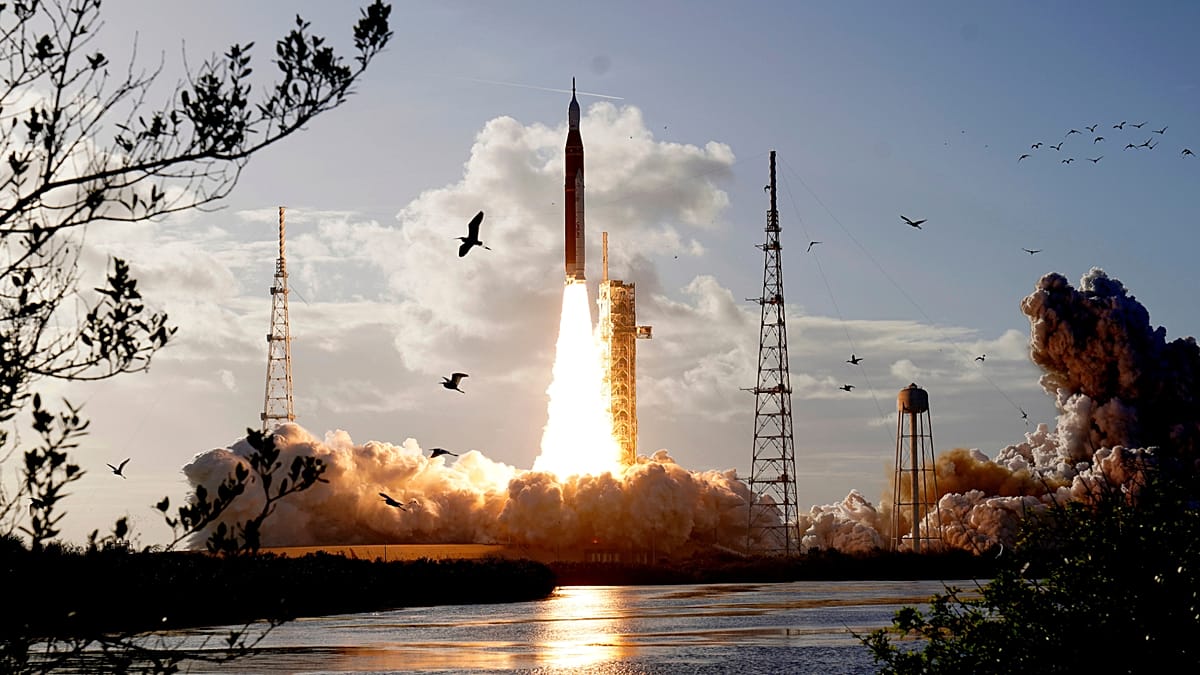
Four astronauts embarked on a historic voyage towards the moon on Wednesday, the first lunar mission in more than 50 years.
Carrying three Americans and one Canadian, the 32-story rocket rose from NASA’s Kennedy Space Center where tens of thousands gathered to witness the launch.
Crowds also jammed the surrounding roads and beaches, reminiscent of the Apollo moonshots in the 1960s and ’70s. It is NASA’s biggest step yet toward establishing a permanent lunar presence.
Artemis II set sail from the same Florida launch site that sent Apollo’s explorers to the moon so long ago.
The team, who donned bright orange suits with blue trim as they blasted off, includes Americans Reid Wiseman, Victor Glover and Christina Koch along with Canadian Jeremy Hansen.
Five minutes into the flight, Commander Reid Wiseman saw the team’s target: “We have a beautiful moonrise, we’re headed right at it,” he said from the capsule.
Tensions were high earlier in the day as hydrogen fuel started flowing into the rocket. Dangerous hydrogen leaks erupted during a countdown test earlier this year, forcing a lengthy flight delay.
To NASA’s relief, no significant hydrogen leaks occurred. The launch team loaded more than 2.6 million litres of fuel into the 32-story Space Launch System rocket on the pad, a smooth operation that set the stage for the Artemis II crew to board.
Then NASA had to overcome a flurry of last-minute technical issues — bad battery sensors and an inability to get commands through to the rocket’s flight termination system. In both cases, the issues were quickly resolved, allowing the launch to proceed.
Push towards a landing in two years
If the plan proceeds as expected, the astronauts will set a record by venturing farther from Earth than any human before.
They won’t pause for a stopover or orbit the moon like Apollo 8’s first lunar visitors did in 1968, but will zoom past the moon and continue another 6,400 kilometres beyond, before making a U-turn and tearing straight home to a splashdown in the Pacific.
It is also the inaugural crewed flight of NASA’s new lunar rocket, dubbed the Space Launch System (SLS).
The mission marks a series of historic accomplishments: it will send the first person of color, the first woman and the first non-American on a lunar mission.
Unlike Apollo, which focused on fast flags and footprints in a breakneck race against the Soviet Union, Artemis is designed to allow the United States to repeatedly return to the Moon, with the goal of establishing a permanent base that will offer a platform for further exploration.
The astronauts will stick close to home for the first 25 hours of their 10-day test flight, checking out the capsule in orbit around Earth before firing the main engine that will propel them to the moon.
The voyage should last approximately 10 days in total, and aims to pave the way for a Moon landing in 2028.
Four days later during the lunar flyby, the moon will appear to be the size of a basketball held at arm’s length. If the lighting is right, the astronauts should see features never before viewed through human eyes and catch snippets of a total solar eclipse.
“NASA is back in the business of sending astronauts to the moon,” NASA Administrator Jared Isaacman told reporters following liftoff, calling the half-century hiatus a brief intermission.
Competition with China
The current era of American lunar investment has frequently been portrayed as an effort to compete with China, which is aiming to land humans on the Moon by 2030.
During the post-launch briefing, Isaacman said competition was “a great way to mobilise the resources of a nation.”
“Competition can be a good thing,” he said. “And we certainly have competition now.”
The Artemis programme has come under pressure from US President Donald Trump, who has pushed its pace with the hope that boots will hit the lunar surface before his second term ends in early 2029.
But the projected date of 2028 for a landing has raised eyebrows among experts, in part because Washington is relying on the private sector’s technological headway.
NASA has refused to release its risk assessment for the mission. Managers contend it’s better than 50-50 — the usual odds for a new rocket — but how much more is murky.
Earlier in the day Trump had said on Truth Social that the US is “WINNING.”
“Economically, Militarily, and now, BEYOND THE STARS. Nobody comes close! America doesn’t just compete, we DOMINATE, and the whole World is watching,” he posted.