

If there is anyone in the art world with the legitimacy to question narratives of power, it is Ai Weiwei. The Chinese artist spent his childhood in exile with his family in a remote region of China because of Mao’s repression and decided to leave his country in 2015 after suffering intense state persecution for drawing attention to the more than 5,000 schoolchildren who died in the 2008 Sichuan earthquake. Now, at 69 and living a quiet life in his country house in Portugal’s Alentejo, he remains on his guard and directs his distrust towards Western democracies and their use of artificial intelligence as a subtle form of censorship.
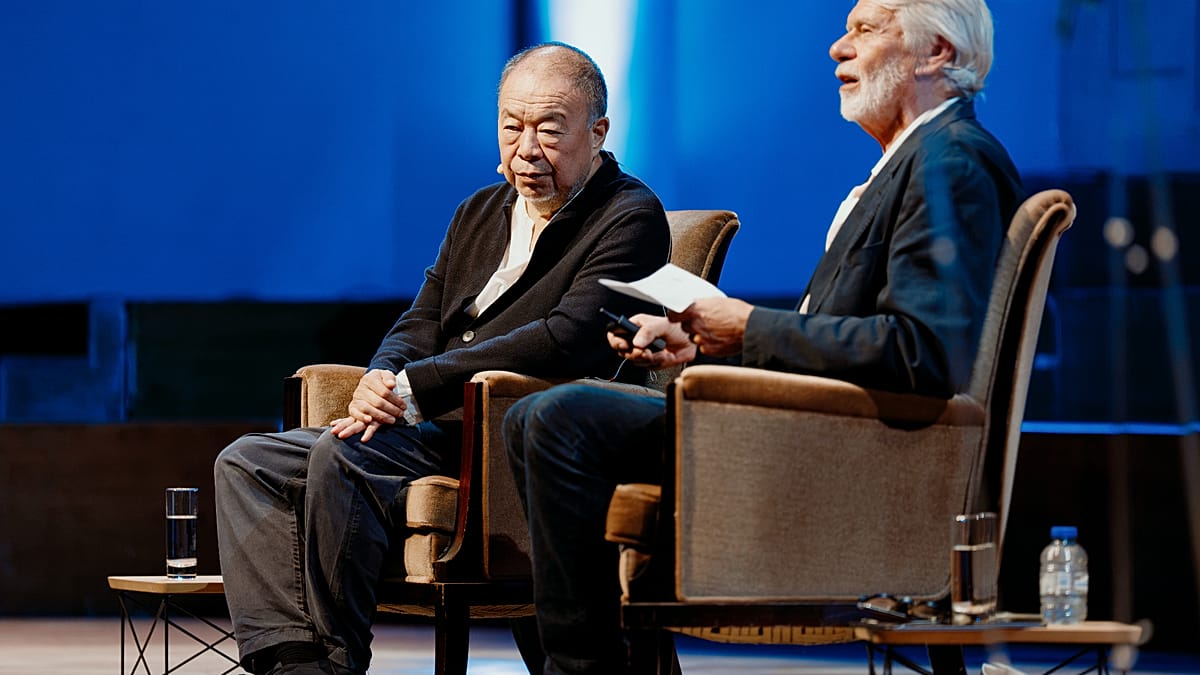
“It may be too late to avoid its dangers. We no longer have privacy and when individuals have no privacy they are no longer individuals, but become the perfect product,” declared Ai Weiwei at Brussels’ Bozar Centre for Fine Arts, in front of the more than 2,000 people who had packed the main auditorium to attend the conversation between the artist and Belgian cultural manager Chris Dercon, of the Fondation Cartier, about his latest book ‘Ai Weiwei on Censorship’ (Thames & Hudson, 2026), held at the beginning of October.
For a creator who cannot conceive a separation between art and political dissent, the main obstacle citizens face in Western society is the tendency towards self-censorship for fear of reprisals. “But in fact, here everyone is free to express and think whatever they like,” remarked Chris Dercon. “In reality it is not like that, because there is always a shared agreement guided by authority, by the state, which sets what is correct and acceptable and what is not,” replied Ai Weiwei, and he insisted on “the power of the individual” to change unjust realities, since “each of us is different”, he added.
This respect for difference, made invisible by those in power, is a common thread in Ai Weiwei’s work. One example is the piece ‘Sunflower Seeds’ (2010), in which he filled London’s Tate Modern with millions of seeds crafted by thousands of artisans as unique ceramic pieces which, once brought together, created a perceptual play between homogeneity and difference and invited the viewer to reflect on the tensions between the individual and the mass.
The message was even clearer in his work ‘Remembering’ (2009), when he intervened on the façade of Munich’s Haus der Kunst, a building that the Nazi regime used to spread its idea of culture through works of art, with 9,000 school backpacks belonging to children who died during the Sichuan earthquake, arranged so that they formed the phrase in Chinese “She lived happily for seven years in this world”. The words came from a conversation the artist had with one of the mothers of the girls who died. “She only wanted people to know that her seven-year-old daughter had been happy while she was alive and I promised I would help her fulfil her wish,” explained Ai Weiwei.
Art as activism
He recalled the consequences of his activism in denouncing the poor state of school infrastructure in China, as well as the secrecy of the state in failing to reveal the names of the victims or the real number of dead.
“The police came for me at three in the morning and I realised how weak I was because a single blow knocked me to the ground,” he recalled. He then showed selfies of his condition afterwards in hospital, in which he stuck his middle finger up at the camera, at the Chinese government. Later came the nightmare of arrest, with more violence, followed by a period of confinement in his own home and years of being unable to leave his country after his passport was confiscated.
As interviewer that evening, Chris Dercon raised a question: why are your artworks always either very small or very large? “Small or large is only an illusion,” replied Ai Weiwei. “Planet Earth may seem big, but the Earth is so small within the universe that you could not even find it,” he continued. “Thousands of people have been killed in Uganda; and in Ukraine thousands of soldiers have lost limbs in the war and they may even consider themselves lucky because they are not dead. Compared with all that, what I do with my art is nothing,” the activist stressed.
This gave rise to a dialogue laced with irony, as befits artists who are aware of their own contradictions. “I have never considered myself a Chinese artist, although my stomach is certainly made for Chinese restaurants,” Ai joked. There were also revealing anecdotes, such as the time when Lego refused to sell him bricks to use in a work because it did not want its products to be used for a political purpose; “as if that statement were not political in itself,” the artist confessed.
After a brief tour through a life story entwined with protest and art, shaped by the legacy of his father Ai Qing’s poetry, there was a desire to round off the portrait with a question about how he would describe himself. “I would give a completely different answer depending on the era of my life,” he replied. “But I would define myself as someone with a great curiosity about the human condition, freedom of expression, human rights and artistic creation.”
For the culture lovers who had gathered to welcome Ai Weiwei in Brussels, it became clear that no action is fortuitous for a contemporary artist who is always conscious of the context in which he places his works. “Some people are not more civilised because they make others suffer more,” he said, referring to the suffering of Congo at the hands of Belgium during the colonial era.
Two exhibitions
Thus the autumn cultural season in Brussels was inaugurated, and this year a large part of the spotlight falls on this artist with the show ‘Ai Weiwei: The Art of Defiance’ at the Patrick Derom gallery until 14 November, and ‘Ai Weiwei: Life, Revolt, Poetry. An homage to Ai Qing & Emile Verhaeren’, on display at the Émile Verhaeren museum until 13 December.
The former is presented as the first major Ai Weiwei retrospective in Belgium, with works that span the different formats he has used throughout his career to defend freedom of expression in the face of state repression. The latter, more personal in tone, brings the great Belgian poet Émile Verhaeren into dialogue with the poet Ai Qing, Ai Weiwei’s father, who helped spread Verhaeren’s legacy in Asia by being the first to translate his poems into Chinese.
A fitting moment in the European capital to welcome an artist who invites us to awaken our critical awareness and not to go through life without at least attempting some act of dissent, however small, against widespread injustice.