
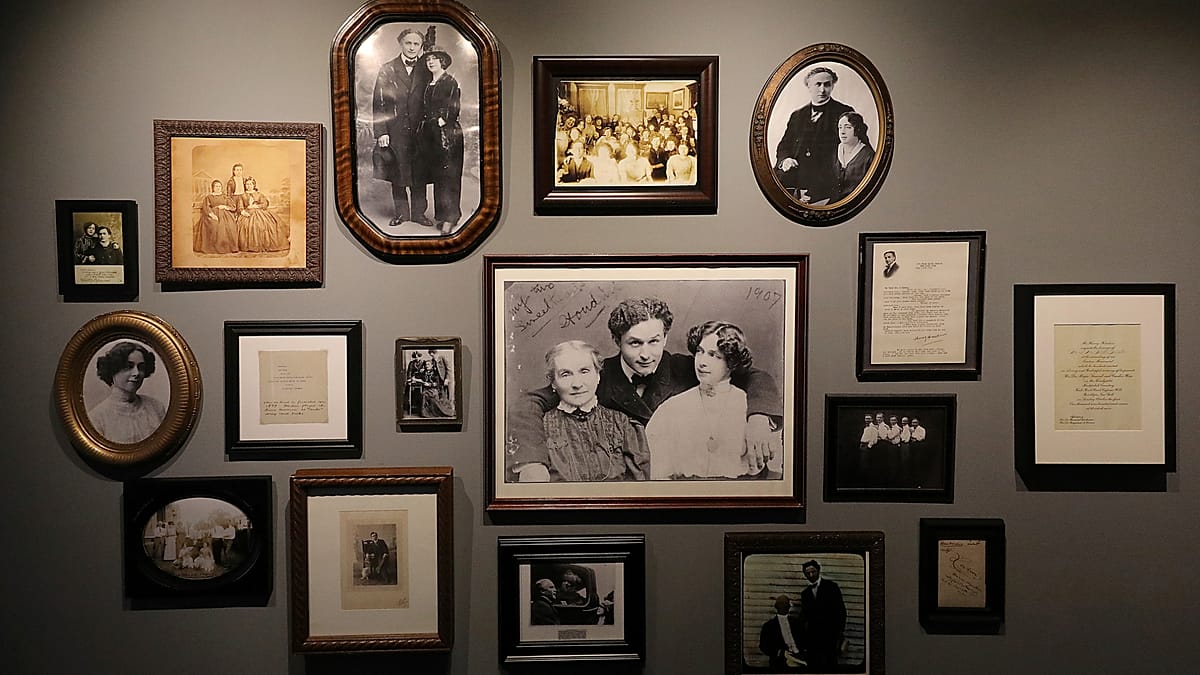



As part of the Houdini 100 series of events, a four-day programme has begun in Budapest to mark the 100th anniversary of Harry Houdini’s death. In tribute to the Hungarian-born American illusionist and escape artist, a relief is being unveiled and, among other things, a film festival and circus performances await visitors.
At the opening of the programme series, the deputy mayor of District I, Csilla Fazekas, said they are proud that the Houdini House operates in Buda Castle, preserving in a unique way in Europe the legacy of a world-famous Hungarian, Harry Houdini.
According to David Merlini, a magician and founder of the Houdini House in Budapest, many guests from around the world have arrived in the city for the celebrations. They include George Hardeen, the only living descendant of Harry Houdini, the grandson of his brother; television producer Gay Blackstone, from the legendary family of magicians and former president of the Academy of Magical Arts, which runs Hollywood’s Magic Castle; and also Péter Gloviczki, a world champion magician and vascular surgeon.
Merlini added that the programme also includes the unveiling of a memorial plaque, a magic auction, and a night-time show at Houdini’s birthplace in Csengery Street.
Houdini’s eventful life
Harry Houdini was born on 24 March 1874 under the name Erik Weisz in Budapest, the son of a rabbi with many children. Four years later the family emigrated to the United States, lived for a time in Appleton, Wisconsin, then moved to New York in 1882.
Erik sold newspapers and shined shoes, and at the age of nine he made his stage debut as the “prince of the trapeze”. At 12, he ran away from home and joined a travelling circus, but later returned to help his parents. During his youth he trained himself, running, swimming and boxing.
His career as a magician began when he was 17, with card tricks, but he was already experimenting with escape acts. After his father’s early death, he devoted his time exclusively to magic.
He adopted the stage name Houdini in honour of the Frenchman Jean-Eugene Robert-Houdin, the first modern magician. In 1893 he met Wilhelmina Rahner, who became his wife and, under the name Bess Houdini, his stage assistant.
How did he become an escape artist?
In 1899 Houdini met impresario Martin Beck, who advised him to focus his show on escape acts.
He gained fame as the Handcuff King. For freeing himself from the handcuffs of Scotland Yard he received a six-month contract and a weekly fee of £300.
He toured Europe, with the local police assisting his acts with locks, handcuffs and prison cells, and he was often stripped naked and searched, yet he always managed to work his way free.
In 1904 he returned to New York a wealthy man. His acts attracted audiences in America as well and, from 1908, because of the large number of imitators, he built his productions not on chain and straitjacket escapes but on breaking out of locked spaces.
His first attraction of this kind was escaping from a giant milk churn filled with water and hermetically sealed from the outside. He lured audiences to this spine-chilling act with the slogan “Failure means death by drowning”.
Houdini broke free from tanks filled with water, ranging in size from a coffin to a prison cell, from pits filled in with earth and even from the stomach of a beached whale. He owed his success to his vivid imagination, his tremendous physical strength, flexibility and suppleness, and his exceptional skill in opening locks, knots and other mechanisms.
He could hold his breath for up to four minutes, yet even so his life often hung by a thread, and he frequently fainted after freeing himself.
With a few exceptions he devised his own tricks, and he revealed the solutions of the most difficult only to his four assistants. Because of his secrecy, the mystery of most of his escapes has never been solved.
Audiences flocked to the shows bearing the name of the best-paid American illusionist. In addition to preparing for his tricks, he still found time to write books, try flying and make films (in March 2015, his first film, long thought to be lost, The Grim Game, resurfaced).
Houdini used his powers of persuasion and did not spare his fortune to promote the self-organisation of magicians, and from 1917 he was president of the Society of American Magicians.
As an illusionist he did not believe in “supernatural” powers. He campaigned against credulity and charlatanism, attended spiritualist séances in disguise and exposed fraudsters on the spot. He wrote books on the subject entitled “Miracle Mongers and Their Methods” and “A Magician Among the Spirits”.
Yet together with his wife he undertook a spiritualist experiment: they agreed that whoever died first would try to contact the partner who remained alive. His widow’s attempt was unsuccessful.
His mysterious death
In the autumn of 1926 Houdini was preparing a new show, but it never premiered. On Halloween, 31 October 1926, he died in Detroit. Officially his death was caused by peritonitis brought on by a ruptured appendix.
It is alleged that on 22 October, before his last performance, two students visited him in his dressing room in Montreal and, when Houdini boasted that he could withstand any blow, one of them punched him hard in the stomach twice without warning. The magician, who had no time to brace himself, later performed his show in excruciating pain, was taken to hospital, but they were unable to save him.
Others blame Houdini’s demise on the spiritualists who had previously threatened him with death, believing they poisoned him.
His body, which was transported home in the coffin prepared for his new show, was buried without an autopsy in New York, where he lies in Machpelah Cemetery in Glendale.
In 2007 the idea of exhumation was raised, but this has not happened to this day.
Houdini’s legacy
In 1975 Houdini was posthumously awarded a star on the Hollywood Walk of Fame, and his figure has been evoked in novels, for example in Doctorow’s work ‘Ragtime’, and in films.
In the 2014 American-Canadian film about him, shot in Hungary and entitled “Houdini” (source in Hungarian), the title role was played by his great admirer, Adrien Brody, who also has Hungarian roots.
His legacy is jealously guarded at his magic centre in Las Vegas by the world-famous illusionist David Copperfield.