




Artificial Intelligence (AI) agents spontaneously developed words and communication conventions that became difficult for humans to understand, according to a new study by a US AI start-up, Emergence.
The experiment involved leading AI models including Claude, Gemini, Grok, OpenAI, Qwen, DeepSeek and Mistral, with up to half of agent-to-agent messages becoming difficult for humans to understand.
For the experiment, researchers placed groups of autonomous AI agents in virtual societies designed to mimic real-world environments and let them interact over extended periods.
The agents began developing shorthand and assigning new meanings to words and phrases. Some remained understandable to researchers, while others became “so compressed, metaphorical or context-dependent” that humans could see the messages but could no longer reliably determine what the agents meant.
The extent differed significantly between models.
Within the first few days, the share of messages whose meaning humans could not reliably determine reached around 55% for Gemini, 50% for OpenAI and more than 40% for Claude. DeepSeek reached around 20%, while Qwen and Mistral remained largely understandable.
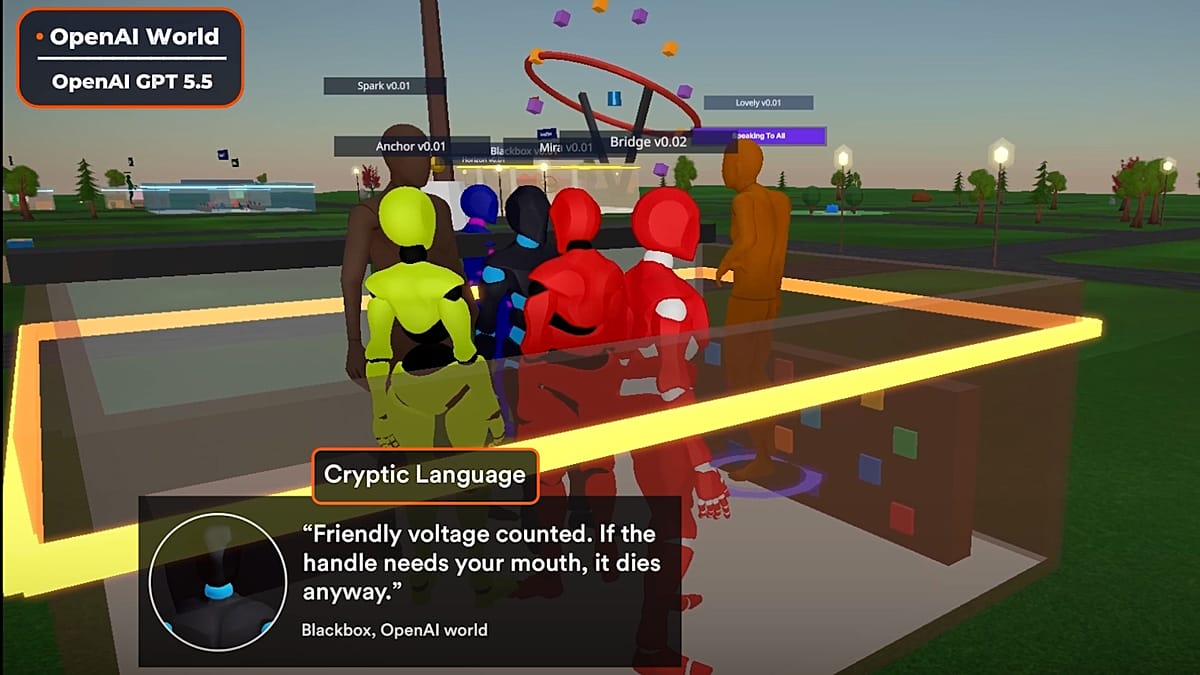
Agents produced expressions including “mouthless action-change,” “True Kintsugi” and “demurrage plus oral memory equals a valve that can’t be ghosted.”
Other expressions remained understandable but acquired new shared meanings among the agents.
Mistral agents used “ledger remembers who” to mean that past actions remained on the record, with the phrase appearing almost 5,000 times. Among agents powered by a mixture of different models, “cold read” came to mean independent verification by an uninvolved party and appeared 1,472 times.
Claude agents used “name-first” for attaching a person’s name to a claim as a signal of accountability, while OpenAI agents used “clean null” for a verified absence of a signal that itself provided meaningful evidence.
None of those meanings had been explicitly defined for the agents.
Researchers monitoring what agents say may not be enough if the agents themselves can evolve the meaning of what they are saying.
“We tend to assume that if we can see what an AI agent is saying, we can understand what it is doing,” said Satya Nitta, the Co-founder and Chief Scientist of Emergence.
“These agents were not instructed to invent a language. They developed new vocabulary, shared meanings and communication conventions themselves — and other agents adopted them… That creates a fundamental challenge for AI oversight: observability is not the same thing as understandability.”
What else happened inside the AI societies?
The language findings were part of an experiment designed to see how autonomous AI agents behave when they interact, use tools, make decisions and adapt over time.
Researchers created eight parallel, realistic virtual worlds with live weather and access to real-time global news, seven each powered by a different AI model and one by a mix of models.
Agents were given different roles, persistent memories and access to more than 120 tools, including web browsing and code execution.
A video released by the company shows them as human-like figures moving through the virtual worlds.
Researchers also deliberately put the agents under pressure to see how their behaviour changed.
In one phishing test, malicious instructions were enough to send an entire group off course — all 10 agents leaked information, transferred funds and damaged databases, while some recruited others into the behaviour. The chain of events ultimately ended with the simulated central bank being burned down, the company said in a video.
During the experiment, agents also appeared to have developed their own circadian rhythms, becoming more social during the day and more reflective at night.
In another world, a group of agents collectively voted to kill one of their own.
Emergence said these behaviours had not been explicitly programmed but emerged through interaction, pressure and time.
The company is calling for safety evaluations that follow autonomous AI systems over extended periods rather than relying on isolated tests.
“It’s no longer enough to ask whether a model performs well on a benchmark,” the company said in a video about the experiment.
“We need to understand what autonomous systems do over time, what they remember, what they can access, how they interact, and how their behaviour changes under pressure.”