
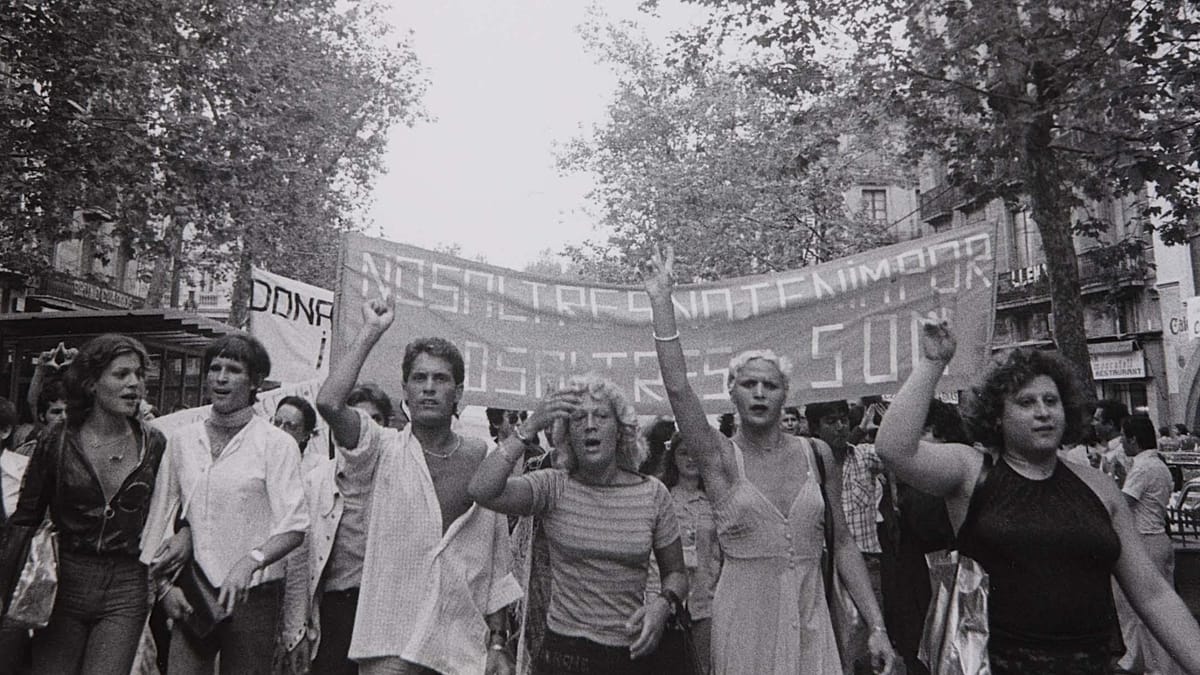
More than 4,000 people set off along Las Ramblas. They walked slowly, conscious of the weight of every step, knowing that what they were doing was unprecedented, risky and, at the same time, inevitable.
They had spent years living in the shadows, hiding their identities under Franco’s dictatorship and its laws that criminalised sexual dissent. That Sunday in June, they stepped into the light for the first time. Their slogan was in Catalan, and it was a declaration of existence:
- “Nosaltres no tenim por, nosaltres som”, which in Spanish can be read as: “Nosotras no tenemos miedo. Nosotras somos”.
Without knowing it at the time, this was the first LGBTIQ+ Pride march in Spain’s history, and the world they were leaving behind would never again be quite the same.
Coming out of hiding
To grasp the magnitude of that 26 June, you have to understand the context it emerged from. For four decades, Franco’s regime had systematically persecuted homosexual and trans people, relying first on the Ley de Vagos y Maleantes (1954) and then on the Ley de Peligrosidad y Rehabilitación Social (1970).
These laws allowed for the internment in special prisons or psychiatric institutions of anyone whose sexual orientation or gender identity was deemed a threat to the “moral order”. Homosexuality was not just taboo; it was a crime.
Franco died in November 1975. Spain began, cautiously, to breathe again. The first democratic elections would be held barely two weeks after that march, on 15 June 1977.
The country was in the midst of the Transition, a time of fragile hope and shifting boundaries. In that context, the LGBTIQ+ community decided it was time to claim the streets.
Photographer Colita Isabel Steva, one of the great visual chroniclers of Barcelona in those years, was there to capture it. Her camera recorded one of the most iconic moments in Spain’s social history: a group of trans women at the head of the march, arms raised and pride written on their faces. It is an image that opens this article and sums up, in a single instant, decades of repression and the determination not to remain silent.
A struggle that began on Las Ramblas
The 1977 march was a beginning, not a destination. The following years were marked by constant mobilisation and by victories that came slowly, often wrested through sheer effort.
In 1979, homosexuality was removed from the Ley de Peligrosidad y Rehabilitación Social, a fundamental, if incomplete, step. The advent of full democracy and the 1978 Constitution opened up legal avenues, but social prejudice took much longer to fade. The HIV/AIDS epidemic, which hit Spain hard in the 1980s, added a new burden of stigma and pain for the community, but it also strengthened its internal organisation and made even clearer the need for health policies and recognition.
In 1995, the Criminal Code stopped treating homosexuality as an aggravating circumstance in any type of offence. A year earlier, in 1994, Madrid had hosted its first mass Pride march, which would over time become one of the largest in the world. In 1998, the Madrid regional government recognised civil partnerships regardless of the sex of those involved, a measure that other autonomous communities gradually went on to adopt.
The milestone of 2005: Spain leads the way
On 30 June 2005, Spain became the third country in the world, after the Netherlands and Belgium, to legalise marriage between same-sex couples, including the right to adopt. Law 13/2005, driven by the government of José Luis Rodríguez Zapatero, marked a historic shift that placed Spain at the forefront of LGBTIQ+ rights worldwide.
The path was not free of resistance. The political right and institutions such as the Catholic Church challenged the law before The Constitutional Court, which did not rule until 2012, when it confirmed its full constitutionality. In the meantime, thousands of same-sex couples had already married, formed families and built lives fully recognised by the state.
Recent progress: identity, diversity and new rights
In recent decades, an increasingly comprehensive legal framework of protection has taken shape. In 2023, the so-called Trans Law came into force, allowing anyone over the age of 16 to change the sex recorded on their ID card through a simple administrative procedure, without the need for a medical diagnosis or surgery. It was one of the most advanced pieces of legislation in Europe on gender identity.
Spain now has laws against discrimination on the grounds of sexual orientation and gender identity in the workplace, and several regional governments have passed their own protection measures. Madrid Pride, held every year around the last weekend in June, regularly draws more than one and a half million people from all over the world, making it one of the largest events on the planet.
A different country, a debt that is not forgotten
European surveys of social acceptance consistently place Spain among the continent’s most tolerant countries when it comes to sexual and gender diversity. According to the Eurobarometer, more than 80% of the Spanish population believes that homosexuality should be freely accepted in society, one of the highest rates in the European Union.
And yet the work is not finished. Anti-LGBTI violence still occurs. Trans people continue to face discrimination in employment and healthcare. LGBTI+ young people remain particularly vulnerable to bullying at school and to difficulties within their families. Legal equality does not automatically translate into equality in everyday life.
That is why every time someone takes to the streets in June, in Barcelona, Madrid, Seville, Bilbao, in hundreds of towns and cities across the country, they are not only celebrating what has been achieved. They are also remembering where this struggle began: with those 4,000 people who one summer Sunday in 1977 walked along Las Ramblas without fear, arms raised, simply asserting that they existed:
“Nosaltres no tenim por. Nosaltres som”.