
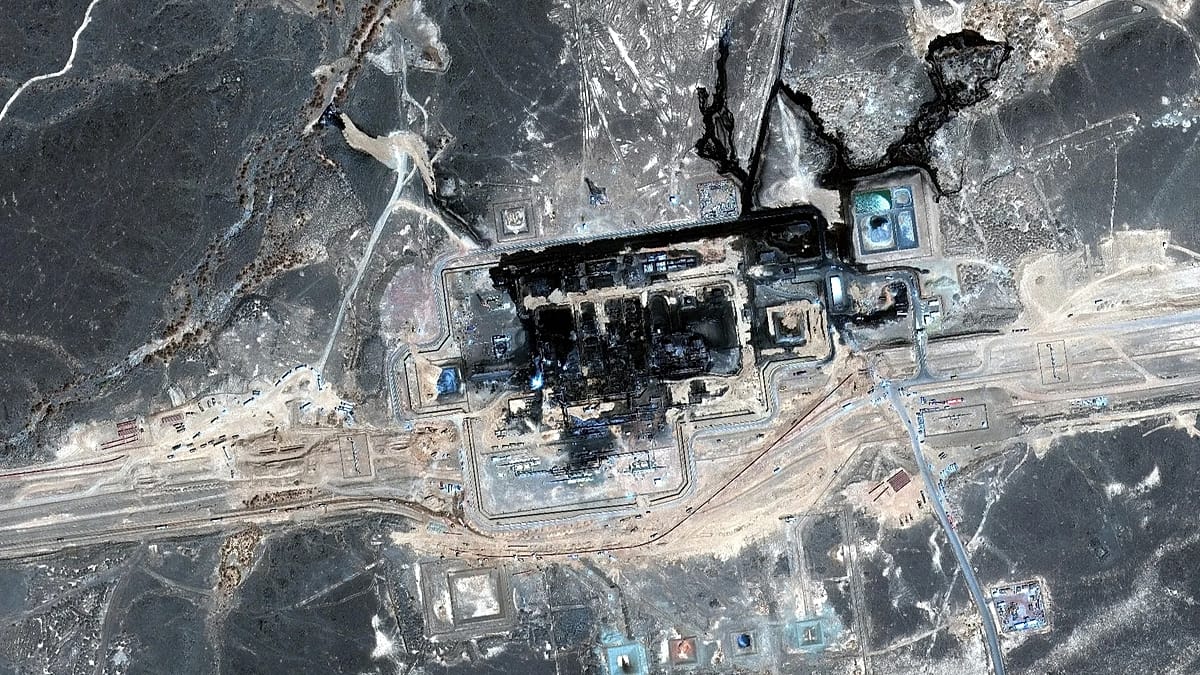
Europe is bracing for a potential oil supply shock after Saudi Arabia shut its East-West pipeline, also known as Petroline, following drone attacks earlier this month from Iran-backed allied Houthis and Iraq.
The Saudi energy ministry announced a precautionary shutdown on 10 September after drone attacks on the pipeline in the Riyadh and Medina regions the previous day.
The siege knocked out one of the kingdom’s most important alternatives to the blockade of the Strait of Hormuz – the transit ruote for 20% of the world’s oil and gas supplies – since the US and Israel launched military attacks on Iran on 28 February.
The pipeline has recently been carrying around 4–5 million barrels per day, roughly 4–5% of global oil supply, and the disruption to it is exposing once again that the EU’s energy diversification strategy provides only one layer of security.
What happened to Saudi Arabia’s oil pipeline?
While diplomatic talks to end the war in Iran keep stalling, Tehran and its regional proxies are executing a coordinated strategy targeting Saudi energy infrastructure in an attempt to completely block Saudi’s oil exports through its eastern flank via the Red Sea.
The attack that shut the 1,200-kilometre East-West pipeline has disrupted the route carrying crude from the kingdom’s eastern fields to the Red Sea port of Yanbu, effectively bypassing Hormuz.
Saudi Arabia’s East-West pipeline was built in 1981, after the Iranian Revolution, to provide an alternative route for crude exports that bypasses the Strait of Hormuz.
Running from the kingdom’s oil-producing east to the Red Sea port of Yanbu, it allows Saudi oil to reach global markets without passing through the Hormuz chokepoint.
What are the implications for Europe?
European refineries have been forced to rethink their crude supply since Saudi Arabia began cancelling some oil cargoes from Yanbu, following the outage of the kingdom’s East-West oil pipeline.
Energy pricing agency Argus reported on 15 September that at least three European refiners had cargoes scheduled for late September cancelled or postponed, in some cases until November, citing unnamed market sources.
Poland’s Orlen, one of the biggest buyers, has bought 16 additional cargoes from Norway, Britain, Algeria, Kazakhstan, Azerbaijan and the Americas to keep its refineries operating through October.
“We inform you that oil deliveries to Poland and the remaining refineries of the Orlen Group are being carried out on an ongoing basis and fully cover their demand,” read a statement from the Polish energy refiner on X on 16 September.
Refineries are the facilities that turn crude oil into diesel, petrol, jet fuel and other products used across the economy. And they are not interchangeable machines: different refineries are configured to process different types of crude.
Why does Europe need Saudi oil?
Europe relies on Saudi crude partly because some Saudi grades have qualities that fit the configuration of European refineries, particularly their ability to process medium and heavier, relatively sour crude.
Replacing those barrels is possible, but finding equivalent grades in sufficient volumes can be costly and may require refiners to adjust their operations – a complex endeavour while the continent is already enduring high energy prices.
Without Saudi oil, Europe’s refiners may have to blend several different crude grades to recreate the characteristics of the Saudi barrels they have lost.
“European refineries that have been reliant on Arab crude via the Red Sea have to find alternatives. But not all crudes are made equal,” said June Goh, senior oil market analyst for the market intelligence Sparta Commodities.
Why are prices about to surge again?
Oil prices are set in global markets, so disruptions to supply can feed through to prices far beyond the country where they occur.
When traders and investors anticipate a tighter market – particularly if spare capacity or inventories are limited – prices can rise even before any physical shortage materialises.
Before the damage to the Saudi pipeline, it could move several million barrels a day – approximately 5.5 million – and has become particularly important with the Strait of Hormuz effectively blocked.
Now, with energy analysts estimating that about 3.5 to 4 million barrels per day are at risk, the gap has led to a surge in prices, with Brent crude oil recently trading above $113 a barrel due to mounting supply risks.
Several European countries are trying to cushion the impact of rising diesel prices, which are being felt at the gas pump as a direct consequence of the shutdown of Saudi Arabia’s pipeline.
How serious could this crisis get?
That depends on whether energy infrastructure becomes a new target of military attacks and how quickly the Saudis can restore the pipeline to function at its normal capacity.
While minor damage to the pipeline has reportedly been repaired, restoring the damaged pumping stations and full pipeline operations could take up to six weeks, according to market intelligence firm Kpler’s head of oil analyst Homayoun Falakshahi.
In the meantime, as Kpler noted on 14 September, a bypass pipeline around the damaged pumping station is serving as a temporary fix in the short term.
“(Saudi) West Coast refineries reduce throughput and increasingly rely on inventories, while Yanbu exports are partially disrupted, including northward flows,” Kpler stated.
Kepler said it had assessed Yanbu’s oil terminal inventories at 9 thousand barrels of crude oil and other West Coast refinery inventories at 16.5 thousand barrels of crude oil.
“Assuming no additional piped throughput, these would be enough to sustain the current pace of loadings and runs for three and nine days, respectively,” according to Kpler.
Meanwhile, Saudi Arabia said on 16 September it expects to fix half of the pipeline’s capacity in the coming days, leading analysts to a more positive outlook. However, its infrastructure could still face additional attacks.
If the damage to the pipeline is not repaired soon, Europe could face higher crude and refined-fuel prices and renewed inflationary pressure.
Until the pipeline resumes normal flows, what might normally be a regional logistics problem could become a potential squeeze for European refiners – and another test of how much room governments have to shield consumers and industry.