
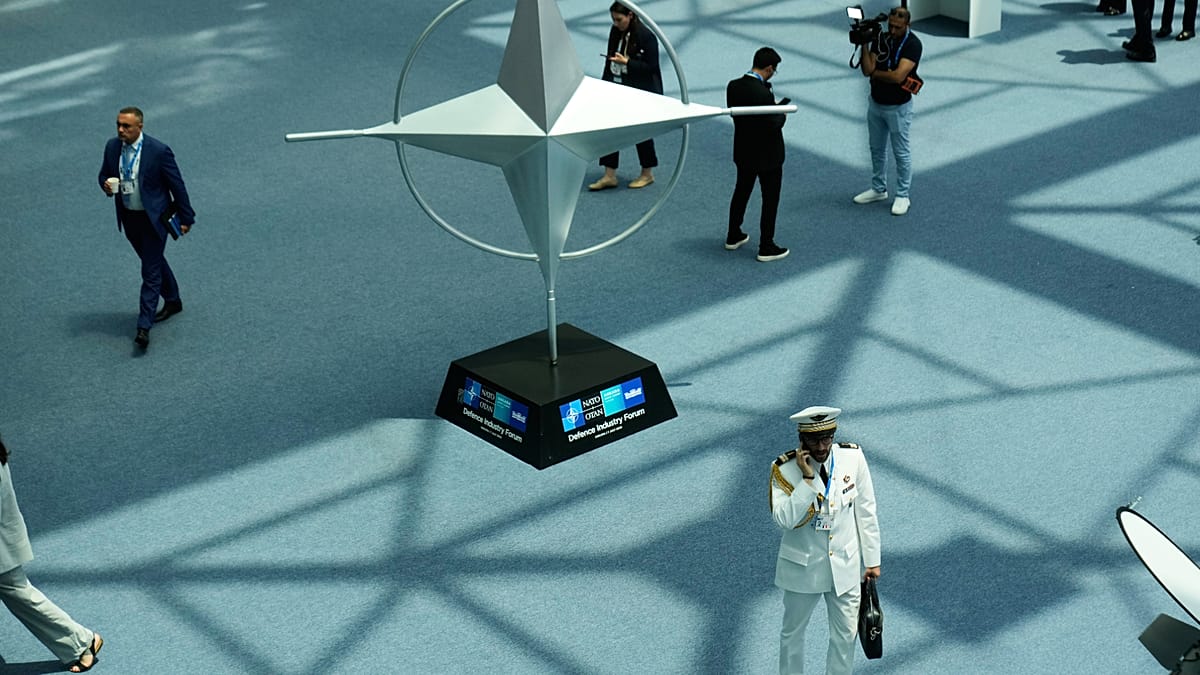
A cluster of mostly smaller NATO allies has committed to a new institution built to finance the West’s military build-up, though the hesitancy of Europe’s heavyweight nations casts doubt over how much financial firepower it can ultimately command.
Canadian Prime Minister Mark Carney announced the nine founding backers of the Defence, Security and Resilience Bank (DSRB) at the NATO summit in Ankara on Tuesday, calling it a foundation for the allies’ collective security.
The signatories, Canada, Albania, Belgium, Greece, Latvia, Luxembourg, Romania, Turkey and Ukraine, will shape the bank’s initial rules before its planned launch in 2027.
First proposed in 2024 by a group of former NATO advisers, senior military figures and bankers, the DSRB will be headquartered in Canada, with a European base planned in Luxembourg.
Cheaper money for costly rearmament
The timing is deliberate. NATO leaders agreed in June 2025 to lift defence spending towards 5% of GDP by 2035, a target that will demand vast sums of new capital.
The problem is no longer simply persuading governments to spend more on defence.
As military budgets expand across NATO, many defence suppliers, particularly smaller companies, still struggle to secure affordable financing, while commercial lenders have often been reluctant to back the sector.
The DSRB idea borrows from the development-bank playbook.
By pooling members’ capital and pursuing a triple-A credit rating, the bank aims to borrow cheaply on international markets and pass those lower borrowing costs on through loans and guarantees, raising up to £100 billion (€117bn) for defence projects.
The ultimate goal is to channel cheaper, long-term financing to governments and defence companies, while also providing guarantees to commercial banks.
If successful, the DSRB could reshape how Western governments finance defence and complement annual defence budgets, similarly to how the European Investment Bank has helped finance infrastructure across Europe or the World Bank in developing nations.
Major lenders including JPMorgan, Deutsche Bank, Commerzbank and ING have already lined up behind the project, alongside Canada’s biggest banks.
The missing heavyweights
For all that ambition, the roster is conspicuously light at the top.
No G7 economy other than Canada has signed up, and the big European military spenders, Britain, Germany and France, are holding back, which analysts warn could cap the bank’s financial reach.
“This is a beginning, but they may have been hoping for the backing of bigger European players,” said Linus Terhorst of the Royal United Services Institute, though he added that the current commitments should be enough to get the bank “airborne”.
Germany has joined discussions as an observer, while Canada says talks are progressing with South Korea.
One reason some large European countries have not joined is that Britain is backing a potentially rival initiative.
Britain is spearheading a separate proposal, the Multilateral Defence Mechanism (MDM), alongside the Netherlands, Finland and Poland, the last of which signed up on Monday.
Also targeting a 2027 launch, the MDM is designed less as a bank and more as a joint procurement vehicle, letting members buy and stockpile equipment together and keep it off their national balance sheets.
“The multilateral defence mechanism will enable us to procure jointly and stockpile equipment off the balance sheet, ensuring better value for money for taxpayers,” UK Chancellor Rachel Reeves said in the House of Commons last month, during a debate on the Defence Investment Plan.
Rather than framing the two as rivals, London casts them as complementary, with Reeves saying Britain is working with Canada on both and positioning the DSRB as the lender to smaller supply-chain firms.
The prospect of overlapping structures, set alongside the European Union’s own SAFE defence loan instrument, underlines how urgently, and how experimentally, Western governments are scrambling to mobilise private capital for defence.
Canada says the door remains open to new members.
Whether Europe’s largest economies eventually join, back rival initiatives or continue with existing EU mechanisms will largely determine whether the DSRB becomes a major pillar of Western defence finance or remains a smaller institution.