
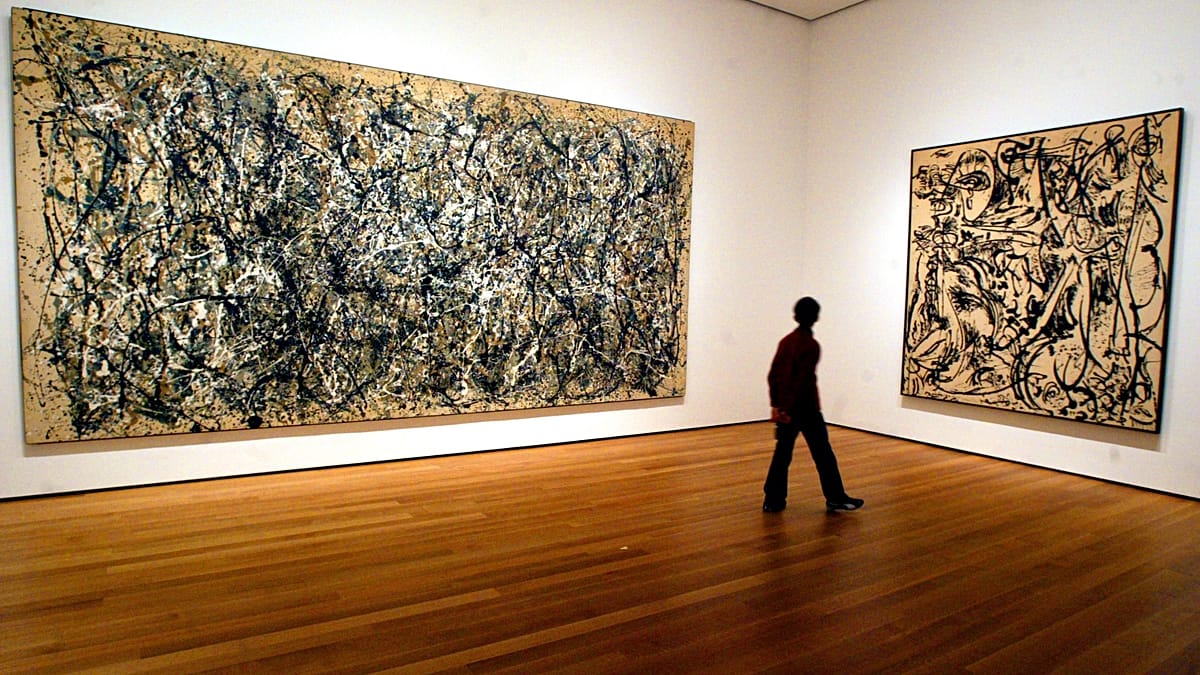
‘A child could have done that’ is modern art’s most banal criticism, but in the case of Jackson Pollock, the cynics are actually right.
The US artist of the abstract expressionist movement was the master of the drip painting, where he dribbled, scattered and flung colours onto a canvas laid on the floor.
A new study has found that Pollock’s style is hard for adults to replicate, whereas children find it… child’s play.
Can you tell if a painting was made by a child or an adult?
And when it comes to the artist, can we reliably tell if an artwork has been created by children or adults? This was the question researchers behind a new Frontiers in Physics study wanted to test.
While sceptics saw talentless disorder in Pollock’s paintings, the real drive of the artist was to reflect on canvas the controlled mechanics and movements of his body as he painted.
Physicist and artist Richard Taylor and his team delved into this idea by asking 18 children aged four to six, as well as 34 adults aged 18 to 25, to create their own Pollock-inspired artworks by splattering diluted paint onto sheets of paper placed on the floor.
These ‘pour paintings’, as the research team calls them, were then subject to careful mathematical analysis.
The scientists studied the pictures’ fractals – patterns that repeat at different scale sizes such as in trees, clouds, and mountains – and lacunarity, which focuses on variations in the gaps between paint clusters.
Based on this, the paintings were scored for the complexity of their patterns and blank spaces.
The results showed that adults’ paintings had higher pattern densities and wider paint trajectories, with lines shooting off in many directions.
Children’s paintings, on the other hand, were characterised by smaller fine-scale patterns and more gaps between paint clusters. They showed simpler, one-dimensional trajectories that changed direction less often, reflecting the differences in their bodies’ movement compared to adults.
Children’s artworks were more similar to Pollock’s paintings
The researchers found that the paintings of the younger group bore more similarity to the artworks of the abstract expressionist school.
“Remarkably, our findings suggest that children’s paintings bear a closer resemblance to Pollock paintings than those created by adults,” Taylor said.
The study posits that changes in an artist’s biomechanical balance may be the reason why children can more accurately replicate their work.
Pollock’s balance was impaired by an incident at birth, when he was almost strangled by his own umbilical cord.
This potentially made his body’s movements simpler and more childlike when painting.
“Along with Claude Monet’s cataracts, Vincent van Gogh’s psychological challenges, and Willem de Kooning’s Alzheimer’s condition, art historical discussions of Pollock’s limited biomechanical balance serve as a reminder that conditions that present challenges in aspects of our daily lives can lead to magnificent achievements in art,” said Taylor.
Childlike pour paintings are more visually pleasing
The authors of the study also looked at how their adult volunteers’ artworks were perceived by the public.
Viewers were asked what they thought about the paintings’ complexity, visual interest, and pleasantness. The results showed that those paintings with more gaps and less complex fractal patterns were perceived as more pleasant.
Children’s paintings, although not analysed, also have those characteristics.
Pleasantness may have to do with familiarity, the researchers said.
“Our previous research indicates that our visual systems have become ‘fluent’ in the visual languages of fractals through millions of years of exposure to them in natural scenery,” Taylor explained.
“This ability to process their visual information triggers an aesthetic response. Intriguingly, this means that the children’s poured paintings are more attractive than the adult ones.”