
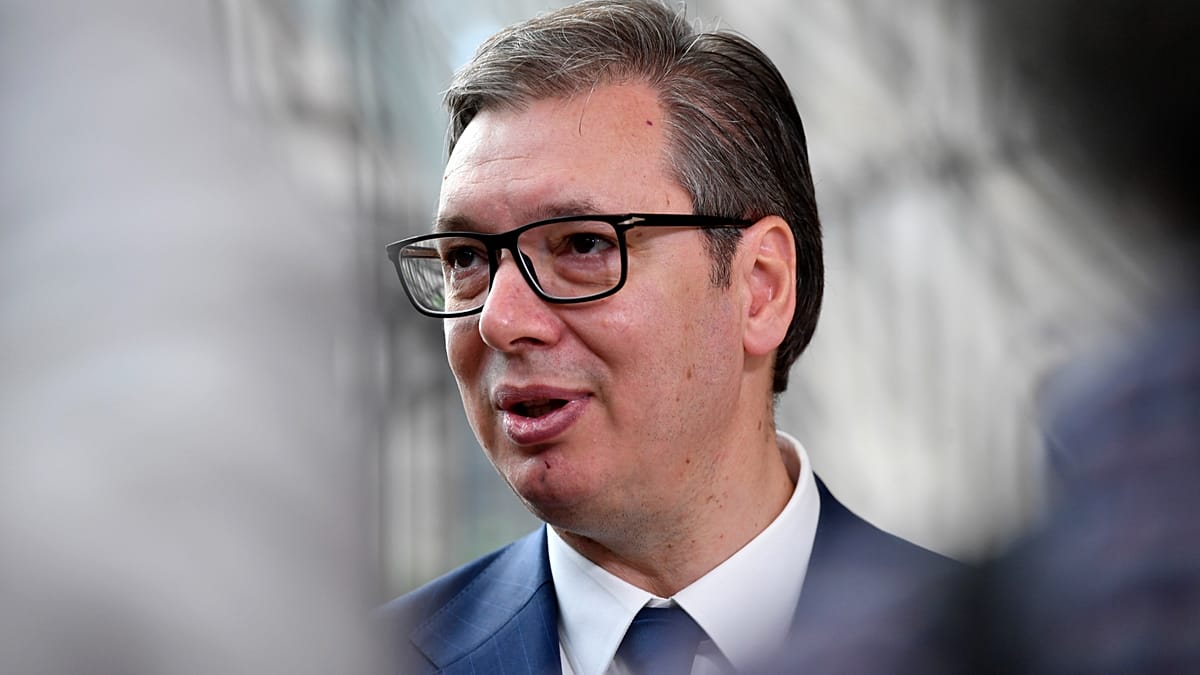
Montenegro is the frontrunner to join the European Union. But officials, diplomats and experts fear Belgrade will do everything it can to prevent that from happening, leaving Brussels in a difficult position between the two candidate countries.
While Montenegro closes in on the finish line, Serbia’s accession bid looks dead in the water: Belgrade has yet to open all negotiation clusters with the EU, and eight member states blocked its latest attempt last month.
“We see some actions by the [Serbian] government and opposition parties that complicate the internal situation in Montenegro,” MEP Tonino Picula (Croatia/S&D) told journalists ahead of the July plenary vote on the annual progress report on candidate countries.
Three officials working for the European Commission and national governments acknowledged they were aware of these attempts to interfere with Montenegro’s internal affairs — a unique complication for the EU.
Division attempts
“Serbia is doing whatever it can to shape Montenegro from the inside, influencing what we are as a country,” Jovana Marović, a former Montenegrin deputy prime minister, told Euronews.
“These efforts will continue after Montenegro joins the EU, but accomplishing certain goals will prove much harder.”
Marović pointed to several initiatives she believes Belgrade is pursuing to derail Montenegro’s accession process, including an attempt to elevate Serbian to an official language alongside Montenegrin by enshrining it in the country’s constitution.
Another controversy centred on a recent attempt, halted by the Ministry of Culture, to rename Podgorica’s National Library — named after Radosav Ljumović, a prominent anti-fascist — after Marko Miljanov, a military leader and writer closely associated with the Montenegrin-Serb historical tradition.
While Marović did not question Miljanov’s historical legacy, she pointed to a recurring pattern: anti-fascist heritage being targeted in favour of identity politics.
“Serbia is systematically trying to create ethnic divisions,” Marović said, pointing to municipal-level initiatives pushed by pro-Serb political forces to “annul” Montenegro’s recognition of Kosovo.
Even so, Marović stressed, these attempts have so far failed to derail the accession process. Montenegro’s political elite has remained cohesive, shown by the broad majority — 74 of 77 lawmakers — that voted in July to open the constitutional reform procedure, with only the hard-line pro-Serb party opposed.
That consensus was reaffirmed in late August, when the constitutional amendments themselves were adopted by a two-thirds majority of 68 votes.
Historic tensions
As is often the case in the Western Balkans, Montenegro and Serbia share a long and fraught history. Montenegro was recognised as a sovereign state at the Congress of Berlin in 1878, then lost that independence to Serbia before regaining it in 2006.
Marking the 20th anniversary of Montenegro’s independence in May, Serbian President Aleksandar Vučić dismissed the event as “a glamorous celebration of secession from my Serbia,” and said attending would amount to “a spit in the face” for Serbs.
The following month, Vučić did attend the EU-Western Balkans Summit in Montenegro’s Tivat, where he said Serbian intelligence had warned him of a high security risk over a possible assassination plot by Montenegrin criminal clans.
“Relations between Serbia and Montenegro have declined in recent months. Serbia might want to be a spoiler for Montenegro’s accession process,” Florian Bieber, coordinator of the Balkans in Europe Policy Advisory Group, told Euronews.
“Montenegro joining the EU creates uncomfortable questions for Serbia,” Bieber said.
According to the Polish Centre for Eastern Studies, Belgrade could try to destabilise Montenegro to derail its EU accession, since Montenegrin membership would undercut Serbia’s regional leadership role and weaken its influence in Podgorica.
Roughly a third of Montenegrin citizens are ethnic Serbs, and Belgrade has maintained substantial influence over its neighbour through aligned political actors, media outlets and the Serbian Orthodox Church.
“Serbia has no interest in interfering with Montenegro’s EU accession process,” Serbia’s Ambassador to the EU, Danijel Apostolović, told Euronews.
“Our focus is on our own reform process and economic growth. At the same time, I regret the lack of a strategic decision by some EU member states regarding Serbia. The European Commission has recommended the opening of Cluster 3 five times, yet we have still not been able to open it,” he said.
EU enlargement hurdles
For Brussels, the deteriorating relationship between Serbia and Montenegro poses a unique challenge: Podgorica is the candidate country closest to joining the bloc, while Serbia is widely regarded as the most important country in the Western Balkans.
The Commission’s recent attempt to put Serbian accession back on the table was prompted precisely by pressure from member states that consider Belgrade too important and influential in the region to be left behind.
Similarly, the need to maintain the geographical balance between candidate countries might prompt some member states to link Ukraine’s accession bid to making progress with the Serbian enlargement process.
For Belgrade, the accession process is not merit-based but driven largely by geopolitics: it points to the presence of some of the region’s strongest criminal clans in Montenegro as evidence that the rule of law there falls short of EU standards.
Despite Serbs being Montenegro’s largest ethnic minority, according to the 2023 census, Belgrade notes that Montenegro does not recognise Serbian as an official language, while Serbia recognises several minority languages at regional and local level.
By contrast, Podgorica attributes Montenegro’s progress on the reforms needed to join the EU to an inclusive approach that brings all ethnic groups into the decision-making process — an approach that marks it out as an outlier in the Western Balkans.
Yet while some pro-Serb parties have taken part in the reform process, others have acted as “agents of a foreign country,” a diplomat who asked not to be named, given the sensitivity of the topic, told Euronews.
“Serbia can threaten the EU accession path,” the diplomat warned. “Montenegro is different from its neighbours because of its political stability and daily work to accommodate all interests. Other countries’ political elites have made different choices.”
Ethnic divisions run deep in Western Balkan societies, and their re-emergence would immensely complicate Montenegro’s resolve to carry out the needed reforms in the last stretch to full EU membership.
Thus, whether the current unity holds under future pressure will decide Podgorica’s path to EU membership. Meanwhile, Brussels will be awkwardly watching.