
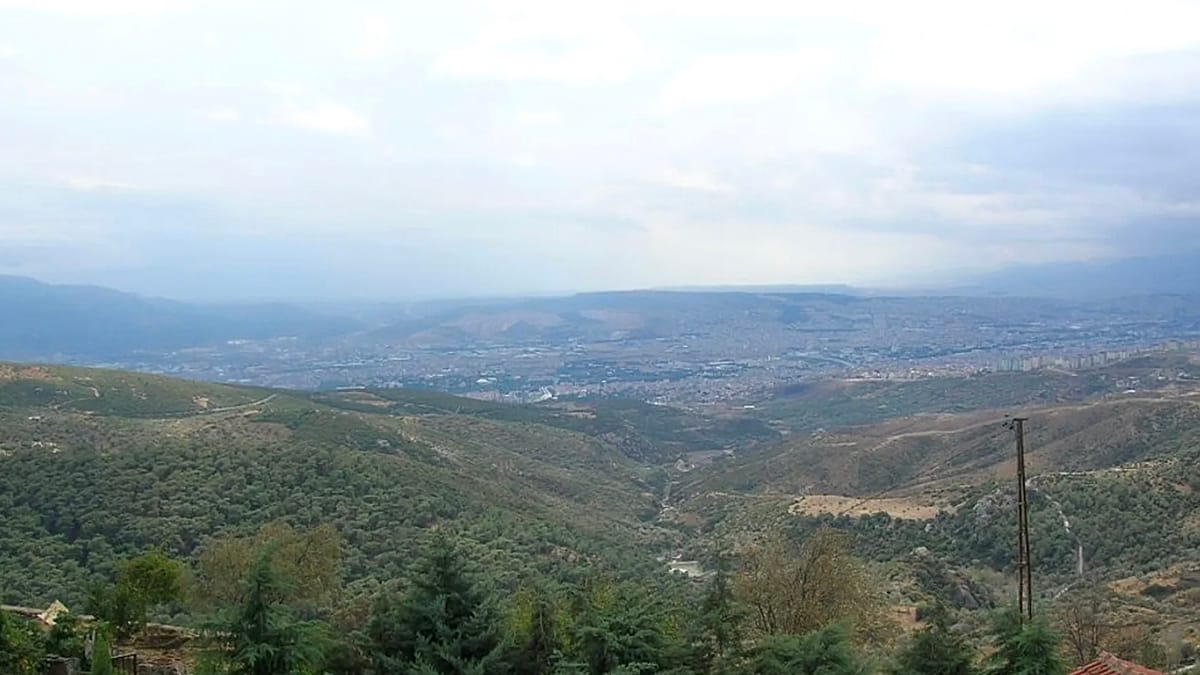
Nestled along the olive-strewn hillsides outside Izmir, a moisture-dampened cave in the Bornova Valley has long held a sacred place in local lore.
Generations of residents have passed down the belief that it was inside this very cavern that the ancient poet Homer sat down to compose “The Odyssey”.
As Christopher Nolan’s film adaptation The Odyssey has become one of this year’s biggest hits both critically and at the global box office, a global frenzy has reignited an age-old literary mystery: Where was literature’s seminal text actually written?
For Turkish archaeologist Prof. Aylin Ümit Erdem, an expert at Ege University, the cinematic craze offers a vital opportunity to re-examine the historical, linguistic, and physical realities connecting Homer to ancient Smyrna, modern-day İzmir.
“When we evaluate Homer, we are dealing with the accepted author of the Iliad and the Odyssey,” Prof. Erdem said in an exclusive interview with Euronews. “Scholars have long debated how an 8th-century BC poet could depict the Trojan War – an event that occurred 400 years earlier – with such vivid detail and tragic depth. Some credit a 400-year continuous oral tradition, while others view the epics as a compilation of stories by various bards.”
Regardless of authorship debates, Prof. Erdem emphasizes that ancient sources overwhelmingly point toward Izmir.
“From the 5th-century BC historian Herodotus to the 1st-century BC geographer Strabo, ancient authors explicitly claimed Homer was from Smyrna. While candidates like Chios or Cyme were raised, Smyrna has stood since antiquity as one of the strongest contenders.”
The Smyrna connection
According to Prof. Erdem, the primary scientific arguments linking Homer to Izmir lie within the language of the texts and the urban geography of the 8th century BC.
“The epics were written predominantly in the Ionic dialect, but they contain significant Aeolic vocabulary and archaic Greek terms,” Prof. Erdem told Euronews. “Geographically, 8th-century BC Smyrna -located at Bayraklı Höyük- sat directly on the boundary separating the Aeolian region to the north from the Ionian region to the south. Bayraklı was founded as an Aeolian settlement before joining the Ionian League. A bard composing in this specific hub would naturally utilize this unique dual-dialect vocabulary.”
Furthermore, Erdem underscores that Bayraklı Höyük represents the only active, fortified urban center in the İzmir basin during the 8th century BC, making it the primary historical setting where Homer would have lived.
However, addressing popular claims of direct physical traces, Prof. Erdem maintains strict scientific caution, drawing a clear line between late ancient reverence and direct 8th-century BC proof.
“We must be clear: we do not yet have direct, concrete archaeological evidence explicitly proving Homer lived or wrote in Smyrna,” Prof. Erdem emphasized to Euronews. “Direct 8th-century BC artifacts inscribed with Homer’s name have not been unearthed at Bayraklı, largely because those deep early strata have not yet been fully exposed across wide excavation areas.”
Prof. Erdem notes that later artifacts, such as Hellenistic coins minted in Smyrna bearing Homer’s portrait or the seated cult statue found at the nearby sanctuary of Klaros, reflect how later generations claimed the poet as a native son rather than providing proof from his actual lifetime.
“Sustaining archaeological excavations with the support of our Ministry of Culture and Tourism and local authorities is vital,” Prof. Erdem added. “If a direct finding linked to Homer is ever to emerge, it will come from digging deeper into these layers.”
While academia awaits definitive excavation results, local enthusiasm in Izmir has reached a peak, fed by centuries of folklore.
Along the hillsides outside the city, a damp cavern in the Bornova Valley has long been revered by locals as the site where Homer composed his masterworks. Ancient texts frequently referred to the bard as Melesigenes (“born of the Meles”), referencing the river flowing beside Bayraklı.
“Preserving Homer’s legacy is a duty we owe to humanity,” Bornova Mayor Ömer Eşki told AFP, detailing municipal plans to restore the cavern for international cultural tourists. “The stories he tells belong to this landscape.”
Local researchers also point to ancient reliefs mirroring the physical contours of the Bornova cave.
“This place was always called Homer’s Valley. For me, there’s no doubt he is from these lands,” Turkish researcher Altan Altın explained to AFP, adding that the poet’s legacy bridges regional histories. “Homer is 2,800 years old, while modern borders are just a century old. Homer is Greek. Homer is Anatolian.”
Archaeologists like Mehmet Akif Erdem also noted that coins and statues prove ancient residents viewed Homer as their own. Yet, as Prof. Erdem highlights for Euronews, while historical and linguistic paths consistently lead back to ancient Smyrna, the ultimate physical proof still rests beneath the earth.