
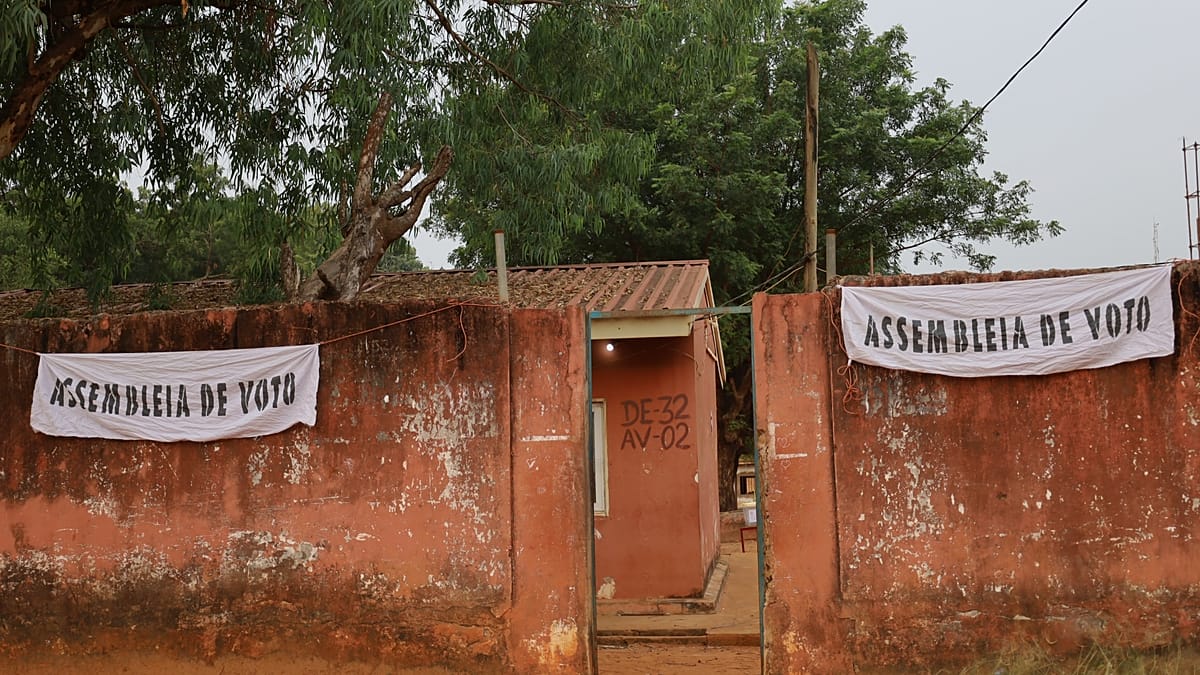
Military-run Guinea-Bissau will hold a referendum on Sunday on a constitutional change that would give the president more powers ahead of a general election meant to restore civilian rule later this year.
This new constitution was presented by transitional, unelected bodies that emerged from the military coup d’état last November.
Bubacar Turé, who heads the Guinean League for Human Rights, told Euronews that at this stage, only the “yes” camp is running an official campaign and is doing so “in all regions.”
“There is a campaign under way led by the military, their political supporters and also some senior figures from the previous regime, who are likewise associated with the transition now in force,” he explains.
Turé points out that advocates of a “no” vote are not authorised to campaign, at a time when “several freedoms are suspended.”
“The climate is not favourable, it is not a climate of freedom,” he concludes, adding that the opposition is issuing a call to boycott.
“There is also a strong appeal for a boycott, not only from political parties but also from civil-society organisations.”
Absolute farce
The main opposition party, the historic African Party for the Independence of Guinea and Cape Verde (PAIGC), is likewise calling for a boycott. The PAIGC says the referendum is “a staging meant to give the appearance of legitimacy to the new constitution” and that the institutions that arose from the coup d’état are “devoid of any democratic legitimacy.”
In its decision, the party also notes that the authorities are preventing the “no” side from campaigning.
All this, it says, is happening in “a context of severe restrictions on public freedoms,” with political activity suspended.
In an interview with RTP, the PAIGC leader called the referendum an “absolute farce.”
Domingos Simões Pereira even said that “what will happen on 30 August is the continuation of the coup d’état carried out on 26 November.”
But the transitional authorities defend the document. In an interview with RFI, the second vice-president of the Transitional Council, the body replacing parliament, Nelson Moreira, said that the current constitution has often been cited as “the cause of instability in Guinea” and that “through the High Military Command it was possible to turn that dream into reality.”
Nelson Moreira also defended the legitimacy of the process.
Constitution already published
Bubacar Turé says the text being put to a vote entails “an excessive concentration of powers in the hands of the president of the republic.” The president will chair the Council of Ministers and while the post of prime minister remains, there is now new wording on how the holder is appointed.
“In the previous constitution, the requirement for appointing the prime minister was based on the election results,” says the human-rights activist. “This new constitution, however, adds the existence or not of a parliamentary majority that guarantees stability.”
“This opens up the possibility that legislative elections will have no meaning at all.”
The activist also points out that the chapter on constitutional review has been removed.
“This constitutional revision has done away with that chapter, which is absurd, strange and extremely dangerous for the rule of law and for democracy,” says Turé.
The way the process unfolded also draws sharp criticism from Bubacar Turé.
“No one was consulted – not political parties, not civil-society organisations, let alone traditional leaders, religious leaders, and so on. Everything was done in secret.”
He also notes that the constitutional text itself has already been published in the Official Gazette.
“What legal effect can this referendum have if the constitution is already in force, since it has already been approved, promulgated and is in force in Guinea-Bissau?” he asks.
‘Nobody knows where this will end’
Tamilton Teixeira is a university professor and commentator on various Guinean media outlets and on RTP África. In an interview with Euronews, he too takes a critical view of the process.
“Nothing guarantees that this process is not just a mere formality,” he says, also highlighting the publication of the constitution.
The professor says that “there are no perfect constitutions” and that the need for constitutional revision in Guinea-Bissau has long been acknowledged. But he questions the fact that it is being carried out under these conditions.
“It could have been done through a constitutional reform that was legal and democratic, which is not the case now. Nobody knows where this will end, what it will lead to,” the commentator says.
“We are talking about an armed group that seized power…and then began to raise issues that we could never have imagined would be among its concerns,” he stresses.
“What has already been put down on paper, as anyone who has followed events will know, reflects the way Embaló behaved as president throughout this period,” he says, in a reference to former president Umaro Sissoco Embaló. “In other words, he has to do things when he wants to do them, even when the law does not allow it.”
“What is being put to a vote is the way Umaro [Embaló] has run the country over the past six years,” he concludes.
A “tired and worn-out” opposition
Umaro Sissoco Embaló was sworn in as president in 2000, in an election result that was contested by candidate Domingos Simões Pereira. His almost six-year presidency was marked by political instability. Embaló dissolved the National People’s Assembly in 2022 and again in 2023.
He eventually called elections in November last year. But, a day before the provisional results were due to be announced, Guinea-Bissau was hit by a coup d’état carried out by the military. At the time, several activists were talking about the victory of Fernando Dias, an independent candidate standing for PAI-Terra Ranka, a coalition backed by the PAIGC. Sissoco Embaló also claimed victory.
After the coup, Embaló was detained for 12 hours but managed to leave the country for exile. Two weeks ago, the president of the transitional republic, General Horta Inta-A, said the referendum was not intended to bring Embaló back.
The PAIGC leader, Domingos Simões Pereira, was meanwhile detained for 60 days. After returning home under house arrest, he was arrested again on 10 July. At the end of July he was authorised to travel to Portugal for medical treatment.
This week, in an interview with RTP, Domingos Simões Pereira said he had never been ill. He is currently in Portugal, but continues to lead the party. The meeting at which the PAIGC decided to boycott the referendum was held online.
Professor Tamilton Teixeira argues that boycotting the referendum was not the opposition’s best strategy.
“I do not think this is how such processes should be handled. They could also have opted to vote no, rather than simply telling people to stay at home and not take part,” he tells Euronews.
The political commentator says that, at this point, the opposition is drained.
“For various reasons, but also through its own fault, the opposition is highly disorganised and badly worn down by all the turmoil that intensified after the uprisings of 26 November.”
EU should “start with sanctions”
Following the coup d’état, Guinea-Bissau was suspended from the Economic Community of West African States (ECOWAS), the African Union and the Community of Portuguese-speaking Countries (CPLP).
Tamilton Teixeira says the CPLP “has actually done a lot.” He adopts a more critical stance, however, towards the European Union.
“We had a case in which the European Union’s own representative in Guinea-Bissau witnessed an act of aggression against the Casa dos Direitos. He was inside when the building was stormed,” he says, recalling that the bloc has a cooperation agreement with Guinea-Bissau.
The professor even argues that the European Union should impose sanctions.
“Africa’s political elite, not only in Guinea-Bissau, lives here but keeps everything else abroad: family, healthcare, their children’s education, medical check-ups,” he explains. “So the starting point should be sanctions.”
Bubacar Turé also criticises the silence of the international community, particularly the United Nations and the European Union.
“Beyond the situation in general, there are multiple human-rights violations – attacks, abductions, beatings, killings – and all these cases remain unpunished, with no firm stance from the international community in relation to this context.”
Instability as the new normal
As for Sunday’s referendum, Bubacar Turé is expecting a record level of abstention.
“The expectation is that abstention will be the main winner of this referendum, because the appeals now being made will naturally be followed by the overwhelming majority of the population,” he says.
“The population does not know or understand the content of the constitution and does not know what is at stake, because there has been no genuine effort to explain it.”
But Tamilton Teixeira says people do know what is at stake.
“People see [the referendum] as part of everyday normality, which does not mean they are unaware of what will happen on the 30th or of what has been happening around the referendum,” says the professor, adding that the population has already grown used to instability.
After the referendum, general elections are scheduled for 6 December, which, according to the authorities, will mark the end of the transitional government.