
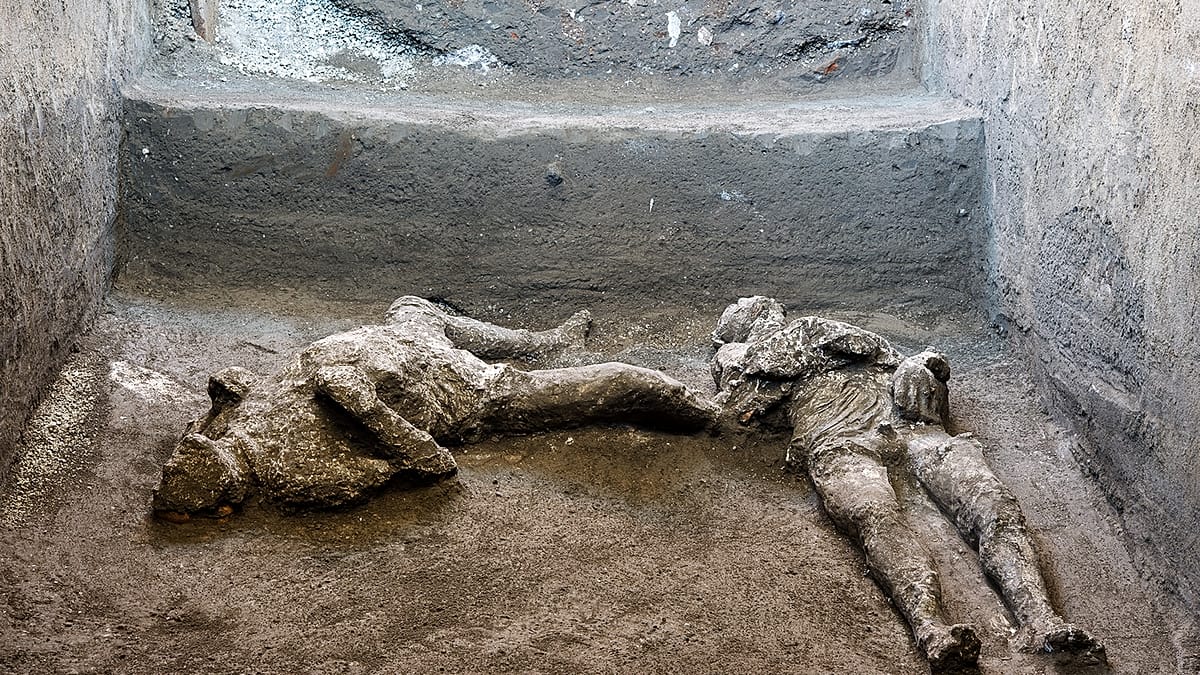
Pompeii did not end in AD 79.. For centuries, while the Roman city remained buried beneath the debris of Vesuvius’ eruption, people went on living among those ruins and kept its memory alive. This surprising story is now being told thanks to a number of new finds in the Insula Meridionalis, in the southern area of ancient Pompeii.
Materials and ceramic artefacts dating from the 15th and 16th centuries have in fact provided fresh evidence of human presence on the site many centuries before the start of the Bourbon excavations, launched in 1748.
The discovery challenges the most common image of Pompeii: on the one hand the Roman city, frozen by the eruption of AD 79; on the other modern Pompeii, brought back to light almost seventeen centuries later. In between, however, lies a far more nuanced story.
The “Pompeii after Pompeii”
“The docu-drama Pompei Fuori dal tempo with Tom Hiddleston, and the work of archaeologist Steven Tuck, show how the theme of the survivors is finally becoming the focus of research and outreach initiatives,” explains Gabriel Zuchtriegel, director of the Archaeological Park of Pompeii.
After the eruption, Pompeii must have looked like a truly post-apocalyptic landscape. And yet, according to new research, it was not completely abandoned. There are traces of people who returned and of communities that continued to use the area.
These, however, were fragile presences, far removed from the grand official narrative. “They are faint traces of precarious lives, in the shadow of official history,” Zuchtriegel points out, explaining why they remained almost invisible for so long.
The finds from the Insula Meridionalis now add another piece to this story. The ceramics and other materials uncovered point to use of the area during the Renaissance, centuries before Pompeii officially returned to prominence with the excavations.
And the Renaissance enters Pompeii’s story
The period is particularly interesting for another reason as well. It is in roughly these same centuries that the Deposition of Christ attributed to Andrea Mantegna, recently rediscovered in the Sanctuary of the Blessed Virgin of Pompeii, was created.
The two stories are not directly connected and belong to separate historical strands. But both tell us something important: Pomeii was not a place completely erased from collective memory.
“Without detracting in any way from researchers such as Gioachino Alcubierre, who came from Spain and promoted the first archaeological excavations at Pompeii in 1748, we have to acknowledge that there was a local community here which, from the very day after the eruption, went on living in Pompeii and guarding its memory,” says Zuchtriegel.
A city never truly forgotten
An apparently simple detail also reinforces this hypothesis: the place name “Civita”, which, according to the director of the Park, bears witness to the local persistence of the memory of a buried city.
Farmers and shepherds who lived among the ancient ruins did not have the tools to describe that heritage in the language of modern archaeology. But that, Zuchtriegel stresses, does not mean they did not remember it.
And this is precisely where the perspective shifts: Pompeii would therefore not be a city “reborn” from nothing in the eighteenth century, but a place that continued, in different forms, to be part of the life and imagination of the local community.
“Pompeii is and has always been a genuine heritage community,” says Zuchtriegel. Its name, then, would not be the outcome of a simple archaeological revival, but the sign of a memory that has remained alive in the area for centuries.
The “Pompeii after Pompeii” is still largely to be told. And the small artefacts found underground this time may prove to be among the most important clues for piecing it together.
Visits to the excavation site
Visitors can tour the Insula Meridionalis excavation site together with the archaeologists and conservators working there. Visits are available, by reservation, from Monday to Friday between 11:00 and 12:00. For information and bookings, you can call 327 2716666.