
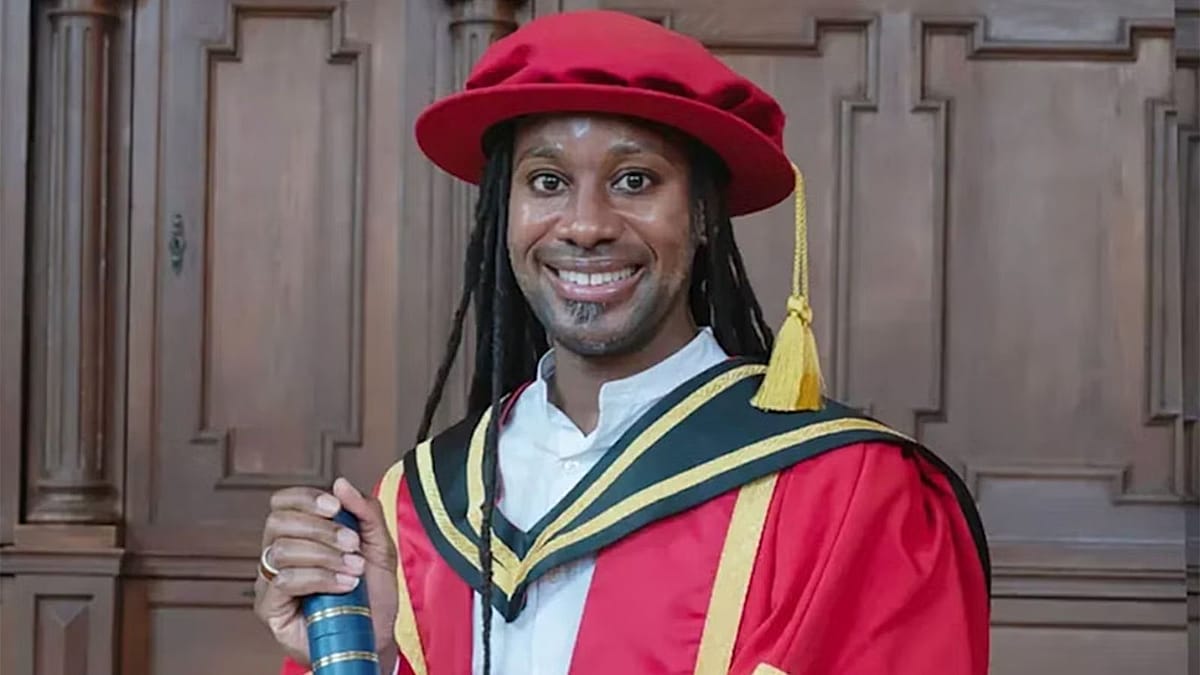
It’s the scandal rocking the highest spheres of British academia, one involving plagiarism allegations, fantastical claims, and not only the downfall of a supposed prodigy but a scathing indictment of one of the UK’s most prestigious educational institutions.
It all centers on Jason Arday, a professor of sociology of education who has resigned from his post at the University of Cambridge after the university launched an inquiry into his “academic qualifications and honorary appointments”.
A university statement said: “The University of Cambridge has begun an investigation following new information about Professor Arday’s academic qualifications and honorary appointments. In order to ensure a fair process, we will not comment further until this has concluded.”
The statement added: “Separately, there remains a number of ongoing complaints regarding academic misconduct, which are being handled in line with our misconduct in research policy.”
The scandal has brought into question Cambridge’s hiring policies, with many exploiting Arday’s story as a means to stoke the flames of culture war regarding representation and DEI (Diversity, Equity and Inclusion) initiatives. No doubt these heated debates will continue, as Arday’s planned memoir, “Great And Unfortunate Things”, co-authored with Eve Claxton, is set to be published in the UK on 27 August – despite the ongoing controversies.
Who is Jason Arday?
Born Jason Atta Kwei Arday on 9 May 1985 to parents orginally from Ghana who lived on a Clapham council housing estate, Jason Arday is the British academic who received a PhD from Liverpool John Moores University in 2015.
He supposedly taught sociology at both Durham University and the University of Glasgow, before publishing papers on critical race theory, racism in the British education sector and his experiences with neurodivergence.
In 2023, at the age of 37, he became the University of Cambridge’s youngest Black professor and a Fellow of Jesus College.
At the time, they proudly declared that he was the 800-year-old institution’s “youngest Black person ever appointed to a professorship”, joining only five other Black professors at Cambridge.
Bhaskar Vira, the university’s pro-vice-chancellor for education, called Arday “an exceptional scholar of race, inequality and education”, adding that he would “contribute significantly to Cambridge’s research in this area and to addressing the under-representation of people from socioeconomically disadvantaged backgrounds, especially those from Black, Asian, and other minority ethnic communities…”
Vira added at the time: “His experiences highlight the barriers faced by many under-represented groups across higher education and especially at leading universities. Cambridge has a responsibility to do everything it can to address this by creating academic spaces where everyone feels they belong.”
After being appointed a professor of sociology and education, media coverage ensued. Arday made television appearances, was awarded several honorary doctorates, and benefitted from positive attention that led many to consider him a “superstar academic”.
However, with his new prestigious status as an academic pioneer came increased scrutiny over Arday’s background and credentials.
Too good to be true?
A few weeks ago came serious allegations of academic misconduct, with initial accusations of potential plagiarism.
In April of this year, Arday delivered a keynote speech at the British Sociological Association, in which he argued that white conservative and right-wing activists used a “playbook” to target Black academics. He called this a “cancer” that his peers should “eradicate from academia”.
The allegations of Arday’s plagiarism were then made public in July.
A Substack post by Nathan Cofnas, a philosopher at the University of Ghent and a self-defined “race realist” who was fired by Cambridge’s Emmanuel College in 2024, claimed that Arday’s PhD thesis, titled “An exploration of peer-monitoring among student teachers’ to inform reflective practice within the context of action research”, was plagiarized after having been put through plagiarism detection software.
The Telegraph reported that analysis had found more than 100 passages in his PhD were similar to another thesis by Paula Zwozdiak-Myers, a student at Brunel University in London, published six years earlier.
In their article, titled “Cambridge’s diversity poster boy in plagiarism row”, the Telegraph cited Dave Harris, emeritus professor at Plymouth Marjon University, who had alerted Cambridge and Liverpool John Moores Universities to his concerns about plagiarism in 2023. He is quoted as saying: “In my opinion, important sections of the work of Professor Jason Arday, both his PhD thesis and some subsequent published articles, solo and jointly written, seem to display indications of serious plagiarism. I can think of no other plausible explanation for what I have read.”
When these allegations were raised, a backlash started, with the University of Cambridge initially saying that those raising concerns about Arday’s academic integrity were doing so for racist motives.
Cambridge said Arday had been the victim of a “vile campaign to undermine his credibility”.
Further complicating things were reports that a Times Higher Education reporter Jack Grove had previously investigated Arday’s alleged plagiarism, assembling a report in September 2025. He contacted Arday for a comment, and Arday responded with a legal letter from the firm Carter-Ruck. The Times Higher Education did not publish the story.
It turns out that Arday also made a complaint about Grove to London’s Metropolitan Police, which started a four-month-long investigation into the journalist.
Mark Rowley, Met Commissioner, later acknowledged that they had “dropped the ball” and that the complaint about Grove should have been “screened out earlier on as not requiring investigation”.
This investigation into a journalist who was only seeking a right of reply brought criticism on social media that the UK were under some sort of “police state” and that the Met were to be held accountable for such action.
Further allegations then came to light regarding Arday’s backstory…
More tall tales?
From plagiarism to fabulism…
On 1 August, The Guardian published its own investigation by Lanre Bakare, highlighting wider discrepancies in claims Arday had made about his life. His story is to be detailed in a memoir for Simon & Schuster, still set to be published later this month.
Details reportedly include that Arday was diagnosed with autism at the age of three; that he was non-verbal until the age of 11; that he was unable to read or write until 18; that he ran 600 miles in six days – soemthing which would make him one of the greatest long-distance runners and endurance athletes in the world; and that he claimed to have raised more than £5 million for charities by running 30 marathons in 35 days – including nine marathons with a hairline fracture in a fibula.
When asked by The Guardian about the £5m figure, Arday clarified that the money was raised with the help of “many fundraising collectives over a two-decade period”.
Arday also claimed that he received online abuse following his appointment at Cambridge, and that an armed masked man had come to his work and threatened him. An investigation by The Guardian found that there was no evidence of this intruder on CCTV and that no other staff had reported seeing the figure.
Arday also claimed that a pig’s head had been sent to his parents’ South London home. He stated that the Metropolitan Police had identified the butchers’ shop from which the pig had been purchased. However, The Guardian found no supporting evidence of these claims and the Met denied that an inquiry had taken place.
Many have raised concerns that these stories are tall tales, and when Bakare challenged Arday on a lack of evidence for some of his claims, Arday said: “To be honest with you, I thought you’d just believe me. Why would I lie?”
His memoir, “Great And Unfortunate Things”, details his “improbable triumphs and heart-breaking setbacks”, according to publicity material for the book. Scrutiny regarding his impressive achievements has reportedly led some stories to be amended or even deleted from the biography.
In an interview with The Times, Arday has further denied claims of lying, saying: “We’re talking about academia here. I didn’t murder somebody. I think the cruelty that I’ve experienced and the positioning of me as this kind of liar and fantasist is totally unacceptable.”
What now?
In a resignation letter published on 5 August on the Good Law Project’s website, Arday said: “While criticism is an inevitable part of academic life, what I have experienced has gone far beyond scholarly disagreement.”
“The relentless accusations, speculation and public commentary have taken a profound toll on me and on those I love.”
He added that the “only way to bring this chapter to an end” was to step away, writing: “This decision should not be interpreted as a loss of faith in scholarship or in the values that first brought me to Cambridge. Nor should it be mistaken for an acceptance of the narratives that have surrounded me. It is simply the decision of someone who has reached the limits of what any person should reasonably be expected to endure.”
“The response from so many people across the world was overwhelming. Thousands celebrated not simply my appointment, but what it represented: that talent, perseverance and hope can triumph over even the greatest adversity.”
Arday concluded his letter by saying he needed “time to heal.”
“I need time to simply be myself again. And when that time comes, I will return.”
Making things worse for Arday are reports by The Times, which used detection software that suggested that the resignation letter had been written using artificial intelligence.
The most recent development has been Arday cancelling several events planned in his book tour, including an event in Edinburgh and a “fireside chat” at the Royal Geographical Society.
Who is to blame?
As to be expected, Arday’s fall from grace has led rightwing media outlets and commentators to pile-on and exploit his story, making him their poster boy in an ongoing culture war centered around “wokeness” and DEI. It has also led many to cry out that leftist media outlets and figures were too quick to dismiss credible concerns regarding Arday.
The bulk of the blame so far has been aimed at Cambridge University, a historic institution which has been routinely criticised for its track record when it comes to diversity.
Questions of judgement and appropriate screening processes have arisen, with an ongoing accusation that Arday may have been fast-tracked so that the university could capitalise on his image.
A joint letter, led by senior academics including Cambridge professor Priyamvada Gopal, has demanded an independent investigation into how Arday had been appointed in the first place, suggesting that he had been employed by those seeking a “quick fix” for their perceived diversity issues. The letter also expressed concern that the scandal would “set back the modest progress Cambridge has made in addressing historical underrepresentation”.
In a statement released last Friday, Cambridge confirmed: “The university will continue to investigate the circumstances around Jason Arday’s appointment and tenure.”
It added: “The findings will feed into a review of the process for the appointment of senior academic roles. In addition, and as previously stated, the university’s Research Policy Committee will review the misconduct in research policy.”
As of writing, Arday continues to claim he has done nothing wrong.
Is he a liar and fantasist who duped the system with falsehoods and a story of triumph over adversity which many were all too keen to lap up? Or is he a victim of that very same system which has led to an ambitious man being caught in the crossfire of the agendas of both liberal types who have exploited him and far-right figures guilty of scapegoating him?
Both things can be true at the same time. What is clear is that this ongoing scandal defies simplistic mudslinging, with all parties sharing responsibility for the reverberations Arday’s story will have on Black academics and the reputation of UK higher education.
Jason Arday’s memoir, “Great And Unfortunate Things”, is still to be published in the UK on 27 August.