
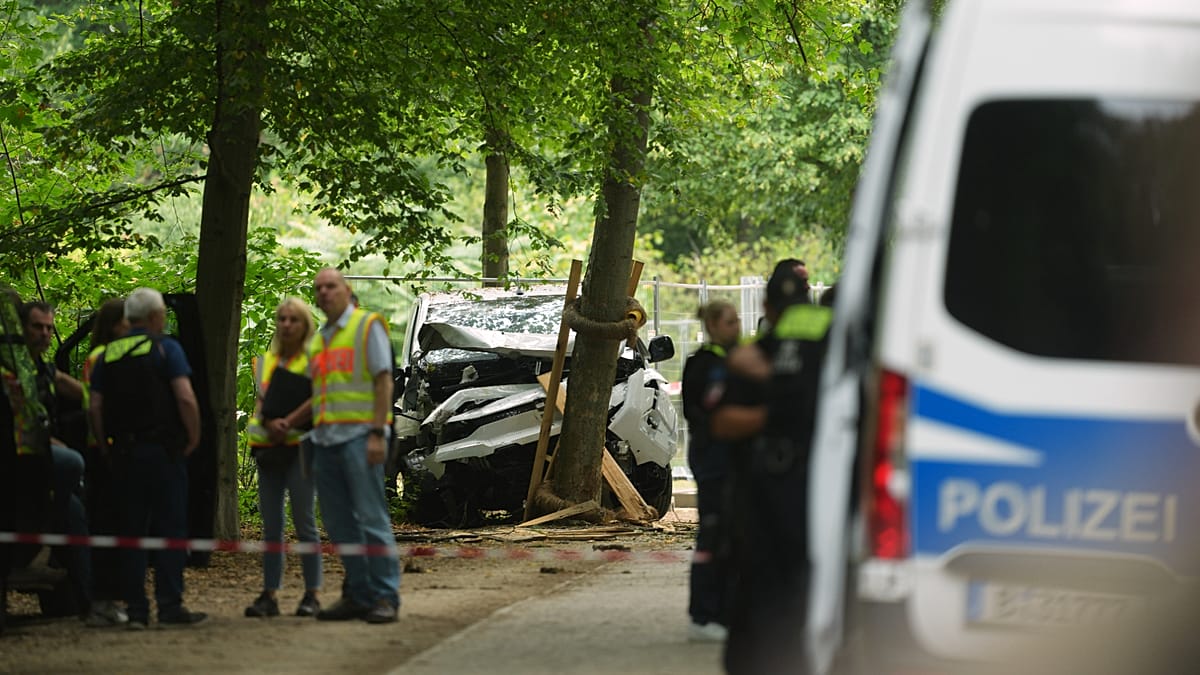
The Berlin Pride attack has reignited questions over whether Europe is adequately monitoring individuals with a history of radicalisation and terrorism-related convictions who may pose a threat, particularly when suspects move across borders.
There is no EU-wide register or official estimate of the number of individuals with established links to terrorism who are being monitored. Europol officials told Euronews that intelligence and security services operate at the national level, with each country applying its own legal definitions, surveillance thresholds and monitoring systems.
Suspect on police radar since 2022
The issue has come into focus after German authorities identified the suspect in the Berlin attack as 21-year-old Abdul Ballout, a German citizen of Lebanese descent known to police for previous violent offences and links to Islamist circles.
Authorities are treating the incident, which claimed the life of one woman and injured 29 others, as an Islamist terrorist attack. The suspect was later shot dead by police.
Ballout had been known to German authorities for several years because of his criminal record, Islamist radicalisation and repeated attempts to join the Islamic State in Syria.
Convicted of assault and robbery-related offences in 2022, he later tried to travel to Syria via Turkey and Lebanon, where he was briefly imprisoned before being returned to Germany.
In May 2026, a Berlin juvenile court sentenced him to 22 months in youth custody for preparing a serious act of violence endangering the state, attempting to join the Islamic State and disseminating the group’s propaganda online.
He was released after the court found there were no longer sufficient grounds for pretrial detention while prosecutors appealed for a harsher sentence.
Authorities had also searched his home earlier this month over suspected weapons offences, although the investigation was dropped after officers found only a toy gun.
Before the attack, Ballout had been ordered to undergo a deradicalisation programme. However, the organisation overseeing it concluded he had attempted to mislead evaluators into believing he had abandoned his extremist views.
Hundreds of potential Islamist threats in Germany
Germany is among the few European countries that publishes detailed figures on Islamist extremism, although authorities distinguish between the wider extremist scene and individuals considered at higher risk of carrying out violence.
The country’s domestic intelligence agency, the Federal Office for the Protection of the Constitution (BfV), estimates that there are around 28,000 people on the Islamist extremist scene.
However, only a small proportion are classified as potential violent actors.
“From the larger group of Islamic extremists, there are about 450 to 470 people who are considered potentially violent,” Dr Raphael Bossong from the German Institute for International and Security Affairs (SWP) told Euronews.
These individuals fall under the German security category **’**Gefährder’ – a term used for people whom authorities believe could potentially commit a serious politically motivated crime.
The number of Islamist Gefährder currently stands at around 446 people, according to figures cited by Bossong from the Federal Criminal Police Office (BKA). However, it fluctuates as investigations develop and individuals are added or removed from monitoring lists.
The numbers also vary among Germany’s federal states. In Berlin, authorities have previously identified around 100 people classified as Islamist Gefährder,although state-level figures are not always publicly available.
Terror threat in Belgium
Belgium also maintains a national watchlist of individuals considered a priority for monitoring under its Terrorism, Extremism and Radicalisation Strategy (T.E.R.), which combines intelligence gathering with prevention and rehabilitation.
According to the Coordination Unit for Threat Analysis, the country’s Common Database on Terrorism, Extremism and Radicalisation contained 529 entities in July 2026. These include 446 linked to Islamist extremism, 47 to right-wing extremism, 12 to left-wing extremism, six to nihilist extremism and 10 to anti-establishment extremism.
“Being included in the database does not automatically mean that someone has been convicted or is in prison,” an OCAD spokesperson told Euronews.
“For every person included, an individual risk assessment is carried out to determine what type of follow-up is required. This may consist of security measures, but also guidance and preventive support through local partners.”
OCAD said Belgium’s approach is based on the principle that terrorism and extremism are “not only a security challenge, but also have a societal component”.
No single European picture
Other European countries also maintain national monitoring systems, but the figures are not directly comparable.
France operates one of Europe’s most transparent systems through theFSPRTwatchlist, which contains several thousand individuals considered at risk of violent radicalisation linked to terrorism. French authorities stress that being included on the list does not necessarily mean someone has committed a crime or belongs to a terrorist organisation.
Outside the EU, the UK has said MI5 manages around 43,000 “subjects of interest” across all terrorism investigations, including Islamist and far-right extremism.
The Netherlands also publishes threat assessments without disclosing the number of individuals under monitoring.
Security experts caution that these figures cannot be combined because they measure different categories, from broader extremist milieus to active intelligence investigations and individuals considered potential attackers.
Europol: No central register, but intelligence sharing continues
The absence of a European-wide statistic has prompted questions over whether the lack of a common database affects cross-border monitoring of suspected extremists.
“Europol does not hold statistics on how many known terrorist suspects are currently being investigated or monitored across the European Union, as member states are not required to share such information with us,” a Europol spokesperson told Euronews.
The agency stressed, however, that the absence of a central figure does not mean that information-sharing mechanisms are missing.
“Counterterrorism investigations are first and foremost a national responsibility,” the spokesperson said. “Where investigations concern individuals with a potential cross-border dimension, member states can share relevant operational information with Europol.”
Europol analyses that information, helps identify links between investigations and facilitates cooperation between national authorities.
“Europol’s role is not to maintain a central register of individuals under investigation, but to support member states in cases where international cooperation is required,” the spokesperson added.
The agency pointed to the EU Terrorism Situation and Trend Report (EU TE-SAT) as the main publicly available source for tracking terrorist threats across the bloc.
The decentralised system means that European security services rely on national intelligence databases combined with information-sharing mechanisms, rather than a single EU-wide watchlist of individuals considered potential terrorist threats.