
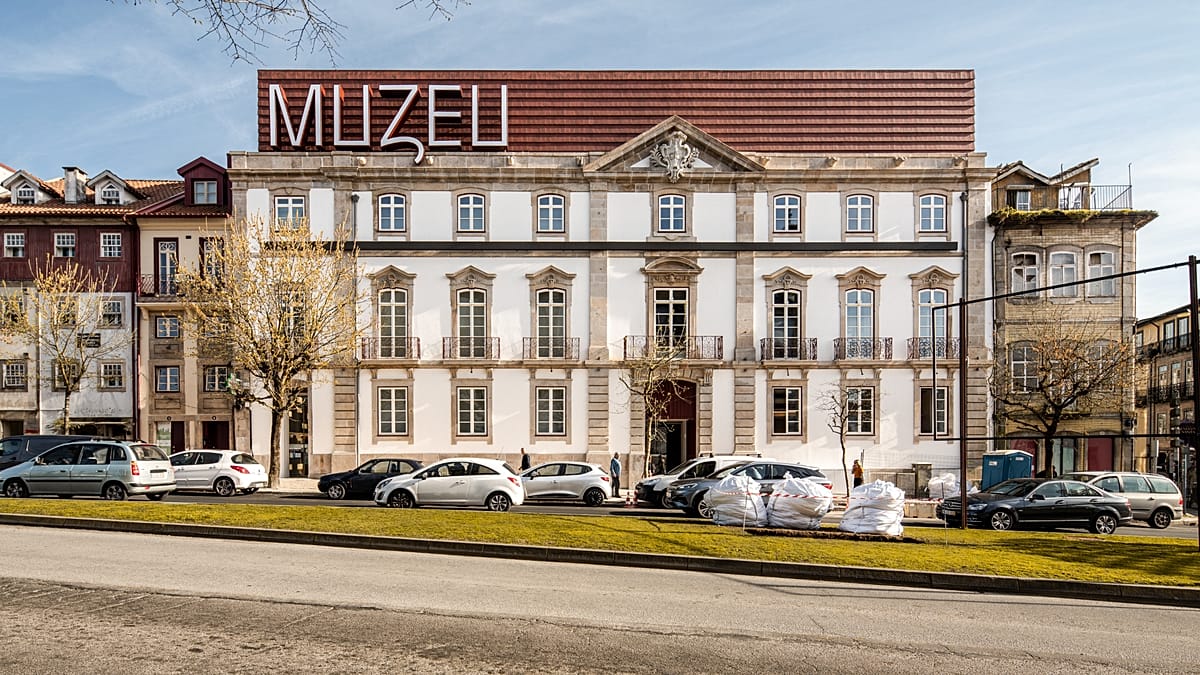
A rally for revolution is the inspiration behind MUZEU, the new contemporary art museum in the Portuguese city of Braga.
Its motto “Be realistic, demand the impossible“ is taken directly from the famous photograph shot by Gérard-Aimé during the civil unrest of May 1968 in Paris, capturing graffiti on the Pont de Neuilly bearing the phrase “Soyez réalistes, demandez l’impossible”.
“May of 1968 was a time of liberation within a country that sought a freedom of movement, not really political, but a freedom to break the social and moral walls of the time that existed“ – founder of MUZEU, José Teixeira, told Euronews Culture.
“Nowadays we are living a new version of May 1968 – morally, socially and ethically. A liberation that opens ourselves and opens the community to the communities and to a communal life. Because today, in the moment we live, especially in Portugal, we value meritocracy, individualism. There is a need for a new debate about the communities and how comprehension and compassion should be brought to the table as a means to solve that as well”.
100 artworks by 84 artists on 5 floors
José Teixeira, the founder of MUZEU is the Chief Executive Officer (CEO) of dstgroup, one of Portugal’s leading industrial companies. He’s also the 35th richest person in Portugal according to Forbes.
Spanning five floors and an exhibition area of approximately 3,000 square meters, his collection brings together more than a hundred artworks by 84 artists – 45 from Portugal and 39 from abroad. A total of 16 countries are represented – comprising 57 men and 27 women.
Among many others Teixiera’s collection features the work of Pablo Picasso, Alex Katz, Artur Lescher, Candida Höfer, Nan Goldin, and Eduardo Batarda.
A dedicated gallery has been set aside for the work of Anselm Kiefer.
Photography holds a uniquely important place in the collection, reflecting one of the Teixeira’s great passions as he believes: “photography captures the moment without taking it away”.
To read, to think and to live in a community
A keen collector over four decades, Teixeira’s company’s campus in Braga is full of large scale works of art, libraries, and sporting equipment for his staff to take advantage of.
Despite his immense wealth and the privilege it provides, Teixeira describes himself as a working man who wants to lead by example.
“Simone Weil is a French philosopher that lived in France during the Nazi occupation of France. She wanted to write about work, so she stopped lecturing classes and sent an application to Renault and worked there as a press operator and milling machine operator,” says Teixeira.
“Later, after working, she wrote a book about it. So if you want to speak about work, you need to know how to do it and do it like Simone Weil – ask the real questions. This is the true importance of literature, poetry, arts, and everything that I spoke about. Poets speak through metaphors, I speak through art works I collect.“
Teixeira likes to think about himself as the signal man, pointing the direction for people working with him and for him – to read, to go to museums, to reflect and think about how to live in a community.
As fragile as people killed by it
A significant element in the new exhibition at MUZEU which opened last Thursday is Handle with care by Lebanese-Canadian artist Elias Nafaa. It comprises of 300 hand-cast glass replicas of weapons used in contemporary conflicts, presented for the first time this year at The Québec City Biennial.
For Nafaa, Handle with care transforms instruments of destruction into delicate objects of contemplation: “I want to make them [weapons] out of a very fragile material so that they are as fragile as what they’re destroying,” he tells Euronews Culture.
“I wanted to reverse the power dynamics, so instead of them looking down on me, I would look down on them, and I wanted to scale them down so they don’t feel as strong or powerful as they are or destructive as they are. This became the start of the work that you see here,“ adds Nafaa.
“18,000 weapons were used by the end of 2025 and I think now it’s over 20,000 that were used on Lebanon by the Israeli army. And what you see here is 300 pieces. I have six models that I researched and identified that were used more commonly.
“The frequency of its use in this space is proportional to its use like in real life so for example the smaller ones which are used mostly you will see more of them in the place the bigger ones which I use a bit less you’ll see less of in this space.”
Visitors should be aware of the difficulties Nafaa had in getting his work exhibited as it was kept in custody for more than two weeks until the eve of the exhibition opening.
Ironically, Nafaa says that while real weapon travel the world mostly fast and freely – legally and illegally – his artwork was being held for a much longer time.
“Handle with Care“ is part of MUZEU’s inaugural programme titled Abrir Abril and is open until 31 October 2026.