
Is France driving away its wealthy in vast numbers? The latest Henley & Partners Wealth Migration Report found that France saw a net loss of 800 millionaires in 2025.
At first glance, it would seem that the wealthy are fleeing the country. However, for context, there are still 2.4 million individuals in France with a net worth of over €1 million, according to the UBS Global Wealth Report.
While France remains an attractive place for the wealthy to live for obvious reasons such as its quality of life and joie de vivre, the overall trend, albeit small for now, is that some of France’s wealthiest citizens are moving and – more importantly – taking their capital.
Last year, each departing millionaire took with them on average €5 million in personal assets, translating to roughly €4 billion leaving the country in total, according to the French Institute for Research on Public Administration and Politics (iFRAP).
Although the number of departing millionaires represents only a tiny fraction of France’s wealthy population, economists point out that the loss of even a relatively small number of high-net-worth individuals can have an outsized economic impact because they often own businesses, fund investment and generate significant tax revenues.
Why are wealthy French residents leaving?
There is no single explanation for why some of France’s richest residents are leaving.
One factor has been the country’s continued political instability, with France seeing six prime ministers in the last five years, repeated budget crises and uncertainty over how successive governments plan to tackle the country’s growing debt burden.
The prospect of Marine Le Pen winning the April 2027 presidential election has added another layer of uncertainty.
While her National Rally party has sought to reassure businesses and investors, economists have questioned whether its spending commitments can be reconciled with France’s already strained public finances and the European Union’s fiscal rules.
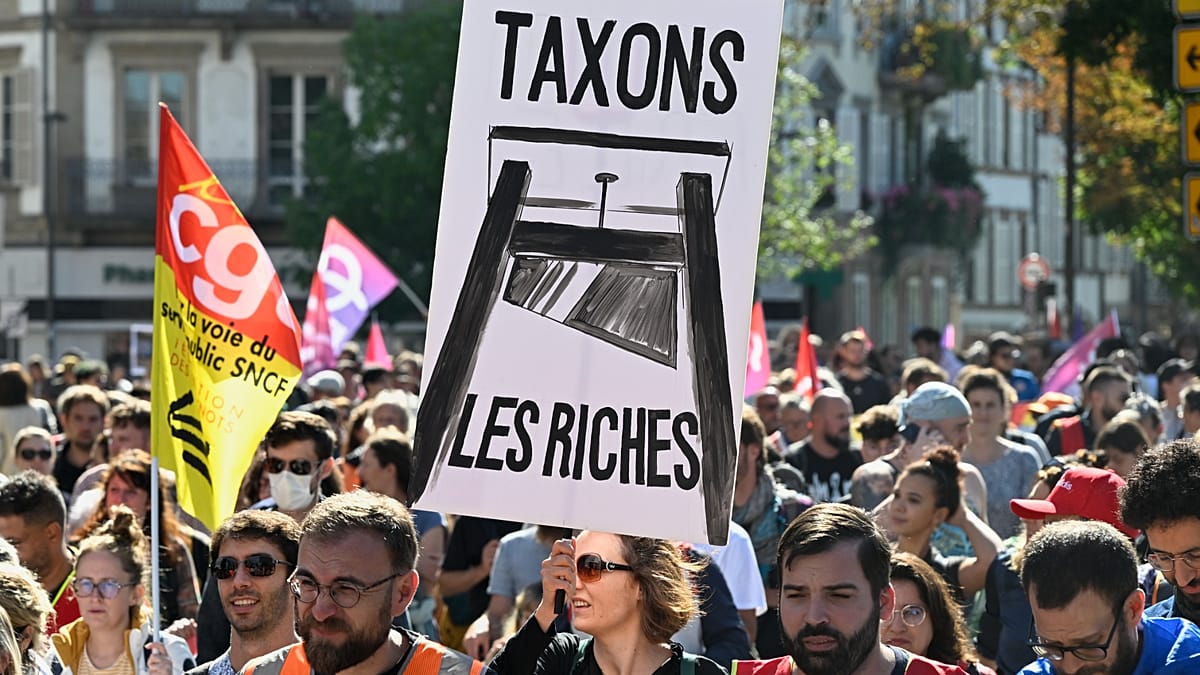
Another important factor has been the growing national and international campaign to tax the rich.
The latest battle over taxing the ultra-rich
France’s latest debate has centred on French economist Gabriel Zucman’s proposal to levy a 2% annual tax on fortunes exceeding €100 million.
The proposal also included an “exit tax”, designed to prevent the capital flight that undermined the ISF. Under the proposal, wealthy individuals who chose to leave France would have continued to owe the tax for five years after relocating abroad.
Supporters argued that the so-called Zucman tax could raise around €20 billion annually while affecting only around 1,800 households. They also argued that the concentration of wealth has accelerated in recent decades and that the wealthiest households should contribute a greater share towards funding public services.
The proposal passed the National Assembly last year but was blocked by the Senate. It was later defeated in the National Assembly during debate on the 2026 budget.
It was then replaced by the 2026 Finance Law, which introduced a 20% tax on luxury assets such as yachts, private jets, sports cars and jewellery, held inside passive family holdings worth at least €5 million, rather than a broad wealth tax.
Not everyone agrees that taxing wealth inevitably leads to an exodus. French economist Thomas Piketty has argued that the risks of capital flight are often overstated and that greater international cooperation could make wealth taxes far more effective.
Piketty maintains that rising wealth inequality has been fuelled by decades of tax cuts for the richest households and argues that carefully designed wealth taxes could reduce inequality without significantly harming investment.
Critics, however, argue that France has already tested many of these ideas. They contend that even a relatively small number of departing entrepreneurs and investors can have a disproportionate effect on economic growth because they own businesses, finance new ventures and generate employment.
France’s long history of taxing wealth
In 1982, President François Mitterrand introduced the Solidarity Tax on Wealth (ISF), which targeted the net assets of high-net-worth individuals. Over its lifetime, the European Commission reports that the tax brought in €63.5 billion and, in its final year in 2017, raised around €4.1 billion.
However, the tax also resulted in an estimated €200 billion in capital flight and reduced annual GDP growth by around 0.2%, according to French economist Eric Pichet.
In 2017, President Emmanuel Macron scrapped the ISF and replaced it with the Real Estate Wealth Tax (IFI), which is an annual tax applied to individuals whose net real estate assets, not allocated to business activities, exceed €1.3 million.
According to the French government, it now raises roughly €1.1 billion each year.
There was also François Hollande’s so-called “Super Tax”, a 75% marginal income tax on annual earnings exceeding €1 million as a means of forcing the wealthiest to help dig the country out of the economic crisis.
However, France’s highest court, the Constitutional Council, struck down the original version in late 2012, ruling that it was unfair to tax individuals at such a high rate.
Hollande’s administration adjusted the tax in the 2014 budget, shifting the burden from the individual to the company, making the employers pay a 50% tax on the portion of salaries exceeding €1 million.
Ultimately, it expired in 2015 after raising less revenue than projected, bringing in just €160 million in 2013 and €260 million in 2014.
At the time, France’s richest man, the CEO of LVMH Bernard Arnault, took out Belgian nationality, and the actor Gérard Depardieu also moved across the border to Belgium before obtaining Russian citizenship.
A majority of French taxpayers disapproved of the 75% rate, although polls showed that six out of 10 voters were in favour of raising income taxes on the wealthy.
Where are the rich going?
Many countries have actively positioned themselves to attract wealthy migrants. The United Arab Emirates remains one of the world’s biggest beneficiaries thanks to its lack of personal income tax.
In Europe, Italy has emerged as one of the continent’s biggest winners after Georgia Meloni’s government introduced a 15% flat-tax regime for qualifying foreign residents.
Under the scheme, eligible individuals can pay a fixed annual tax on foreign income regardless of how much they earn overseas, making the country very attractive to entrepreneurs and investors with international assets.
Switzerland has long attracted wealthy people through its favourable tax arrangements for certain foreign residents, while Monaco remains a popular destination for Europe’s ultra-wealthy thanks to its lack of personal income tax.
Portugal has also attracted thousands of wealthy migrants through its Non-Habitual Resident tax regime, although recent reforms have made the scheme less generous than it once was.
Ultimately, France’s net loss of 800 millionaires represents only a tiny fraction of its wealthy population. Yet it reflects a broader question facing governments across Europe: how to raise tax revenues and tackle inequality without encouraging investment and capital to move elsewhere.
As people and capital become increasingly mobile, that balance is becoming more difficult to strike.