
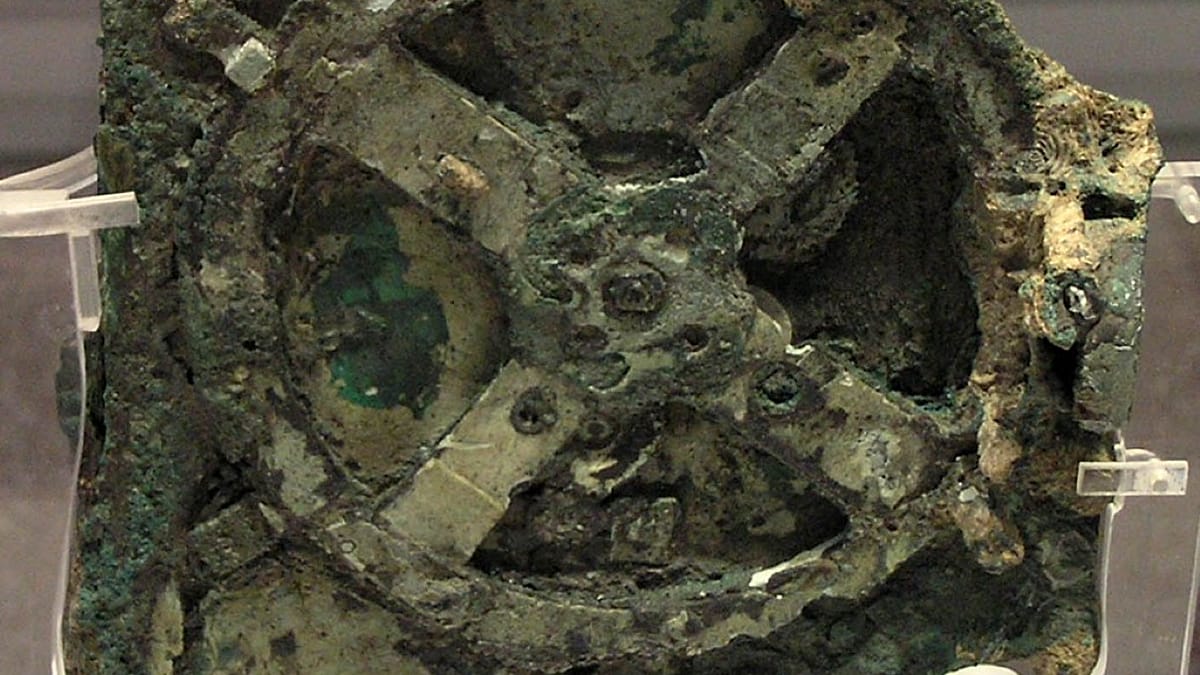
In 1901, a group of sponge divers came across, off the Greek island of Antikythera, the remains of a Roman shipwreck. Amid amphorae and statues they found a corroded block of bronze and wood which, for years, no one quite knew how to interpret. In time it would become one of the most closely studied objects in archaeology: a geared mechanism dated to between 150 and 100 BCE, designed to calculate astronomical positions and predict eclipses.
A shipwreck hiding more than it seemed
The artefact is now kept in the National Archaeological Museum of Athens, and its dating places its manufacture in the late 2nd or early 1st century BCE, coinciding with the sinking of the ship that was carrying it.
One of the most widely cited hypotheses, set out in the Antikythera Mechanism Research Project, points to an origin linked to the Corinthian colonies, possibly Syracuse, and therefore to the school of Archimedes, although its exact authorship remains unconfirmed.
The device incorporated more than 30 hand-operated bronze gears that modelled the cycles of the Moon, the Sun and the known planets, and used an epicyclic gearing system, similar to a modern differential, to compensate for orbital irregularities.
On the front, a small sphere, half white and half black, rotated to show the exact lunar phase. On the back, at least four dials represented the Metonic cycle, the Saros cycle, the calendar of panhellenic sporting games and the exeligmos, used to refine eclipse predictions.
Decades of X‑rays to crack a mystery…
Deciphering those pieces, fragmented and corroded by the sea, took decades. In 1959, physicist Derek de Solla Price began studying the 82 recovered fragments; later, together with Greek nuclear physicist Charalampos Karakalos, he captured the first X‑ray and gamma‑ray images of the mechanism’s interior. This revealed 27 gear wheels, some with as many as 127 and 235 teeth, a level of precision that astonished the scientific community and in 2017 led Google to dedicate a doodle to it as the first mechanical computer in history.
…that actually worked?
Not everything is certain. Several subsequent studies by Tony Freeth and Alexander Jones, which simulated the mechanism, found that its indicator for the position of Mars could be off by as much as 38 degrees, a margin of error which the researchers attribute not to manufacturing defects but to the limits of Greek astronomy itself at the time.
A more recent study goes further and suggests that even the smallest manufacturing error could have caused the mechanism to jam or slip, reopening the question of whether the machine ever became fully functional or whether, in practice, it was more cumbersome than useful.
Interest in the mechanism has not faded. Replicas on various scales have been built around the world for educational purposes, such as Mexico’s Monumental Antikythera Mechanism project, designed to train a new generation of physicists and engineers.
Its driving force, researcher Raúl Pérez Enríquez, sums up the enduring fascination with the artefact like this: “It is the universe of the ancient world seen from a new perspective, with the Earth at the centre and the planets revolving around it, just as the Greeks imagined it more than two millennia ago.”