
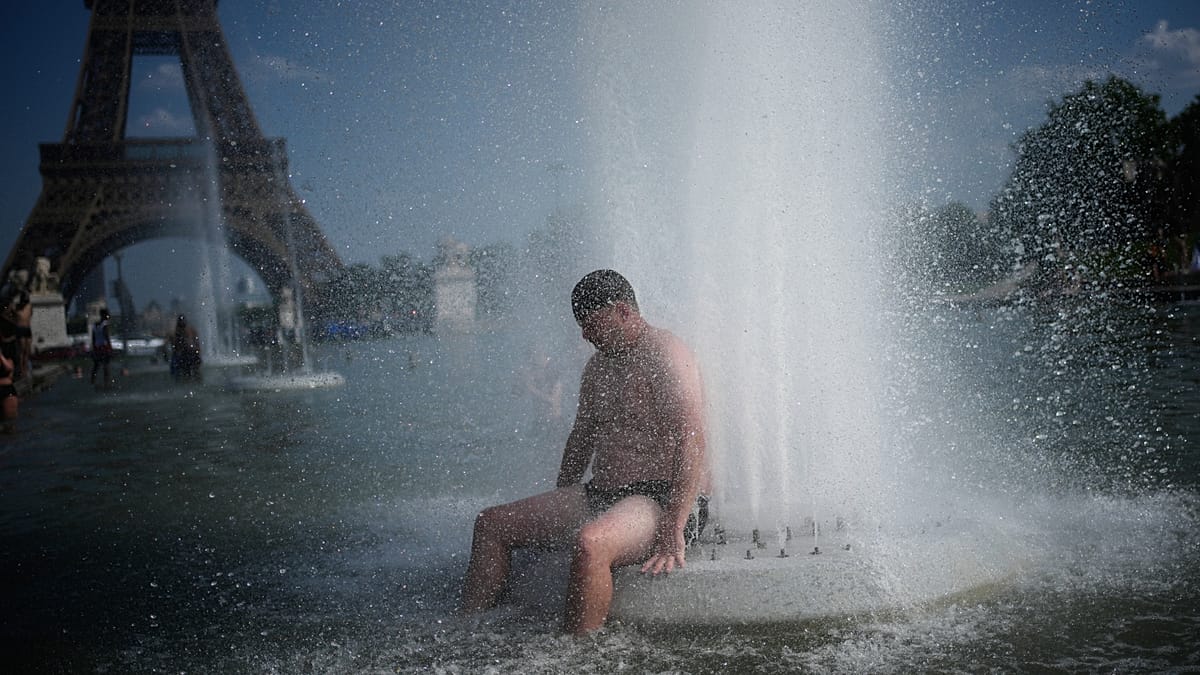
After a brutal heatwave that claimed around 1,300 lives in Europe and with a second one approaching at the beginning of July, climate politics are becoming more polarised than ever.
Unveiled in 2019, the European Green Deal is built on the premise of consuming less energy, burning fewer fossil fuels and making Europe’s homes more efficient in an effort to prevent future warming by reducing greenhouse gas emissions (GHGs).
Yet Brussels’ vision was shaped largely by winter, prioritising how to keep Europeans warm while cutting reliance on imported gas.
Then came the heat. As Europeans struggled through scorching temperatures, many began to feel the costs of the Green Deal before they experienced its benefits.
Executive European Commission Vice-President for a clean, just and competitive transition, Teresa Ribera, acknowledged that the heatwave currently hitting Europe is something “we knew could happen, but we have not been smart enough to address the root causes.”
“There is still this fierce fight against facts, science, preparedness and investment (in clean energy), so we are failing people. We need to reject this kind of bullshit based on lies and against people’s interests,” Ribera told the Guardian newspaper.
From Paris to Amsterdam, from Madrid to Munich, scorching summers are becoming longer and more intense. The continent that spent decades insulating homes against the cold is discovering that many of those same buildings have become heat traps in July.
France, Germany, Poland and the United Kingdom recorded their hottest day ever in June.
“We can’t just lock down people, especially the vulnerable ones, during the extreme summers to come. We need to adapt the public space. We need more green spaces that make a massive difference in terms of the ambient temperatures, including in the nearby buildings,” EU lawmaker Martin Hojsík (Czech Republic/Renew Europe) told Euronews.
Air-conditioning politics
There is little disagreement that Europe needs more cooling. The challenge is that the fastest way to cool millions of homes is to install millions of air conditioners.
Such a decision would pose an affront to the EU’s climate transition and a political paradox for the European Commission, which has recently denied having a pro or against stance on air-conditioning ahead of its climate adaptation strategy slated for the fourth quarter of the year.
When dealing with impossible temperatures, EU lawmaker Roman Haiden (Austria/Patriots for Europe) defended the use of air conditioning as a “rather obvious solution”.
“Turn on AC if you are hot, turn on the heater if you are cold,” Haiden told Euronews.
A similar vision was echoed by EU lawmaker Michal Kobosko (Poland/Renew Europe), who said Europe would “definitely need” to increase the number and volume of air-conditioning systems in the near future, for “both our factories and homes in Europe.”
“It’s not a choice but a must. Two issues here: this trend should drive demand for Europe’s projected and produced air-conditioning systems, not just for Chinese ones. Secondly, air conditioning consumes a lot of energy. The situation differs among member states, but generally speaking, we will need a lot of additional sources of clean and affordable energy here,” Kobosko told Euronews.
Also hailing from the liberals, EU lawmaker Ana Vasconcelos (Portugal/Renew Europe) backs air conditioning as part of the answer to extreme heat.
“On a rollout plan: the answer is yes if that plan means letting the market work by lowering the tax and regulatory burdens that stand in the way of the law of supply and demand, which brings down prices for people to afford what they need,” Vasconcelos told Euronews.
The Green Deal encourages electrification because electricity can increasingly be generated from renewable sources. However, it’s not only the GHGs linked to air-conditioning use but also the strain such appliances place on the bloc’s obsolete grid power that raises concerns about air-conditioning use.
Air-conditioning critics argue that if every household responds to extreme heat by installing conventional air conditioners, electricity demand could surge on the hottest afternoons, forcing costly investments in the grid and backup generation.
But its supporters argue that the EU’s Grids Package, a legislation designed to revamp the power grid to accelerate the influx of clean power, should meet the current needs of ordinary people as well as those arising from the maintenance of controversial data centers.
This scenario is forcing a broader rethink of what climate policy should look like, with growing support for the idea that cooling can no longer be treated as a consumer choice but as critical infrastructure.
Green Deal’s summer test
Air conditioning was associated with shopping malls in southern Spain, hotels in Greece or office towers in Italy. In northern Europe, it remained an exception rather than the rule and buildings were designed to retain heat.
Public policy has focused on insulation, efficient boilers and replacing fossil gas with heat pumps — measures that have required ordinary citizens to make significant investments, often burdened by extensive red tape.
Demand for cooling is rising rapidly in countries such as France, Germany, Belgium and the Netherlands, where households increasingly view air conditioning not as a luxury but as protection against dangerous temperatures.
In the United Kingdom last week, there were long queues for air-conditioning units at a Hampshire supermarket, with people rushing to secure quick and affordable solutions to cope with the heatwave.
Across Europe, schools, hospitals and care homes are confronting heat levels they were never designed to withstand. Employers are rethinking workplace safety and cities are opening cooling centres alongside their long-established winter shelters.
“We must, of course, reduce CO2 emissions, but we must adapt to climate change, because inaction has consequences on health, on the economy, on everyday life, on well-being and on biodiversity. But we have to do it as a group, together, at the European level,” Belgian Climate Minister Jean-Luc Crucke recently told reporters.
Adaptation vs decarbonisation
The challenge for EU lawmakers is that adaptation and decarbonisation no longer align as neatly as they once did. Moreover, in recent months, parts of the EU have scaled back or delayed elements of the Green Deal under pressure from farmers, industry and conservative political groups, citing a lack of competitiveness.
Reacting to the sense of urgency, the European Green Party has recently called for an emergency meeting of EU heads of government, arguing that extreme heat has become a continent-wide security, health and economic crisis rather than a seasonal weather event.
“Europe faces a clear choice: to weaken or strengthen the Green Deal protections that keep people safe. The science is clear. All people living in Europe are already suffering the consequences,” stated lawmaker Ciaran Cuffe (Ireland), co-chair of the European Green Party, citing the World Health Organization’s deadly heatwave figures in the region.
By linking rising temperatures directly to those policy reversals, the Greens are attempting to shift the political narrative from the costs of climate action to the costs of climate inaction.
The Brussels-based European Consumer Organisation (BEUC) argued that “air-conditioning comes in addition to more passive solutions” that are also needed: better urban design that integrates trees, painting houses in reflective colours or installing shutters and shading.
“People in many parts of Europe also need to heat their homes in winter, so there’s a legitimate argument about cooling in the summer, ” said Frederico Oliveira da Silva, BEUC’s head of energy.
However, the consumer organisation noted the value of heat pumps in providing both cooling and heating, but recognised that up-front cost is still an issue and urged governments “to provide support to those that need it”.
EU lawmaker Hojsík said heat pump technology should “not be dismissed” arguing that it’s an investment “that can be easily publicly supported from the bloc’s carbon market revenue, the Emissions Trading System (ETS).
“This investment is beneficial on many levels and is clearly eligible for public support from ETS revenue and would negate the impact of ETS2 from heating on households, ” Hojsík said.
“We should also not forget the need for housing renovation that can be similarly supported from ETS revenue.”
Class war
Politics are also becoming more complex, as heat exposes inequalities just as sharply as cold once did. Wealthier households can install cooling systems while poorer families often endure dangerous indoor temperatures.
Cities with more parks and tree cover stay cooler than concrete-dominated neighbourhoods, highlighting access to cooling as a growing social issue in a warming Europe.
This does not mean the Green Deal has failed, but rather that its centre of gravity is changing.
The heatwaves sweeping across the continent suggest that another task is becoming equally urgent — helping Europeans live with a climate that has already changed.
The Green Deal was designed to reduce carbon emissions. It must now prove it can also help Europe cope with rising heat.