
By Laila Humairah
Published on
At the fifth edition of what organisers call “the festival for digital freedom,” the conversation around blockchain moved beyond Bitcoin and crypto speculation.
The focus shifted to a bigger question: can decentralised technology challenge the growing power of Big Tech over data, artificial intelligence and the digital economy?
At the heart of the debate is whether Web3 can deliver on its original promise — an internet where users have genuine ownership and control over their digital lives.
“Less trust, but more truth” emerged as one of the summit’s key themes: the idea that while institutional trust may be eroding, technology can still be used to build more verifiable systems.
Developers, economists and activists are examining how blockchain could reshape the way digital information is owned and shared.
Bill Laboon, vice president of technical operations at the Web3 Foundation, argues that personal data has become one of the most valuable assets in the digital economy.
“Over the course of a digital lifetime, a person gives about $162,000 (€141,000) worth of value to various companies without knowing it,” he said, adding that the rise of AI has made questions around data ownership even more pressing.
“The danger in AI often is the data that it gets from you. What we don’t want is that it knows your particular information,” he said.
The battle over digital power
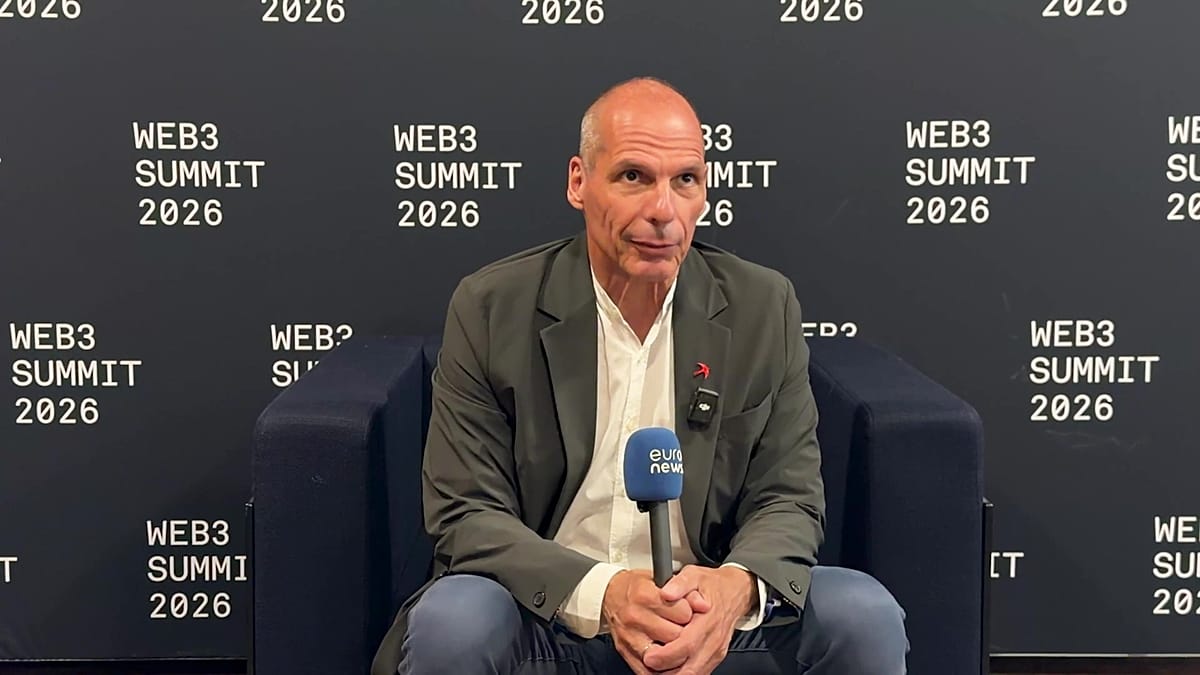
For economist and author Yanis Varoufakis, the debate is ultimately about who controls the infrastructure shaping modern society.
The former Greek finance minister has long argued that technology giants have accumulated unprecedented influence over digital systems, creating what he calls “technofeudalism.”
“Every political regime which is unsustainable because of this clash between what is in the interest of the many versus what is in the interest of the few, can only be ameliorated through democratic action,” he said.
While he acknowledges that Web3 has useful applications, he remains sceptical that technology alone can overcome the dominance of Big Tech.
Blockchain for the collective good
Others at the summit believe that while Web3’s early promise has been overshadowed by speculation, decentralised systems can still support alternative economic models.
Joshua Davila, founder of The Blockchain Socialist, argues that blockchain can help communities build new forms of collective ownership.
“Inspired by the existing solidarity economy, like cooperative banks and cooperative movements, we’ve built a bunch of applications to try to bring together local currencies and credit unions into one,” he said.
“The idea for us is that you should have a place where you put your money and the interest being generated from that money is going into what you support instead,” he added.
As AI accelerates the race for control of digital infrastructure, supporters and critics of Web3 alike see decentralisation as an opportunity to redistribute power — though they differ sharply on whether the technology can deliver it without creating new forms of inequality.