
By Dr Timo Graf, Senior Research Officer at the Zentrum für Militärgeschichte und Sozialwissenschaften der Bundeswehr in Potsdam
Published on
The opinions expressed in this article are those of the author and do not represent in any way the editorial position of Euronews.
Russia is waging a war of aggression against Ukraine and a hybrid war against Europe as a whole. At the same time, the US is retreating from its role as Europe’s military security guarantor.
Against this backdrop, Germany is assuming greater responsibility for the defence of Europe. In fact, Germany is investing heavily in strengthening its own defence capabilities and has become Ukraine’s largest military supporter in Europe. Yet doubts persist about the willingness of Germans to defend their country.
Opinion polls show that a majority of the population would not be prepared to pick up a weapon in the event of a military attack on Germany. Findings of this kind regularly generate headlines in both German and international media. Such reports unsettle Germany’s allies, potentially encourage aggressors, and undermine public confidence in the country’s own resilience.
A more nuanced assessment of the empirical evidence points to very different conclusions about the defensive resolve of the German population.
Germany’s underestimated defence potential
It is true that, on average, personal willingness to defend one’s country is stronger in the Nordic and Baltic states than in Germany (and many other European countries). The high approval ratings recorded in those countries are often cited as evidence of Germany’s comparatively low willingness to fight.
To avoid comparing apples with oranges, however, it is necessary to take into account differences in defence systems (conscription, voluntary military service, or fully professional armed forces) as well as historical experiences of military – and specifically Russian – aggression. Furthermore, when assessing the actual defence potential of different countries, survey data on willingness to defend the nation should be considered in relation to population size.
Compared with the Baltic and Nordic countries, Germany benefits from the advantage of scale. Lithuania has a population of just under three million and Finland fewer than six million, whereas Germany counts a population of around 83 million. According to the annual representative survey conducted by the Centre for Military History and Social Sciences of the Bundeswehr (ZMSBw), 54 % of German men and 21 % of German women currently say they would be willing to defend the country with a weapon.
Defence does not begin at the front line
If we focus solely on the 20-to-40 age group – broadly speaking, those fit to serve – 54 per cent of men and as many as 23 % of women say they would be prepared to engage in armed combat. In absolute terms, census figures suggest this would amount to more than five million men and more than two million women.
There is therefore no evidence of an absolute shortage of citizens willing to contribute to national defence. Moreover, a population’s practical readiness to defend itself cannot be reduced solely to a willingness to engage in armed combat. Only a portion of the population would be required to make a military contribution, just as only a relatively small share of the armed forces consists of frontline combat troops.
The concept of comprehensive defence as a whole-of-government and whole-of-society endeavour extends far beyond the military sphere. As Ukraine’s experience demonstrates, a country’s capacity to defend itself and endure under attack rests on a broad foundation: the state, civil society and industry all make essential contributions. Surveys conducted in Germany regarding possible engagement in civil protection indicate a very high level of willingness to contribute – significantly higher than the willingness to take up arms. Not everyone needs to serve in the military in order to make an important contribution to national defence.
Indeed, resilience starts earlier than that. The starting point is the perception of a threat.
Since 2022, more than 60 % of Germans have viewed Russia as a direct military threat to Germany’s security; before 2022, the figure stood at only around a quarter to a third of the population. Russia is now regarded as a threat by a majority across all socio-demographic groups and among voters of all political parties. On the basis of this broad societal consensus, an absolute majority supports major financial investment in defence (64 per cent) as well as the reintroduction of military service (53 %).
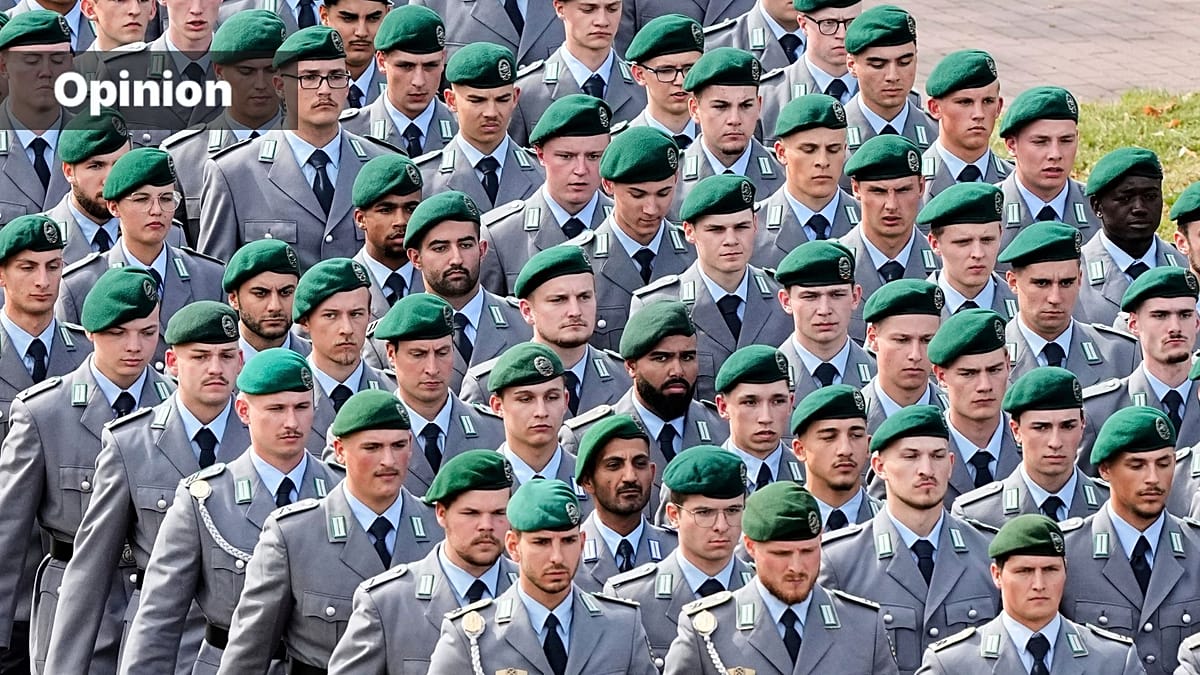
And contrary to the common assumption that Germany is deeply sceptical of military institutions, public support for the armed forces remains strong. Since 2000, at least three-quarters of respondents have reported a positive view of the Bundeswehr. A similar proportion express trust in the armed forces and regard them as a normal part of society. Nothing about this fundamentally positive attitude towards the Bundeswehr has changed since 2022 – nor did it need to. The support was already there.
The myth of German pacifism
But are Germans not, by and large, pacifists? The notion of “German pacifism” is a narrative – and a distorted image – that reveals more about the ideological and intellectual outlook of those who promote it than it does about the strategic culture of the German public.
Empirical studies of pacifism as a guiding principle in foreign and security policy, based on ZMSBw survey data, show that even before 2022 no more than 27 % of Germans could be described as convinced pacifists. By contrast, a clear majority of at least 60 % were pragmatists or realists who fundamentally regarded both non-military and military instruments as legitimate tools of German foreign and security policy.
Since 2022, the proportion of pacifists has fallen to 13 %, while the share of realists has risen to nearly 70 %. Realists now constitute a majority across all socio-demographic groups and among voters of all political parties. The broad public support for Germany’s shift in defence policy since 2022 is therefore best understood as the response of a pragmatic majority to a changed threat environment.
Resilience despite doubts
Germany is Europe’s largest economy and most populous country. In absolute terms, it spends more on defence than any other European nation and is the strongestsupporter of Ukraine in its defence against Russian aggression.
A majority of citizens support this policy because they are security-policy pragmatists who recognise Russia as a direct threat to Germany’s security. And that is merely the response to being indirectly affected by war.
If Germany itself were subjected to a military attack, many millions would be prepared to fight with a weapon.
Despite often critical media coverage, no one should underestimate Germany’s capacity for self-defence: not Russia, not Germany’s allies, and above all not Germans themselves.
Dr Timo Graf is a senior research officer in the Military Sociology Research Division at the Bundeswehr Centre for Military History and Social Sciences (ZMSBw) in Potsdam.