
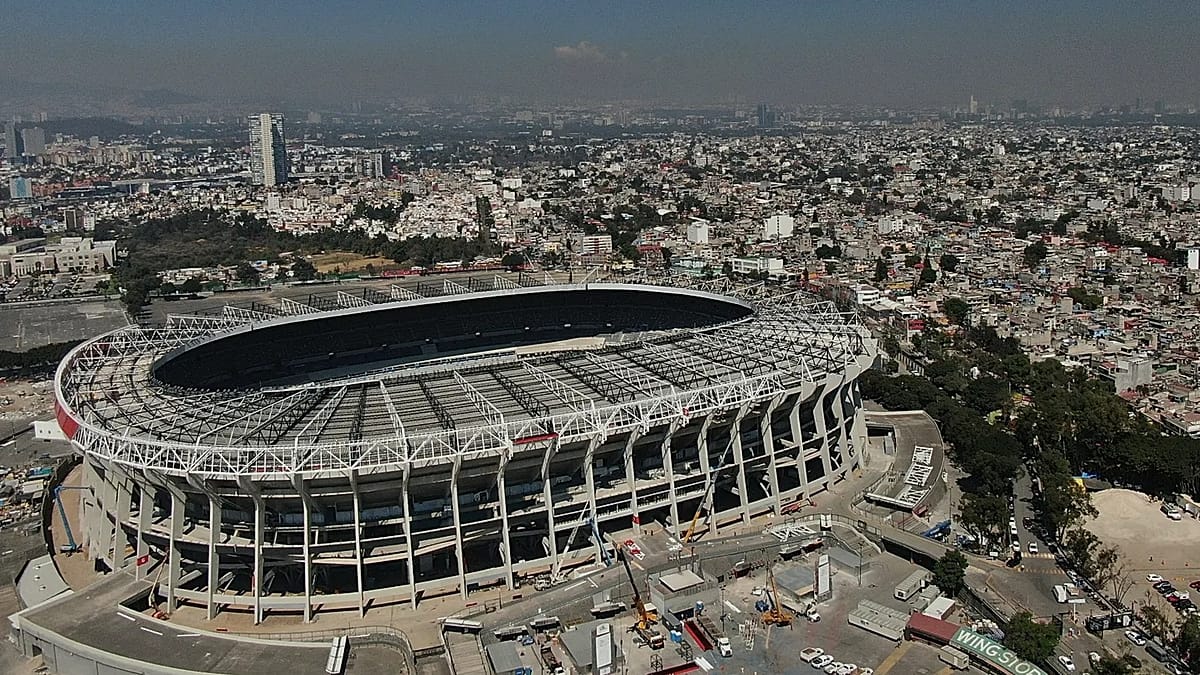
Mexico City is preparing to take centre stage once again.
On 11 June, Mexico will face South Africa in the opening match of the FIFA World Cup 2026 at the iconic Estadio Azteca, officially known as Estadio Ciudad de México during the tournament.
The match will make history: no stadium has ever hosted three World Cup opening games, and only a handful of venues are as closely linked to football’s biggest moments.
The Azteca opened in 1966 and has a capacity of approximately 87,500 after extensive renovations costing around 3.6 billion pesos (€160 million) completed in early 2026. It is the largest stadium in Latin America.
A stadium woven into football history
Pelé lifted the World Cup trophy there in 1970 after leading Brazil to a 4-1 victory over Italy in the final, while the same tournament produced what is still widely considered the greatest World Cup match ever played: the semifinal between Italy and West Germany, which Italy won 4-3 in extra time in what became known as the Game of the Century.
Sixteen years later, Diego Maradona led Argentina to glory on the same pitch during the 1986 tournament, beating West Germany 3-2 in the final.
It was also here, in the quarterfinals against England, that Maradona scored the iconic Hand of God goal — with fans still debating whether he punched the ball into the net with his left hand — and, four minutes later, the Goal of the Century, a 60-metre solo run past five English players that was voted the greatest goal in World Cup history by FIFA.
Mauricio Rocha Iturbide remembers those moments vividly. The Mexican architect was inside Estadio Azteca when Argentina faced England in one of the most famous matches in World Cup history.
“When Maradona made those two beautiful goals, the goal where he dribbled past everyone on the field and then the more famous one, the ‘Hand of God’, we never saw the hand from where we were sitting,” he recalled.
“Only the people of England that were very close said, ‘This not fair, this is not a goal,’ but the referee saw the goal.”
For the opening match, Mexico’s opponents South Africa will come with their own World Cup history. They hosted the 2010 tournament — the first to be staged on African soil — and became synonymous with the distinctive sound of the vuvuzela that defined the competition.
The stadium will host five matches during the 2026 World Cup, placing Mexico City at the heart of the tournament once again.
Excitement building in the capital
With just days to go until kickoff, signs of World Cup fever are already appearing across the Mexican capital.
Mexico City sits at 2,240 metres above sea level — a significant physical challenge for visiting players unaccustomed to the altitude, which can affect endurance in sports competitions.
Outside the stadium, fans have been stopping to take photos, meet the tournament mascot and visit one of the sport’s most famous landmarks.
Last Saturday, thousands of supporters gathered nearby to perform a giant human wave in an attempt to break a Guinness World Record.
For football fan Monse Palafox, the anticipation is already growing.
“Well, it’s incredible because, as it says, the ball comes back home,” she said. “You can already feel the excitement. I have a feeling that the opening is going to be a great, happy celebration. That’s how we do it in Mexico.”
Christian Díaz said hosting another World Cup is a source of pride.
“Yes, we’re very excited,” he said. “We’ve hosted the World Cup twice before and getting to do it again is thrilling.”
For some supporters, memories of the last World Cup are still fresh.
Pablo Anguiano travelled nearly 15,000 kilometres from Mexico to Qatar for the 2022 competition and was there to witness Argentina lift the trophy after one of the most dramatic finals in World Cup history.
“My last World Cup was in Qatar. It was amazing because I really enjoyed the city,” he said. “And you can say that you have the most exciting final in the World Cup against Argentina and France.”
A World Cup across three countries
The FIFA World Cup 2026 will be staged across Mexico, the United States and Canada — the first worldwide football tournament to be hosted across three countries and the first to feature 48 teams, up from the previous format of 32.
Over 39 days, millions of fans are expected to travel between the three host nations as North America hosts the largest World Cup in the tournament’s history.
For Mexico City, however, the spotlight is already on the opening match and the stadium that is preparing to make football history once again.