
At first glance it could look like a scene from a western: a man on horseback crossing the pastures to look after the livestock. Only we are not in Texas; we are in Canale Monterano, where the figure of the buttero tells the story and identity of the Maremma area of Lazio.
Here, however, the horse is not a symbol of the past but a working tool and a direct link with a centuries-old tradition that still shapes the land, with practices handed down from generation to generation and protected above all by the Butteri di Canale Monterano association.
Unlike the more recent American cowboys, the buttero has its roots in very ancient traditions and is seen by many as an heir to Etruscan civilisation. Their stock of knowledge is thought to have reached us almost intact.
Modern butteri between Tolfa and Canale Monterano
From the Greek βουτόρος – ox-goad – the buttero was for centuries a key figure in free-range cattle farming and at the heart of rural community life. Even today, Maremma cows live only on open pasture and, to round them up, the herdsmen rely on their skill on horseback, an essential part of the job, and they are riders specialised in what is known as “monta da lavoro”, a working style of riding.
As technology advanced, the buttero’s trade almost disappeared, but the passion of those attached to this way of life helped preserve the role.
“I had uncles, my mother’s cousins. To keep the memory alive and keep the tradition going, we never abandoned it, even in our own small way,” explains Rinaldo Camilletti, a buttero and owner of a cattle and sheep farm in Canale Monterano, which he runs together with his son Cesare.
For 27-year-old vet and young buttera Marta Papa, the role is less about driving and more about “working alongside the animals because our horses and our cows were born and raised here, so all I can do is ride alongside them and accompany them”.
For her and her 21-year-old brother Alessandro, their family and deep roots in the local area weighed heavily in their decision to become butteri, but Marta also stressed that “living in this environment is something I absolutely love; for me it really is a breath of fresh air”.
The buttero’s role in rural life: a typical day and duties
In the past, “the buttero not only had to manage the cattle herds, he also had to see to the rimessaggi (bringing them into the pens), and to weaning the calves”. With the trained horses on which he spent most of the day, the herdsman “had to round up the herds, wean the calves and drive them into the enclosures made of chestnut stakes, which we call rimessini,” Camilletti explains.
To carry out these tasks the butteri also relied on trained dogs, often to bring animals back onto the right path “because ours is a hilly area, and in places the terrain is quite difficult”, Camilletti says. Once in the pens, the cattle were cared for and branded so the herd could be identified, given that in this area more than 70 per cent of the population lived off farming and livestock and, at the time, there were no microchips or ear tags.
Branding with a hot iron – known as merca and used to recognise one’s animals even from afar – was a central moment in rural life, a collective celebration for the owner, the farm and all the butteri and teams who had taken part in the work.
The Riarto of Canale Monterano and reinterpreting tradition
Today, of course, traditions have been revisited. “In the past, the way the animals were driven, managed and even recognised was different: every buttero, every group of butteri, knew which animals were theirs, which areas they grazed, how they moved, and for example here we used to have the tradition of merca, branding the animals,” Marta says, pointing out that legislation has long since banned it.
The means by which the buttero reaches the animals have also changed: “it is no longer just the horse but also tractors and farm machinery; farms have become more efficient in many respects, so there have been various changes that have made the work a bit easier too,” Marta adds.
In her view, the changes have brought many advantages but also many drawbacks for both butteri and livestock, “in the sense that a lot of people no longer do this job, or at least it is no longer their main source of income. Maybe it has become a more marginal activity, both in terms of numbers and in practical day-to-day importance”. At the same time, when it comes to the animals, “small everyday attentions that the buttero might have had 50 or 70 years ago have been lost, because the work we do with animals today is different from a few decades ago”.
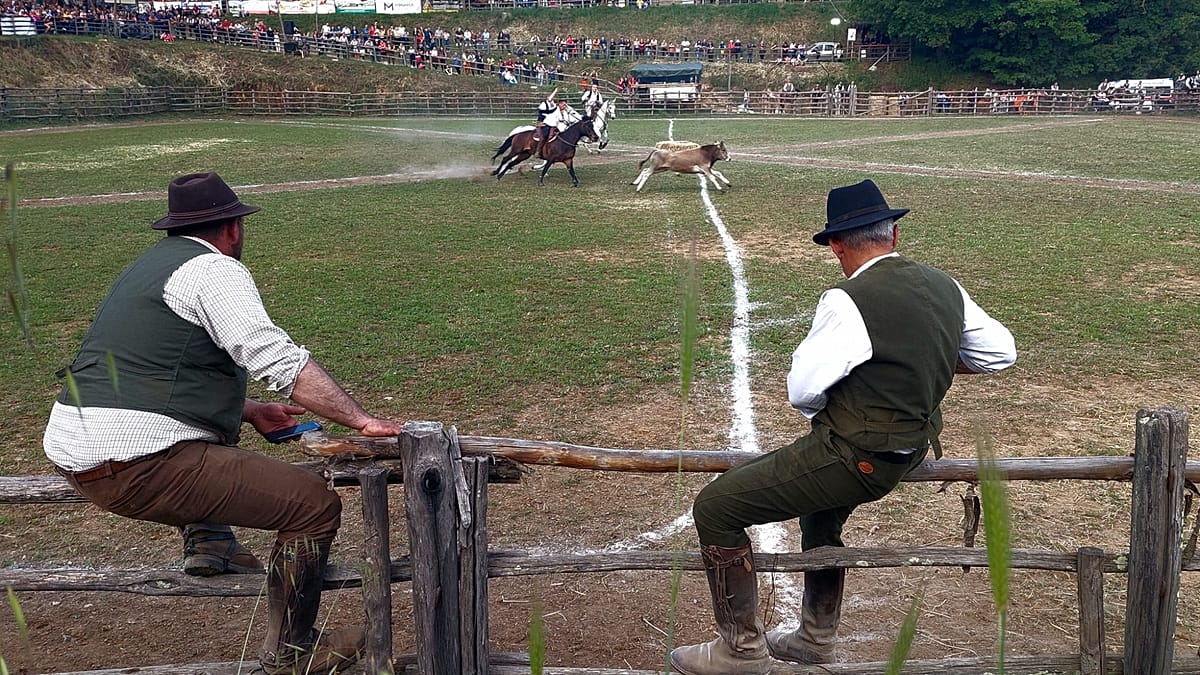
Every May, to keep the memory of the past alive, the Butteri di Canale Monterano association organises a festival called Riarto, which recreates the moment before the start of transhumance, twice a year, when the butteri would meet to exchange goods and challenge each other in skill contests. The most distinctive of these is calf roping, a reworking of cattle branding. Teams of three riders have to catch the animal using a lacciara, a non-rigid rope, unlike the ones used in US rodeos, which makes the task more difficult. Once it has been caught, the calf is symbolically branded with chalk.
Breaking in horses and cattle
Another key moment in the buttero’s life was breaking in the horse, a process that could take different forms. In this case, Camilletti explains, “it had to be a specific kind of breaking in with the bit, which we call ‘a mazzetto’. They had to hold the horse’s reins in one hand only, keeping the other free to carry out other tasks with the animals.”
This was also very demanding work, given that horses were less used to human contact than they are today and were “rather difficult characters because they came from free-range pasture in the mountains,” the breeder recalls. The buttero could break in horses for himself or for others, and it was a crucial job “bearing in mind that back then there was no mechanical equipment”.
The cattle also had to be broken in, “because there were huge wooden carts that were pulled by Maremma oxen, which in any case are somewhat strong-willed animals”.
When he was not in the saddle, the buttero, who would spend months away from home tending his herds, rested in huts on the pastures, built from branches and vegetation with a hearth inside. One of the staple dishes in his daily life was acquacotta, a soup made with seasonal wild greens, Camilletti recalls. The inn, meanwhile, was a place to meet and socialise, often frequented by herdsmen on their afternoons off.