
Every four years, FIFA stages a spectacle that is all but guaranteed to dominate front pages around the world, mostly thanks to events on the pitch.
Yet, almost inevitably, the limelight is sometimes stolen by moments that transcend the game.
Euronews has taken a look back at ten such occasions that have shaped the history of the World Cup.
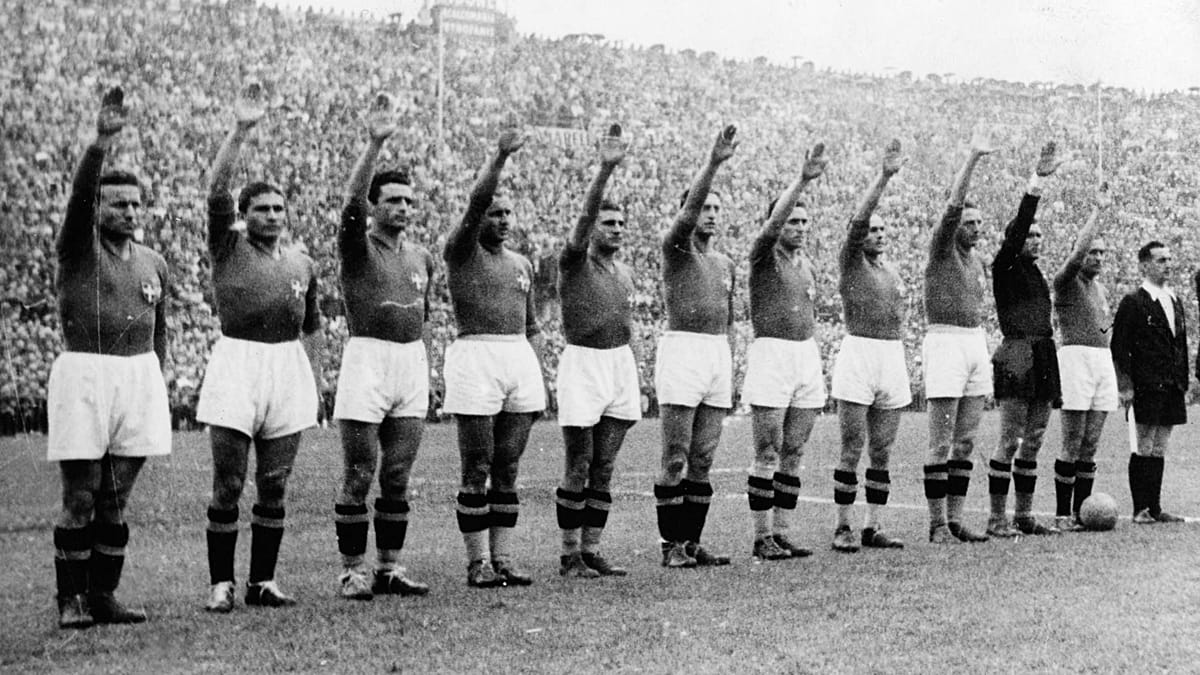
1. France ’38 – Mussolini’s ‘blackshirts’ triumph
In 1938, just a year before the outbreak of the Second World War, France hosted the third World Cup. It was marked by mounting geopolitical tensions across Europe.
Italy went into the competition as one of the big favourites, having already lifted the trophy four years earlier, in 1934, when the Azzurri staged the tournament themselves.
This time, the Italian team travelled to France as the representative of a fascist regime that was increasingly unpopular in Europe, amid a wave of protests against Benito Mussolini and his intervention in the Spanish Civil War. Head coach Vittorio Pozzo imposed an almost military discipline and fully embraced the use of football as a propaganda tool for the regime.
Tension erupted in their opening game against Norway and intensified in the clash with France, when Italy took to the pitch in black shirts and gave the fascist salute, a gesture that drew deafening boos from the stands and came to symbolise the extreme politicisation of that edition of the tournament.
In spite of the hostile atmosphere, the Italians progressed comfortably and beat Hungary 4-2 in the final, securing their second consecutive title. The victory was trumpeted by the regime as a source of national pride and used to bolster the fascist narrative, although it would go down as one of the most controversial and politicised episodes in the tournament’s history.
2. Brazil ’50 – Hosts humbled in the ‘Maracanazo’
The 1950 World Cup produced one of the most striking episodes in sporting history: Uruguay’s shock victory over Brazil in a packed Maracanã. Officially, around 170,000 people attended the match, but it is estimated that the real figure was closer to 200,000.
In the build-up, Rio de Janeiro was in party mood. Under the format in force at the time, the Seleção only needed a draw to lift the cup: songs already celebrating the title, triumphalist headlines and a crowd utterly convinced the hosts would win. Brazil went ahead in the second half, but Uruguay dug deep. Juan Alberto Schiaffino levelled the score and, with eleven minutes remaining, Alcides Ghiggia silenced the stadium with the decisive winner.
The stadium fell silent; the Brazilian players left the pitch shattered and the entire country went into shock. The so‑called ‘Maracanazo’ became a historic wound for Brazil and the greatest feat in Uruguayan football, a game that changed the World Cup story for good.
3. Spain ’82 – Not even ‘Mágico’ González could spare El Salvador humiliation
The 1982 World Cup brought one of its harshest chapters with Hungary’s historic 10-1 thrashing of El Salvador, the heaviest defeat ever recorded at the tournament. The match, played in Elche, exposed a high‑risk tactical gamble by El Salvador in a context marked by civil war and logistical hardship.
Despite the Hungarian whirlwind, El Salvador still produced a symbolic moment when Luis Ramírez scored the country’s first ever World Cup goal, celebrated more as an act of dignity than of jubilation. Far from mocking them, the crowd connected with a team that kept on attacking in the face of adversity.
Amid the chaos, Jorge Alberto González Barillas, better known as ‘Mágico’ González, the only professional in the squad, lit up the occasion with his flair and dribbling, winning admirers across the tournament. For El Salvador, a World Cup that had threatened to become a chapter to forget ended up vindicating a generation determined to show the world a different side of a country devastated by violence.
4. Mexico ’86 – The ‘hand of God’
The 1986 World Cup quarter-final between Argentina and England went down in folklore thanks to one of football’s most controversial and memorable moments: the so‑called “hand of God” by Diego Armando Maradona, which put the South Americans in front. But there was far more to the match than that single incident.
Played in a context of maximum sporting and political tension, fuelled in particular by the Falklands War, the game reached half-time goalless after a scrappy, fiercely contested first period, with Maradona repeatedly chopped down. Barely into the second half, the No.10 put his team ahead with a goal scored with his left hand that the referee allowed to stand despite furious protests from the England players.
Six minutes later Maradona produced his definitive masterpiece: a run from inside his own half, slaloming past half the opposing team before beating the goalkeeper, a strike widely regarded as one of the greatest goals in World Cup history. England pulled one back late on but could not find an equaliser. Argentina went on to reach the final, where they would eventually defeat Germany.
5. United States ’94 – The mistake that cost Andrés Escobar his life
The own goal scored by Andrés Escobar at the 1994 World Cup in the United States turned into one of football’s most tragic episodes. Captain of a Colombia side seen as a genuine contender, the defender put through his own net in the defeat against the hosts, a result that hastened his country’s elimination in the group stage.
Days after returning to Medellín, the player was shot dead outside a bar. He was 27. The murder shocked the world and came to symbolise the violence that gripped Colombia in the 1990s, marked by drug trafficking, illegal betting and huge pressure on football. Although for years it was portrayed as revenge for gambling losses, the case reflected a much broader social backdrop, in which the sport was deeply marked by fear and intimidation.
Escobar, known as “the gentleman of football,” championed the game as a space for coexistence and values. His death turned him into a symbol of a generation trapped between sporting talent and rampant violence, and a reminder that, as his then coach, Pancho Maturana, put it, it was not football that killed him, but “society”.
6. France ’98 – Zidane’s headbutt
The 2006 World Cup final in Germany was defined by one of the most bewildering scenes football has seen. Zinedine Zidane, France captain and playing the last match of his professional career, went from brushing immortality to signing off with a brutal headbutt on Marco Materazzi.
Zidane had dragged France to the final with decisive displays in the knockout rounds and opened the scoring in Berlin with a Panenka‑style penalty. In extra time, after an exchange of words with the Italian defender, he lost his cool and was sent off, leaving his team down to ten men at the crucial moment.
Without their leader on the pitch, France lost to Italy in the penalty shoot-out. The image of Zidane walking alone towards the dressing room, passing the World Cup trophy on his way, became the symbol of a night of glory that slipped away. A departure as brilliant as it was human for one of football’s greatest legends.
7. South Africa ’10 – Iniesta’s ‘goal of my life’
Spain won the 2010 World Cup in South Africa playing a distinctive brand of football and a final forever defined by one decisive moment. Arriving as favourites after their Euro 2008 triumph, Vicente del Bosque’s side began the tournament with a shock defeat to Switzerland that revived old fears. Instead of falling apart, the team regrouped game by game, tightened their grip on possession, fully committed to their tiki-taka style and edged their way through with narrow wins until they reached the final.
The showdown with the Netherlands in Johannesburg was tense, physical and cagey, with little room for flair. As the match seemed to be heading for penalties, in the 116th minute of extra time came the move that would define the tournament: a pass from Cesc Fàbregas, control from Andrés Iniesta and a low, angled shot beyond Maarten Stekelenburg. The 1-0 sparked wild celebrations and delivered Spain their first World Cup.
That goal came to symbolise the culmination of a style built on patience, possession and belief, and turned that team into a historic reference point in world football, a status underlined just two years later when they lifted the third European Championship in their history, and their second in a row.
8. Brazil ’14 – A historic mauling of the five-time champions
On 8 July 2014, the World Cup in Brazil witnessed one of its most staggering nights. In the semi-final in Belo Horizonte, Germany exposed all the hosts’ frailties with a 7-1 that would be remembered as one of the biggest humiliations in the tournament’s history.
The game was effectively over within minutes. After the opening German goal, Joachim Löw’s team struck four more times between the 23rd and 29th minute, with Miroslav Klose becoming the World Cup’s all-time leading scorer and Toni Kroos grabbing a blistering brace. Brazil, overwhelmed physically and mentally, could only watch in disbelief as they collapsed in front of their own fans.
In the second half, André Schürrle added two more, while Oscar grabbed a late consolation. It was Brazil’s first defeat in a World Cup semi-final in 76 years and their heaviest home loss in almost a century. The so‑called ‘Mineirazo’ came to stand for a collective trauma and one of the worst nights in Brazilian football.
9. Russia ’18 – VAR takes centre stage
The 2018 World Cup in Russia will be remembered, among other things, as the first major international tournament in which VAR played a starring role. The video assistant referee system made its presence felt from the group stage onwards, sparking debate and controversy but also a widespread feeling that refereeing decisions were fairer.
Its influence was crucial to how the competition unfolded and extended all the way to the final, where the referee awarded a penalty after consulting VAR. According to FIFA, the system pushed the accuracy of refereeing decisions up to 99.2%, after being used in more than 400 incidents. The governing body would later claim that video review had put an end to offside goals and corrected 16 key decisions.
VAR’s impact was also evident on the pitch: never before had so many penalties been awarded or so many goals scored from set pieces. With its share of controversy, drama and upsets, the 2018 World Cup in Russia bowed out leaving behind full stadiums, a month‑long carnival atmosphere and a host nation that surpassed all expectations by reaching the quarterfinals.
10. Qatar ’22 – Messi is finally world champion
Argentina claimed their third World Cup in Qatar 2022 after beating France in a thrilling final decided on penalties, following a 3-3 draw after extra time. The pulsating encounter, gripping from start to finish, was dominated by Lionel Messi and Kylian Mbappé in an unforgettable generational duel.
Argentina controlled much of the match and went 2-0 up before the breakthrough a Messi penalty and a goal from Ángel Di María. France, missing for long spells, produced a stunning late response: Mbappé pulled one back from the spot and, within barely a minute, levelled with a spectacular strike.
In extra time, Messi struck again to make it 3-2, but Mbappé completed his hat-trick with another penalty to force a shoot-out. From twelve yards, Emiliano Martínez was decisive and Argentina finally lifted the World Cup. A triumph that crowned Messi with the only major title missing from his collection.