
The Visegrád group may be staging a comeback. With new Hungarian Prime Minister Péter Magyar seeking to reset ties with its neighbours, the main political alliance of Central European nations that once punched well above its weight in European politics could be poised for a second act.
The Visegrád Four (V4), which brought together Poland, Slovakia, Czechia, and Hungary, was established in the aftermath of the collapse of communism. The group wielded considerable influence within the European Union after all four members joined the bloc in 2004, and surged to the forefront of European politics during the 2015 migration crisis.
But relations within the group began to fray after Russia’s full-scale invasion of Ukraine in 2022. Hungary’s former Prime Minister Viktor Orbán remained Moscow’s closest ally inside the European Union, driving a wedge between Budapest and Warsaw in particular.
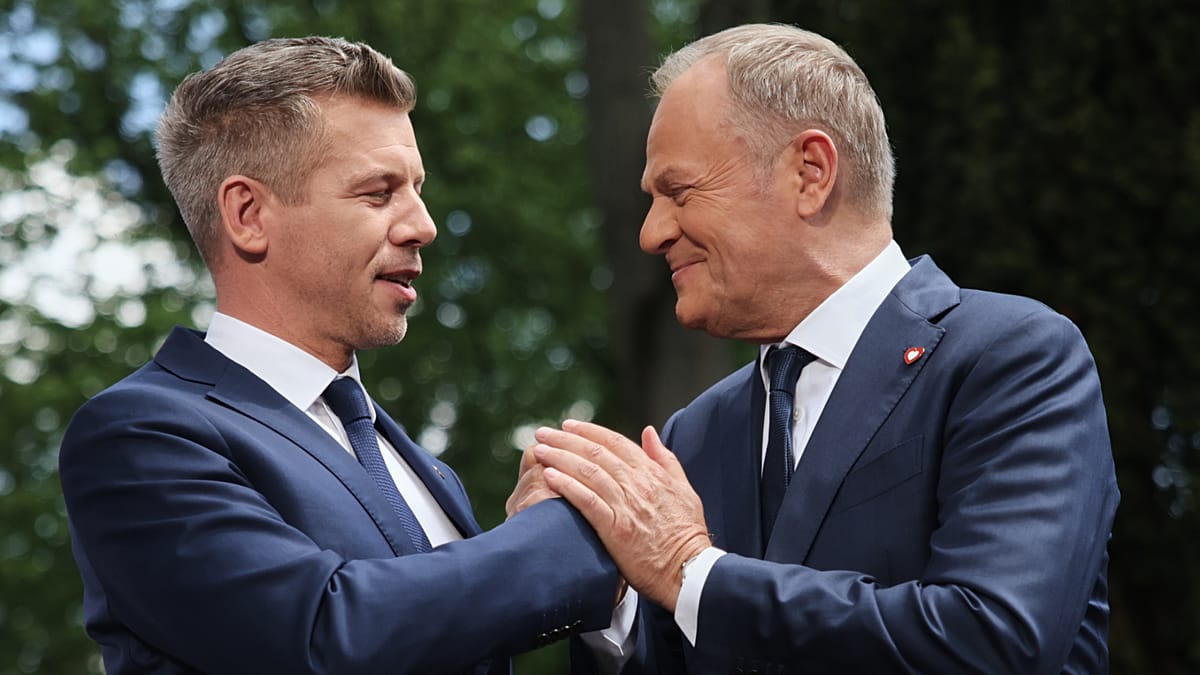
Magyar ended Orbán’s 16-year grip on power with a landslide victory last month. The new Hungarian leader wasted little time: he chose Poland as the destination for his first state visit abroad, framing it as both a diplomatic and symbolic reset, citing centuries of friendship between the two nations.
He also framed his visit as a starting point for a broader effort to revitalise the Visegrád Group.
“We’re ready to revive Visegrád 4,” Magyar continued. “We’ll work on organising a V4 summit in Budapest at the end of June.”
The appetite for revival is not confined to Budapest, according to several diplomatic sources. Slovakia, which takes over the V4 chairmanship in July, is also keen to bring the grouping back to life.
“Three musketeers are waiting for the fourth and the revival of V4,” Slovak Prime Minister Robert Fico posted on X alongside a photograph with Tusk and Czech Prime Minister Andrej Babiš two weeks ago.
What a revived V4 would actually mean in practice — and whether it can reclaim real influence in EU power dynamics, which many in Central and Eastern Europe view as too dominated by Western member states — remains to be seen.
Advocates of the group note that the four countries together represent a population and an economy comparable in scale to Italy, giving them a collective voice that Brussels can hardly ignore.
The agenda is also an open question. Many of the causes the V4 once championed — tougher migration controls, a pro-business agenda — have since become mainstream across much of the EU. The group will need to find fresh terrain.
Still, geographical proximity is not the only bond. The four countries share broadly similar economic structures, which tend to bring their interests into alignment on specific issues, two diplomatic sources told Euronews.
Regional infrastructure — such as cross-border high-speed rail links and electricity grid interconnections — appears to be the natural starting point.
Alignment is also expected on nuclear energy, resistance to elements of the European green agenda such as the Emissions Trading System, and the coming negotiations over the EU’s long-term budget, particularly cohesion funding for the bloc’s less wealthy regions.
The format is also expected to remain deliberately flexible, expanding on an issue-by-issue basis. Austria is seen as the obvious candidate for a V4+ arrangement, given that Vienna already runs its own cooperation format with Czechia and Slovakia through the Austerlitz group.
“I consider it important to expand the cooperation of the Visegrád Four, whether with our Scandinavian friends, or with Austria, Croatia, Slovenia, Romania or the Western Balkan countries that have not yet joined the EU,” Magyar said in Warsaw.
France, Germany and Italy are also mentioned as potential ad hoc partners depending on the subject.
Fault lines remain, however. Differences over Russia and Ukraine will not dissolve quickly, and will not always be easy to manage. Hungary’s new government has signalled some continuity on Russian gas imports, while pledging to phase them out by 2035.
Hungarian-Slovak relations remain periodically strained by a long-running dispute over the post-World War II Beneš decrees, a grievance that tends to resurface around election time — and Slovakia heads to the polls next year.
Babiš, meanwhile, was a close Orbán ally and sits in the same European Parliament group. Whether that history will sour his relations with Magyar’s government is not yet clear.
“The focus has always been on the subject of common interests. More controversial issues won’t be put on the table,” one diplomatic source told Euronews.
After several years of estrangement, the four Visegrád countries appear to have more in common than divides them. In an era of heightened geopolitical uncertainty, the V4 may once again choose to speak with a single, louder voice.
“The heart of Europe beats in Central Europe today,” Magyar said.