
Published on
A team of British scientists has achieved what they say is the first-ever plasma ignition inside a nuclear fusion rocket engine – a huge step that could one day make trips across the solar system, and to Mars, much faster.
Pulsar Fusion revealed the milestone during a live stream at Amazon’s MARS Conference, hosted by Jeff Bezos in California this week, with CEO Richard Dinan calling it an “exceptional moment” for the company.
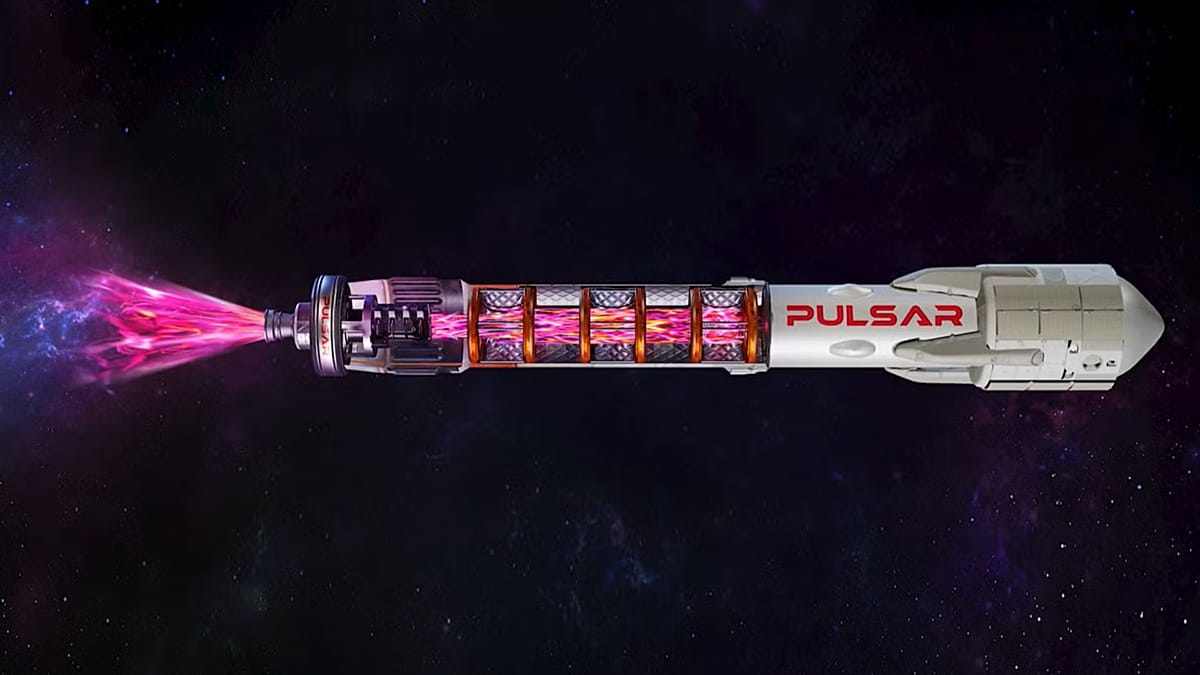
The team successfully created plasma – an intensely hot, electrically charged state of matter, often described as the fourth state of matter – using electric and magnetic fields inside its experimental and early prototype “Sunbird fusion exhaust system”.
The test, which took place at the company’s headquarters in Bletchley, UK, was streamed to California and is an early demonstration of how a future fusion-powered spacecraft engine might work.
What is nuclear fusion – and why does it matter?
According to the International Atomic Energy Agency, nuclear fusion is “the process by which two light atomic nuclei combine to form a single heavier one while releasing massive amounts of energy.”
Essentially, it works similarly to the process which powers the Sun, along with all other stars, fusing atoms together to release huge amounts of energy.
Although the idea of nuclear fusion was initially proposed in the 1920s, creating and managing fusion reactions on Earth has proven to be very challenging so far. At extremely high temperatures, plasma needs to be kept steady. But because space provides extremely cold temperatures and an almost perfect vacuum, engineers think it could be the perfect environment for it to thrive.
If fusion propulsion becomes possible, it has the potential to be far more powerful than today’s rocket engines – potentially delivering up to 1,000 times more thrust than conventional systems used in orbit and allowing spacecraft to reach speeds of roughly 800,000 kilometres per hour (500,000 mph).
Faster journeys to Mars
At those speeds, missions to Mars could shrink from months-long journeys to just a few weeks.
Shorter trips would not only make missions cheaper and more practical but could also reduce major health risks astronauts face in space, including radiation exposure and long periods spent in microgravity.
“With the space economy projected to exceed $1.8 trillion by 2035, faster in-space transport isn’t just a scientific goal; it’s an economic one,” Pulsar Fusion said after the test.
The company now plans further testing of its Sunbird system to improve performance. Upcoming upgrades include more powerful superconducting magnets designed to better contain and control plasma.