
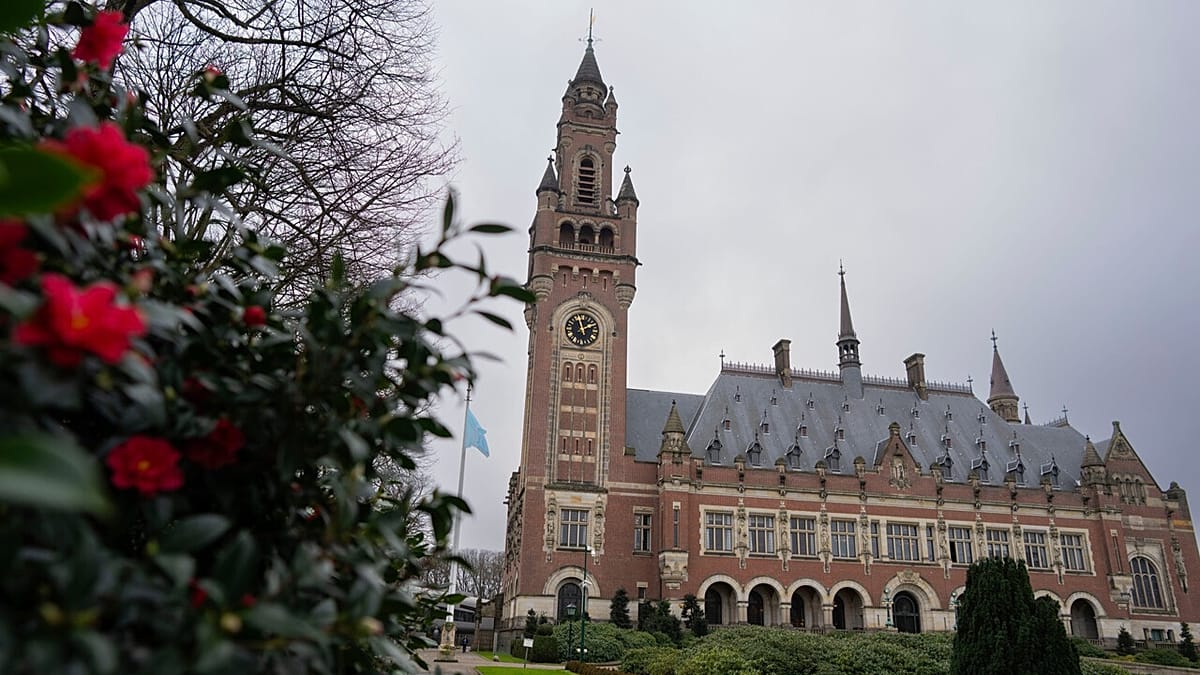
The Slovenian government has decided against joining South Africa’s genocide case against Israel at the International Court of Justice, despite having previously expressed desire to participate in the proceedings.
Several countries, including the Netherlands, Iceland, Hungary, the US, Fiji and Namibia, have filed interventions in recent days to submit their observations on the interpretation of the treaty.
Slovenia decided against participating due to “security risks”. While Prime Minister Robert Golob had initially been inclined to give the proposal the green light, he was ultimately swayed against doing so by national security officials, local media reported.
They reportedly cautioned that joining the lawsuit could jeopardise Slovenia’s national security, noting that many of the country’s cyber defence systems are of Israeli origin.
It was reportedly also highlighted that Israeli authorities play a crucial role in facilitating Slovenian humanitarian operations in Gaza, as well as in the evacuation of Slovenian nationals from the Middle East.
Foreign Minister Tanja Fajon expressed regret over the decision, adding that the debate was “quite emotional and exhausting”. She did not say which ministers voted for or against the proposal.
Fajon stressed that Slovenia will continue to hold its stance in respect of international and humanitarian law, and continues to respect the work of international courts.
“The Slovenian government, through its principled policy, has regularly warned against and opposed the policies of Israeli Prime Minister Benjamin Netanyahu against the Palestinian population. Slovenia will continue to do so,” the foreign ministry said.
Asked whether the decision was influenced by external pressures, she said “it is clear that these pressures exist, we are all subjected to them by superpowers, and ultimately this must be taken into account when deciding. But again, one thing is principled stances, another might be questions of national security.”
Election campaign overshadowed by scandal
The move came on the backdrop of a tense ongoing election campaign overshadowed by scandals and allegations of election interference.
On Thursday Prime Minister Golob asked the EU to probe alleged election interference after secretly recorded videos were aired ahead of this weekend’s parliamentary polls.
Golob’s liberals are in a tight race against the conservatives of nationalist former premier Janez Jansa, whom Golob unseated four years ago.
In the weeks leading up to the election on 22 March, a series of secretly recorded conversations were published, featuring a Slovenian lobbyist, a lawyer, a former minister and a manager.
The videos allegedly show the officials suggesting ways to influence decision makers in Golob’s centre-left coalition government in order to speed up procedures or win contracts.
A Slovenian rights group, together with an investigative journalist and two researchers, on Monday claimed that an Israeli intelligence firm, Black Cube, was behind the videos and that the firm was linked to Jansa’s Slovenian Democratic Party (SDS).
SDS has rejected the charges, saying in a statement it had never heard about Black Cube.
SDS called for independent investigations, criticising Golob’s administration for alleged misuse of public resources and media manipulation, and accusing the government of attempting to distract from its own wrongdoings.
Earlier this week, Slovenia’s Foreign Minister Tanja Fajon slammed the videos as “a direct attack against our sovereignty”.
French President Emmanuel Macron said Golob “was the victim of clear-cut interference” by “third countries” and misinformation.
“Today, in every election in Europe, there is interference that disrupts electoral processes,” Macron said, calling on the EU executive to come up with guidelines on how to fight the interference.
Additional sources • AFP