
During the US-Israeli military buildup preceding the war that erupted one week ago, Iran continuously warned the world that it would fight back if attacked to bring havoc to the region and beyond.
One week after the war engulfed the region, Iran’s waves of attacks triggered significant turmoil in the global energy markets.
Ever since the Iran war broke out last Saturday, Tehran has kept expanding its aerial barrage across the Gulf, and then on Thursday, it attacked Azerbaijan as well.
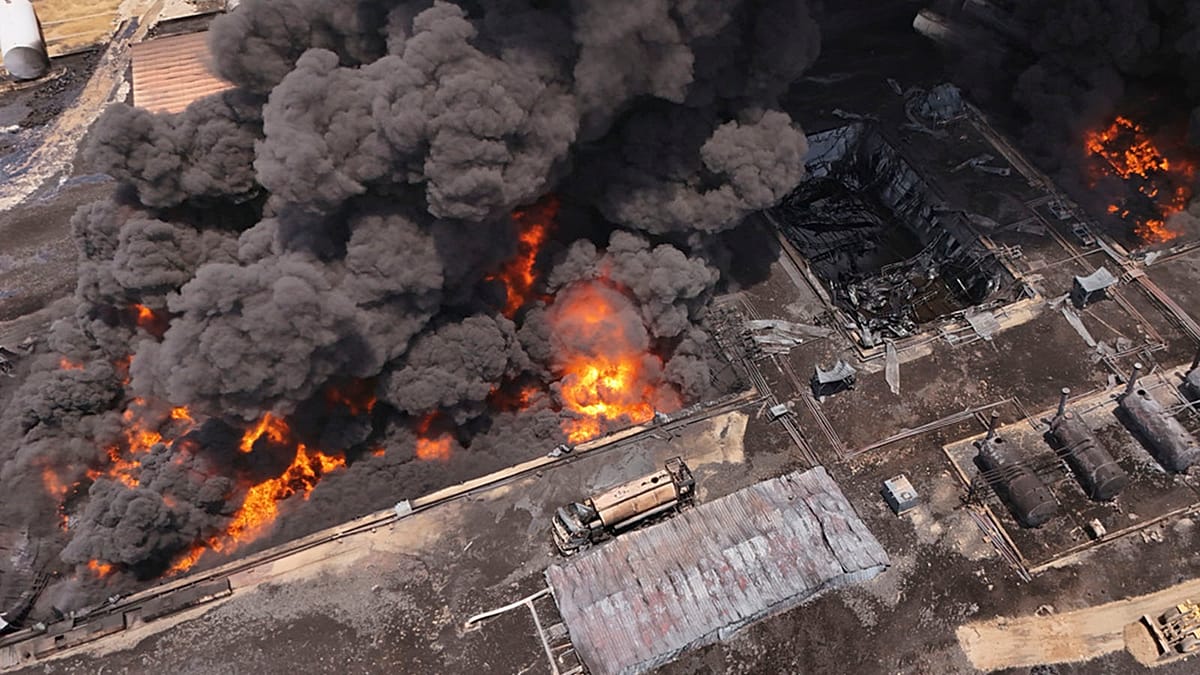
Tehran has been claiming that it is only targeting US and Israeli interests, but the reality on the ground showed that its missiles and drones were also directed at the Gulf’s sprawling energy infrastructures that fuel the world’s largest economies and its global energy balances.
In addition, Iran cracked down on the Strait of Hormuz shipping lanes — where 20% of global oil passes through — stranding more than 200 ships, as reported by trade and logistics service Lloyd’s List.
Qatar halted its liquified natural gas production at the world’s top LNG plant after Iranian drones targeted its operational complexes in Mesaieed and Ras Laffan Industrial City, sending shockwaves around global energy trade and triggering soaring prices.
Qatar’s LNG production accounts for about 20% of global supply and plays a key role in balancing demand in Asian and European markets.
Then another wave of Iranian strikes forced the world’s largest oil refinery in Saudi Arabia to shut down as well, while Iraqi oil production and Israeli gas fields were impacted too. Dubai’s ports, some of the world’s largest, are reportedly impacted as well.
In an assessment on Friday, the UK Foreign Office said that while Iranian missile and drone attacks are coming at a lower tempo than in the first days of the war, the range of targets is diversifying, with an increasing focus on economic and energy-industry targets.
In an interview published by the Financial Times on Friday, Qatar’s Energy Minister Saad al-Kaabi warned that the war “could bring down the economies of the world.”
“If this war continues for a few weeks, GDP growth around the world will be impacted. Everybody’s energy price is going to go higher. There will be shortages of some products and there will be a chain reaction of factories that cannot supply,” he said.
Iran’s Hormuz bottleneck
Dr Yousef Alshammari, president of the London College of Energy Economics, told Euronews on Thursday that only a blockade of the Strait of Hormuz itself could trigger a global recession if it continues.
“As we continue to go towards the summer, I believe the risks of global recession can be amplified,” Alshammari said.
“And then I think we can have a political pressure coming particularly from China which is the major consumer of Iranian oil,” he explained.
“I don’t think China will stay silent here, and certainly the best-case scenario is that we have the Strait of Hormuz coming back on.”
According to Alshammari, a gas price hike of more than 50% is already evident, particularly in Europe. Yet, the oil price increase is lower than what most markets and analysts expected.
“And that is due mainly to the fact that we are in a period of low demand, and secondly, due to the fact that the global oil markets continue to be well supplied,” he said.
No plan, no sense
Former US ambassador to Azerbaijan Matthew Bryza told Euronews the attacks on Azerbaijan and recent strikes on Turkey and Cyprus “don’t make much sense in terms of a coherent, rational military plan”.
“It is difficult to understand why Iran would have launched drone attacks against Azerbaijan’s region of Nakhchivan since Iran obviously does not want to see Azerbaijan brought into the military conflict,” Bryza said.
According to Bryza, Iran’s attack on Azerbaijan made even less sense since Azerbaijan’s President Ilham Aliyev “is the only head of state anywhere in the world to visit an Iranian embassy to offer condolences after the start of the war when attacks killed Iran’s supreme leader and other senior Iranian officials.”
“And even as Azerbaijan’s president said, there was a call from Iran seeking Azerbaijan’s help to evacuate Iranians from Beirut,” Bryza said.
“President Aliyev sent a plane and said, no, we’re not going to take any money for it. And then hours later, Iran attacked Azerbaijan. So, it makes no sense.”
Bryza suggested Tehran may be attempting to disrupt societies and economies to pressure US President Donald Trump, as continued supply chain disruptions and rising oil prices could hurt Republicans in November’s midterm elections and persuade Trump to ease pressure on Iran.
However, Bryza said the most likely explanation is that lower-level commanders are making individual decisions following Khamenei’s directive several weeks ago to delegate military command if senior officials were killed.
“For whatever reason, they think (their decisions) makes sense, even if they don’t make sense in the grander scheme of things,” the former diplomat concluded.